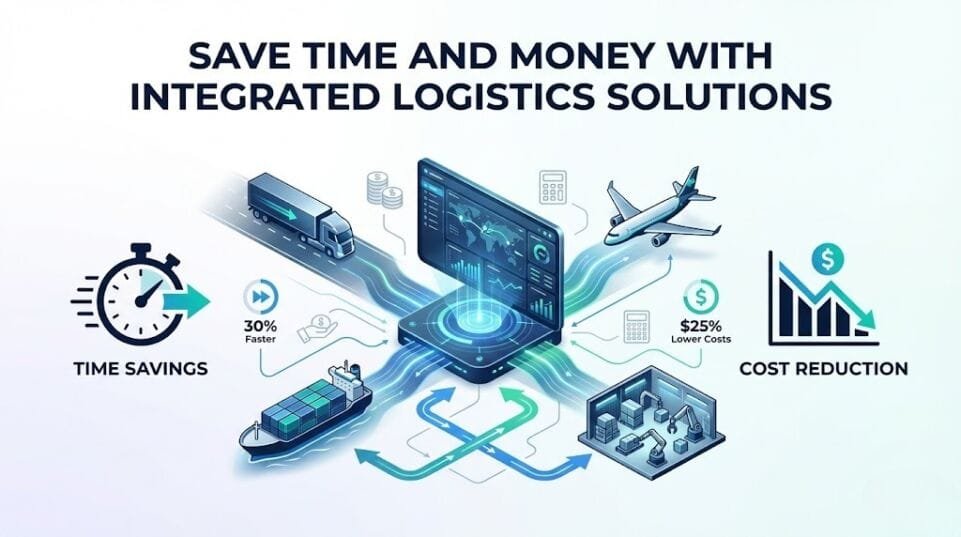
Every day, businesses lose time and money due to fragmented logistics disconnected transportation, inefficient warehousing, rising shipping costs, and delayed deliveries. These challenges are especially evident in global trade operations such as shipping from china to us , where poor coordination across transportation, warehousing, and customs can quickly increase costs and cause delays. Inefficient planning of Shipping Routes further limits flexibility, slows delivery times, and reduces overall competitiveness.
Integrated Logistics offers a smarter way forward. By connecting supply chain management, freight forwarding, inventory, and order fulfillment into one unified system, companies gain end-to-end visibility and control over critical processes, including shipping from china to us and the optimization of Shipping Routes. This integrated approach improves decision-making, reduces risks, and ensures faster, more reliable deliveries.
With the right technology and data integration, logistics stops being a cost center and becomes a strategic advantage. If saving time, reducing costs, and building a more resilient supply chain matter to your business, the insights in this article will show you exactly how integrated logistics makes it possible.
The Hidden Cost of Disconnected Logistics
Businesses often underestimate the true cost of fragmented logistics operations. When transportation, warehousing, and order fulfillment operate in isolation, inefficiencies multiply, directly impacting shipping costs, delivery time, and overall supply chain performance. These hidden costs are not always visible in accounting reports but manifest as delays, stockouts, and wasted labor ultimately affecting customer satisfaction and profitability.
Why Traditional Logistics Models Create Inefficiencies?
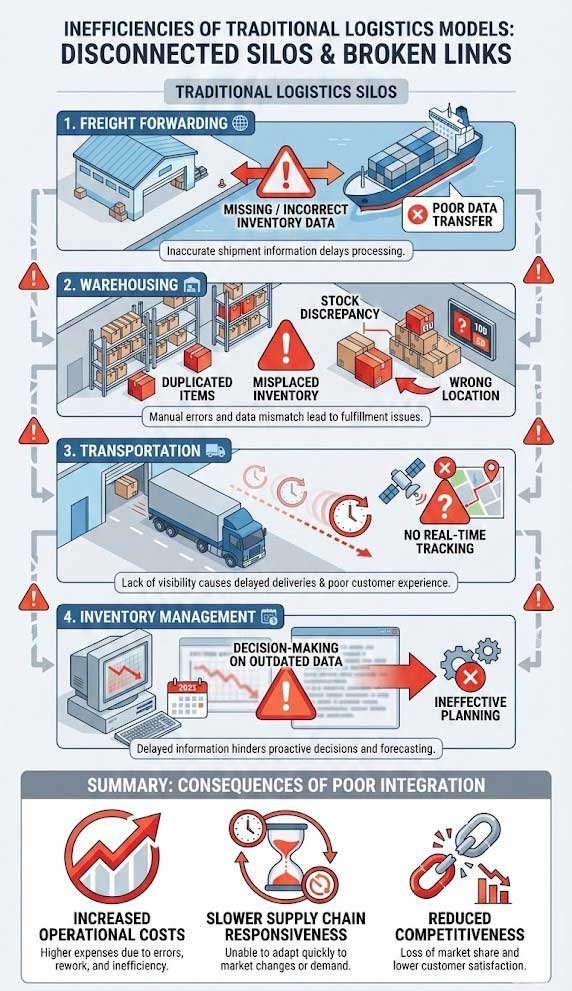
Traditional logistics approaches treat each functionfreight forwarding, warehousing, transportation, and inventory management as separate silos. This separation prevents smooth communication, causing redundant processes and reactive problem-solving. For example:
- Freight may arrive at a warehouse without proper inventory updates, leading to misallocation.
- Order fulfillment teams may dispatch items without real time tracking data, causing delivery delays.
- Decisions are often based on outdated or partial information, increasing operational risk.
The cumulative effect is higher operational costs and slower responsiveness across the supply chain, which directly affects competitiveness.
Operational Silos and Lack of End-to-End Visibility
One of the biggest challenges of disconnected logistics is the lack of end-to-end visibility. Without a unified system, businesses cannot monitor shipments, inventory levels, or order status in real time. This fragmentation creates bottlenecks:
- Warehouses hold excess stock because inventory data is delayed.
- Transportation routes are under-optimized due to incomplete shipment information.
- Customs clearance or regulatory processes are delayed because documentation isn’t coordinated across teams.
What Integrated Logistics Really Means
Integrated logistics is more than just a buzzword—it represents a strategic shift in how businesses manage their supply chains. Instead of operating as fragmented departments, all logistics functions—transportation management, warehousing, freight forwarding, inventory management, and order fulfillment—are connected through shared data, processes, and technology. The goal is clear: reduce inefficiencies, improve visibility, and enable faster, smarter decisions across the entire supply chain.
Integrated Logistics as a Unified Operating Model
In a unified operating model, each logistics component communicates seamlessly with the others. For example:
- Freight forwarders share real-time shipment updates with warehouses.
- Inventory levels trigger automatic replenishment orders in ERP systems.
- Transportation routes are dynamically optimized based on demand, delivery schedules, and customs requirements.
This coordination transforms logistics from a reactive, cost-driven function into a proactive, strategic asset. Businesses gain real-time tracking, streamlined customs clearance, and more predictable delivery times, which ultimately reduces overall shipping costs and operational waste.
Core Components of an Integrated Logistics System
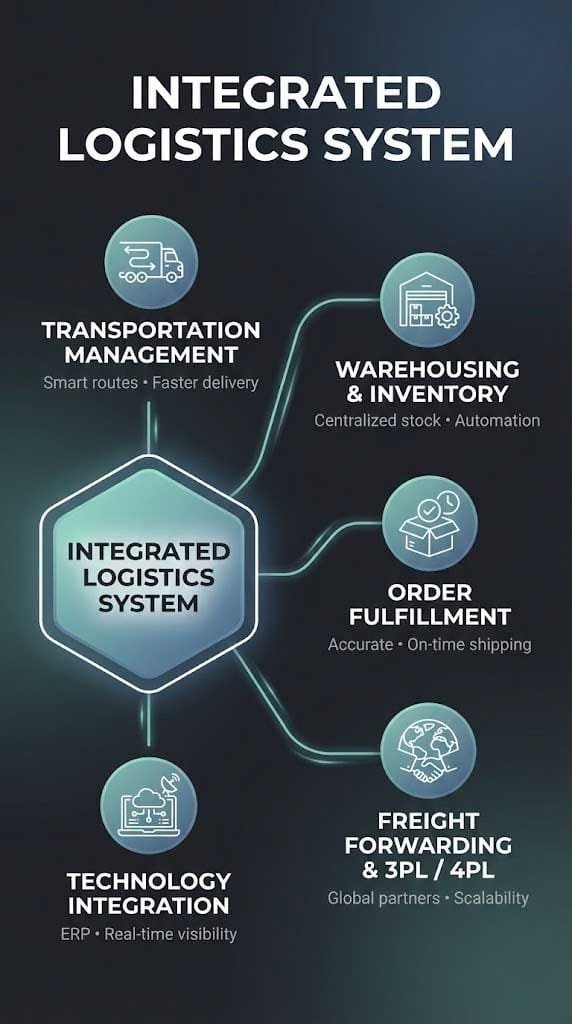
An effective integrated logistics system typically includes:
- Transportation Management : Planning and optimizing routes, carriers, and modes to balance cost and speed.
- Warehousing and Inventory Management : Centralized visibility of stock levels, automated replenishment, and optimized storage.
- Order Fulfillment : Coordinated picking, packing, and shipping processes for faster, accurate deliveries.
- Freight Forwarding and 3PL/4PL Partnerships : Leveraging expert partners for specialized services and broader reach.
- Technology Integration : ERP systems, logistics software, and real-time tracking to ensure end-to-end visibility and data-driven decisions.
By combining these components, businesses can achieve seamless supply chain operations, minimize bottlenecks, and turn logistics into a measurable competitive advantage.
How Integrated Logistics Saves Time
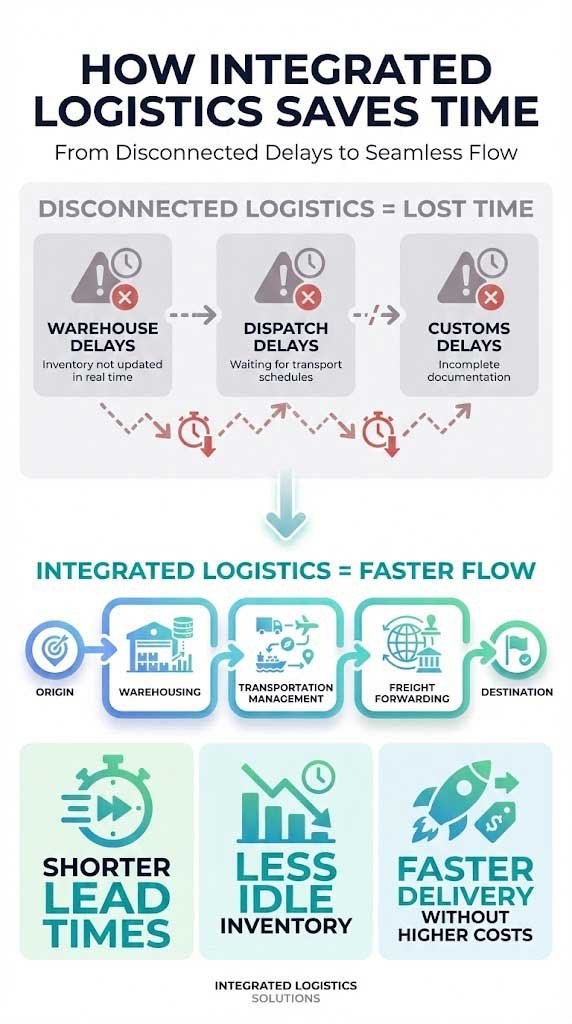
Time is one of the most valuable resources in any supply chain. Disconnected logistics processes create delays at every step waiting for inventory updates, misaligned shipments, and reactive problem-solving. Integrated Logistics eliminates these delays by connecting all functions, enabling faster operations, and reducing wasted time across the entire supply chain.
- Eliminating Delays Between Logistics Processes
- Traditional supply chains often suffer from handoff delays. For example:
- Freight arrives at a warehouse, but inventory systems are not updated in real-time, causing picking errors.
- Order fulfillment waits for transportation schedules, slowing down dispatch.
- Customs clearance processes stall due to incomplete or uncoordinated documentation.
With Integrated Logistics, these processes are synchronized. Warehousing, transportation management, and freight forwarding communicate continuously, ensuring that goods move seamlessly from origin to destination. Businesses can cut lead times, reduce idle inventory, and accelerate delivery without increasing costs.
Faster Decision-Making Through Centralized Data
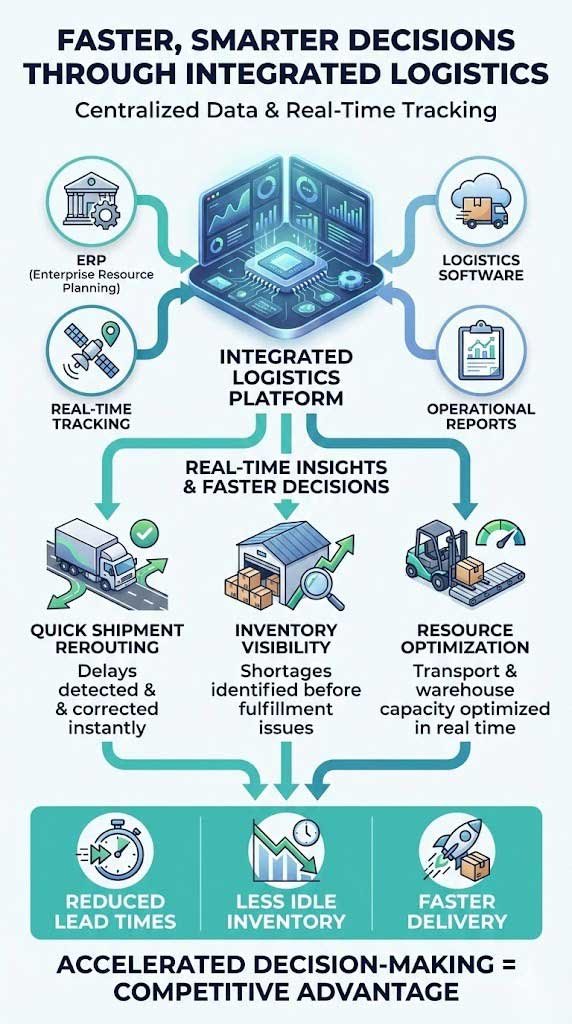
Integrated logistics leverages centralized data and real-time tracking to empower decision-makers. By consolidating information from ERP systems, logistics software, and operational reports:
- Managers can quickly reroute shipments if delays occur.
- Inventory shortages are detected before they affect order fulfillment.
- Transportation and warehousing resources are optimized in real time.
This data-driven approach not only speeds up day-to-day operations but also allows businesses to proactively prevent disruptions, ensuring that time savings are consistent and measurable across the entire supply chain.
With Integrated Logistics, these processes are synchronized. Warehousing, transportation management, and freight forwarding communicate continuously, ensuring that goods move seamlessly from origin to destination. Businesses can cut lead times, reduce idle inventory, and accelerate delivery without increasing costs.
How Integrated Logistics Reduces Costs
Reducing costs is a central goal for any supply chain, yet traditional logistics models often obscure the real sources of inefficiency. Fragmented operations lead to unnecessary expenses in transportation, inventory, and administrative processes. Integrated Logistics tackles these challenges by streamlining operations, improving visibility, and leveraging data to make smarter financial decisions across the entire supply chain.
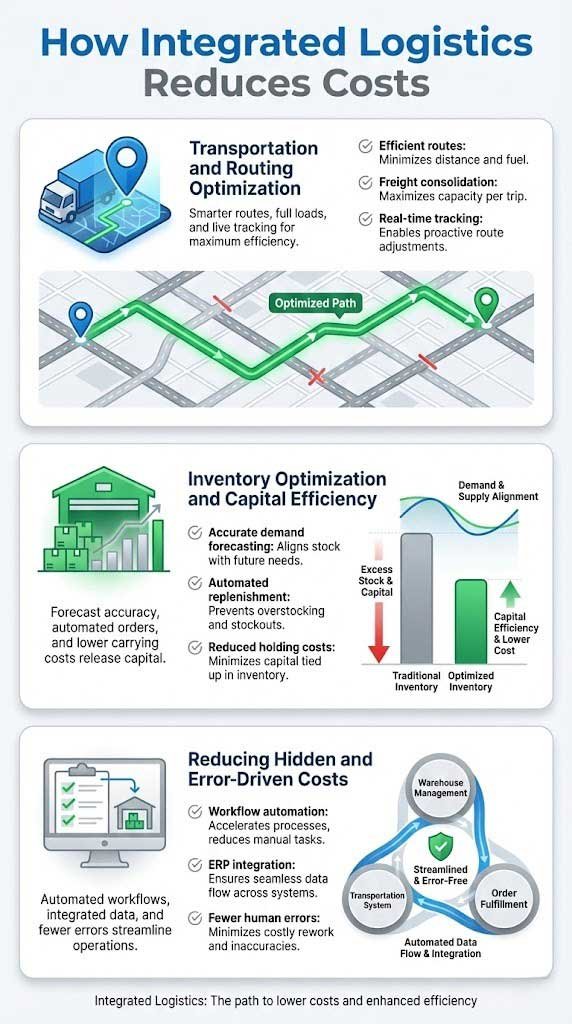
Transportation and Routing Optimization
Transportation is often one of the largest cost centers in logistics. In disconnected systems, suboptimal routes, uncoordinated carriers, and underutilized vehicles drive expenses up. With an integrated logistics approach:
- Transportation management systems (TMS) analyze shipment patterns to identify the most efficient routes.
- Freight consolidation reduces per-unit shipping costs while minimizing empty miles.
- Real-time tracking and communication with freight forwarders allow proactive adjustments to delays, avoiding costly expedited shipments.
By optimizing transportation, companies achieve both lower shipping costs and faster delivery times, creating a direct financial benefit.
Inventory Optimization and Capital Efficiency
Excess inventory ties up capital, while stockouts result in lost sales and emergency replenishment costs. Integrated Logistics provides end-to-end visibility into inventory management, enabling:
- Accurate demand forecasting based on real-time data.
- Automated replenishment to maintain optimal stock levels.
- Reduced holding costs through efficient warehousing and cross-docking strategies.
This ensures that capital is deployed effectively and storage costs are minimized without compromising service levels.
Reducing Hidden and Error-Driven Costs
Disconnected logistics often generates hidden costs manual errors, duplicate handling, misrouted shipments, and delayed customs clearance. Integrated systems address these issues by:
- Automating workflows and data sharing between warehousing, transportation, and order fulfillment.
- Implementing ERP systems and logistics software for consistent, accurate information.
- Reducing administrative overhead and human errors through real-time tracking and alerts.
These improvements not only save money directly but also prevent costly disruptions, ensuring that the supply chain operates smoothly and predictably.
Integrated Logistics vs Traditional Logistics
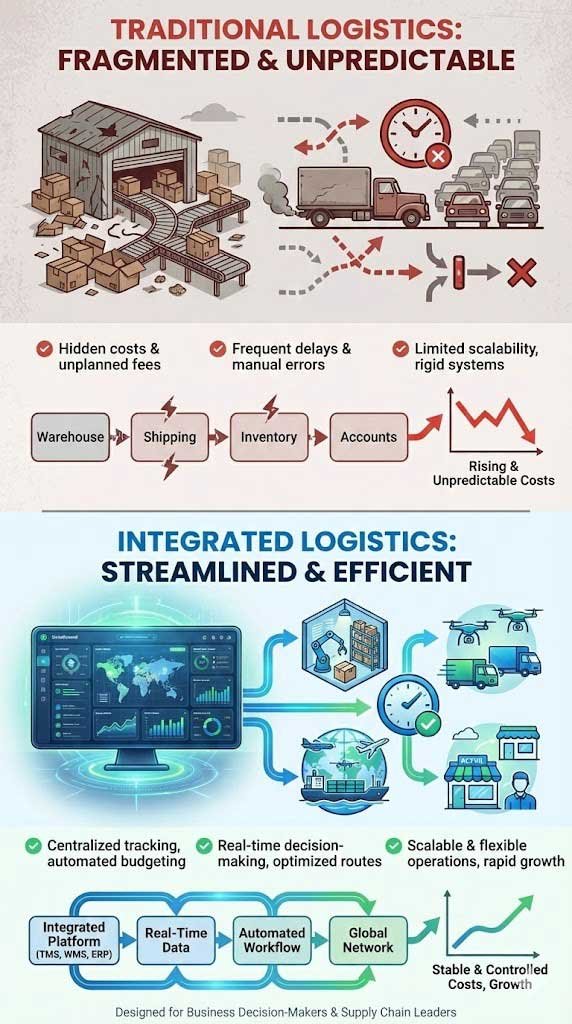
As businesses scale, the limitations of traditional logistics become increasingly clear. Fragmented systems may appear manageable at a small scale, but they often lead to unpredictable costs, delays, and operational bottlenecks. Integrated Logistics, by contrast, offers a coordinated, data-driven approach that enhances visibility, control, and efficiency across the entire supply chain.
Cost Predictability and Financial Control
Traditional logistics models struggle with hidden expenses, such as unplanned shipping fees, inventory mismanagement, or expedited delivery costs due to misalignment between warehousing and freight forwarding. In contrast, Integrated Logistics:
- Provides centralized tracking of shipments and inventory, enabling more accurate forecasting of shipping costs and operational expenditures.
- Uses data from ERP systems and logistics software to automate budgeting and identify inefficiencies in real time.
- Reduces financial risk by minimizing delays, errors, and emergency interventions across transportation management and order fulfillment.
- The result is greater cost predictability and tighter financial control, helping businesses plan and invest with confidence.
Speed, Scalability, and Operational Flexibility
Traditional logistics is often rigid: adding new products, handling higher volumes, or expanding to new regions can cause delays and strain existing operations. Integrated Logistics, however, enables:
- Faster decision-making using real-time data integration across supply chain management functions.
- Seamless scalability, allowing companies to increase throughput without proportional increases in labor or infrastructure.
- Greater operational flexibility, adapting routes, inventory allocation, and fulfillment strategies dynamically in response to market demands.
By removing silos and connecting all logistics functions, integrated systems empower businesses to respond quickly to changes, scale efficiently, and maintain high levels of customer satisfaction.
Real-World Applications of Integrated Logistics
Integrated logistics isn’t just a theoretical concept—it delivers measurable benefits across diverse industries. By unifying supply chain management, transportation, warehousing, and order fulfillment, businesses can respond faster, reduce costs, and enhance customer satisfaction. The following examples illustrate how integrated logistics works in practice.
eCommerce and Omnichannel Businesses
For eCommerce companies, speed and accuracy are critical. Fragmented logistics can lead to delayed deliveries, inventory errors, and dissatisfied customers. Integrated logistics enables:
- Real-time inventory visibility across multiple sales channels.
- Coordination between warehouses, transportation management, and freight forwarders for optimized shipping.
- Faster order fulfillment and improved tracking, enhancing customer experience.
Brands like Amazon and Shopify-powered retailers use integrated systems to synchronize warehouses, delivery partners, and order management, cutting delivery times and operational costs significantly.
Import and Export Operations
Global trade involves complex supply chains with multiple stakeholders, customs regulations, and shipping modes. Traditional logistics often causes delays and unexpected costs. Integrated logistics allows:
- Streamlined customs clearance processes with accurate, timely documentation.
- Coordination between 3PL/4PL providers, shipping agents, and internal operations for optimized routes.
- Real-time tracking of shipments from port to warehouse, minimizing lead times and reducing shipping costs.
Companies engaged in international trade, such as electronics importers or fashion retailers, rely on integration to avoid bottlenecks and maintain predictable delivery schedules.
Manufacturing and Production-Driven Companies
Manufacturers face challenges in synchronizing production schedules with inbound materials and outbound distribution. Disconnected logistics can result in stockouts, overstocking, and production delays. Integrated logistics provides:
- Centralized inventory and order visibility to align production planning with supplier deliveries.
- Optimized transportation of raw materials and finished goods through coordinated freight forwarding and warehousing.
- Faster response to supply disruptions or demand fluctuations through real-time data integration.
Automotive, electronics, and consumer goods manufacturers benefit from integrated logistics by reducing idle inventory, lowering costs, and ensuring production lines run smoothly without interruption.
When Integrated Logistics Becomes a Strategic Advantage
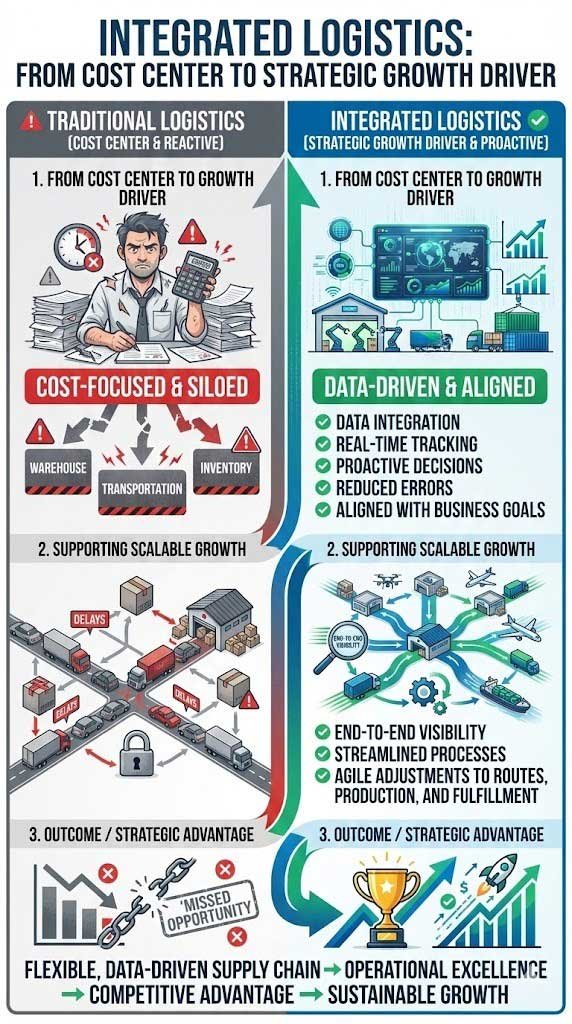
Beyond operational efficiency, integrated logistics can transform the role of logistics from a reactive, cost-focused function into a strategic driver of business growth. By unifying supply chain management, transportation, warehousing, and order fulfillment, businesses gain the agility and insight needed to scale without disruption.
Turning Logistics from a Cost Center into a Growth Driver
Traditional logistics is often seen purely as a cost center, focused on minimizing expenses. Integrated logistics changes that perspective by:
- Leveraging data integration and real-time tracking to identify efficiencies and unlock savings.
- Using insights from ERP systems and logistics software to make proactive decisions that accelerate delivery, improve inventory management, and reduce errors.
- Aligning freight forwarding and 3PL/4PL partnerships with business objectives, ensuring logistics actively contributes to revenue growth rather than just controlling costs.
This transformation allows companies to reallocate resources toward expansion initiatives, innovation, and market responsiveness.
Supporting Business Growth Without Operational Chaos
As businesses grow, complexity increases, and uncoordinated logistics can quickly become a bottleneck. Integrated logistics supports growth by:
- Providing end-to-end visibility, ensuring leaders can monitor every shipment, inventory level, and order status.
- Streamlining processes across all logistics functions to handle increased volumes efficiently.
- Enabling agile adjustments to transportation routes, production schedules, and fulfillment strategies in real time, preventing operational chaos.
In essence, integrated logistics equips companies with a scalable, flexible, and data-driven supply chain, turning operational excellence into a tangible competitive advantage and enabling sustainable growth.
Integrated Logistics Right for Your Business?
While Integrated Logistics offers significant benefits, it’s not a one-size-fits-all solution. Understanding whether your business is ready to adopt a unified supply chain model is crucial to ensure ROI and operational success.
Key Signs Your Business Needs Integrated Logistics
Businesses should consider integrated logistics if they face recurring challenges such as:
- Rising shipping costs due to fragmented transportation and freight management.
- Frequent delays in order fulfillment or delivery times, impacting customer satisfaction.
- Lack of visibility across warehousing, inventory, and transportation systems.
- Difficulty scaling operations without introducing errors or operational bottlenecks.
- Complexity in managing multiple 3PL/4PL providers, suppliers, or sales channels.
If these issues persist, integrating logistics functions through ERP systems, logistics software, and real-time tracking can streamline operations, reduce costs, and improve overall efficiency.
Situations Where Integrated Logistics May Not Be Necessary
Integrated logistics may be overkill for businesses that:
- Operate on a small scale with limited product lines or low shipment volumes.
- Have simple supply chains where inventory management, transportation, and warehousing are already coordinated efficiently.
- Do not rely heavily on external freight forwarding or third-party logistics providers.
In such cases, maintaining a simpler, modular approach may be more cost-effective until the business scales and operational complexity justifies full integration.
How to Choose the Right Integrated Logistics Partner
Selecting the right partner is critical to successfully implementing Integrated Logistics. A reliable logistics provider or 3PL/4PL partner ensures seamless coordination across transportation, warehousing, inventory management, and order fulfillment while leveraging technology and expertise to drive efficiency.
Technology, Transparency, and Data Visibility
A capable partner should provide:
- Real-time tracking of shipments and inventory across all locations.
- Integration with ERP systems and logistics software for centralized data access.
- Clear visibility into shipping costs, delivery timelines, and operational performance.
Technology and transparency enable businesses to make data-driven decisions, optimize routes, and prevent delays or unexpected expenses.
Experience, Industry Knowledge, and Scalability
Beyond technology, a partner’s experience and industry expertise are crucial:
- Familiarity with customs clearance, international freight forwarding, and regulatory compliance.
- Ability to handle complex supply chains across multiple industries, such as eCommerce, manufacturing, or import/export.
- Scalable solutions that grow with your business, adapting to increased shipment volumes or expanded distribution networks.
Choosing a partner who combines advanced technology, operational transparency, and proven industry expertise ensures your integrated logistics system delivers maximum efficiency, cost savings, and operational agility.
Final Thoughts: Why Integrated Logistics Is an Investment, Not an Expense
Integrated logistics is more than a cost-saving measure it’s a strategic investment that transforms the way a business operates. By unifying supply chain management, transportation, warehousing, and order fulfillment, companies gain real-time visibility, reduce errors, and streamline operations, turning logistics into a growth enabler rather than a reactive cost center.
Businesses that adopt integrated logistics benefit from:
- Time savings through faster decision-making and synchronized operations.
- Cost reductions via optimized transportation, inventory efficiency, and reduced error-driven expenses.
- Operational agility, allowing them to scale, respond to market changes, and maintain consistent service quality.
- Data-driven insights, empowering managers to make informed, proactive decisions across the supply chain.
In today’s competitive markets, fragmented logistics is no longer sustainable. Investing in integrated logistics is an investment in efficiency, reliability, and long-term growth. Companies that embrace this approach position themselves to maximize profitability, enhance customer satisfaction, and achieve sustainable operational excellence.