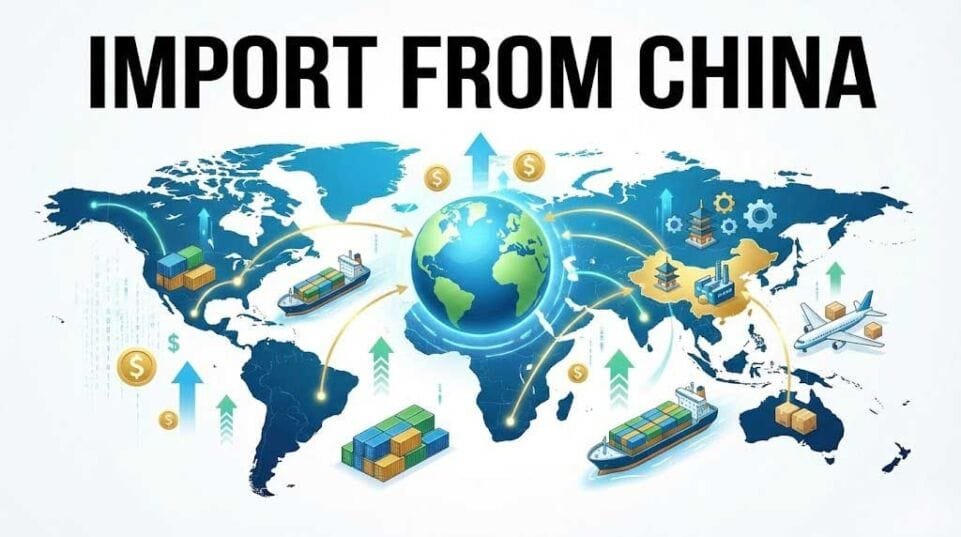
Profitable to Import from China is a strategy many businesses use to maximize earnings. By sourcing goods directly from Chinese manufacturers, companies benefit from low production costs, a wide variety of products, and efficient shipping options.
What Does Importing from China Mean?
Importing from China means purchasing goods from Chinese manufacturers or suppliers and shipping them to another country,
such as the United States, for resale or business use. This process includes sourcing products, negotiating prices, placing bulk orders, shipping from China to the US, and completing customs clearance.
Many businesses choose China due to low production costs, a wide variety of Made in China products, and strong manufacturing capabilities.
Popular platforms like Alibaba, Made in China, Global Sources, and 1688 help buyers connect with OEM and ODM suppliers.
Shipping from China to the US is usually done via established shipping routes, including sea freight from major Chinese ports (Shanghai, Ningbo, Shenzhen) to US ports (Los Angeles, Long Beach, New York), or air freight for faster delivery.
The main goal of importing from China is to reduce costs and increase profit margins, but businesses must also consider shipping fees, duties, taxes, and logistics risks before deciding if it is profitable.
Why China Is a Global Manufacturing Hub?
China is considered the world’s largest manufacturing hub due to its strong supply chain, skilled workforce, and massive industrial infrastructure. One of the main reasons businesses choose China is its ability to produce goods at scale while keeping costs low.
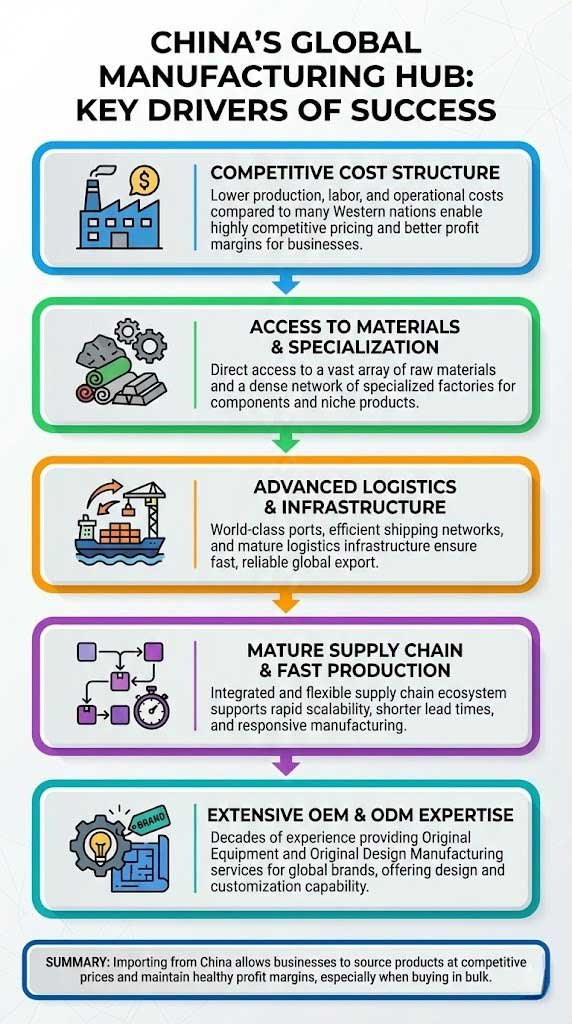
Key factors that make China a global manufacturing center include:
- Low-cost manufacturing compared to many Western countries
- Access to raw materials and specialized factories
- Advanced logistics and export infrastructure
- A mature China supply chain that supports fast production
- Experience in OEM and ODM manufacturing for global brands
Because of these advantages, importing from China allows businesses to source products at competitive prices, making it easier to maintain healthy profit margins especially when buying in bulk.
Common Products Imported from China
A wide variety of products are imported from China every day. Businesses across different industries rely on China export products due to their affordability and diversity.
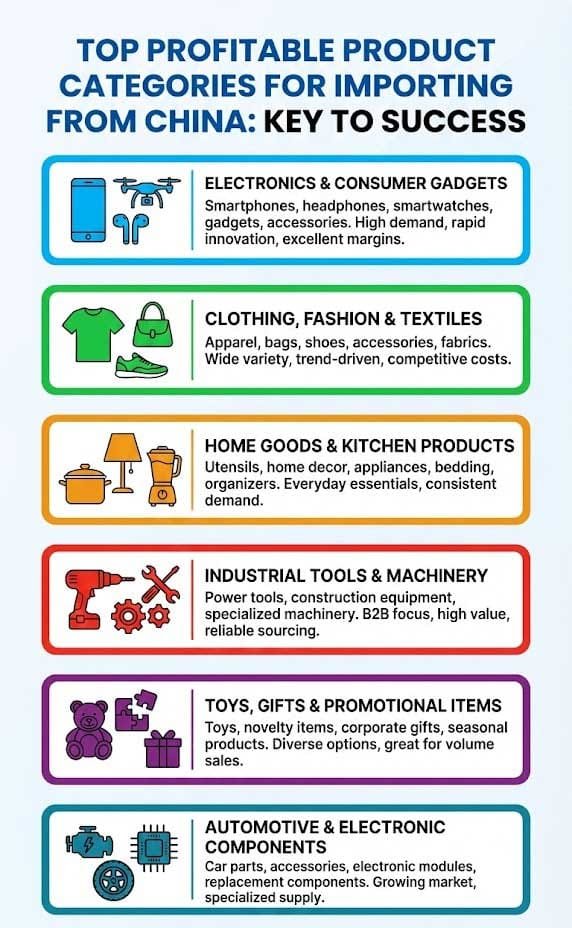
Some of the most common and profitable categories include:
- Electronics and consumer gadgets
- Clothing, fashion accessories, and textiles
- Home goods and kitchen products
- Industrial tools and machinery
- Toys, gifts, and promotional items
- Automotive and electronic components
These products are often sourced through China wholesale suppliers and shipped via sea freight from China or air freight, depending on cost and urgency. Choosing the right product category is a key step in determining how profitable importing from China can be.
Why Do Businesses Import from China?
Businesses import from China mainly to reduce costs, increase profit margins, and access a global-scale supply chain. For startups, eCommerce sellers, and established companies alike, importing from China offers a balance of affordability, variety, and scalability that few other countries can match.
Thanks to China’s advanced manufacturing ecosystem, companies can source products faster, customize them through OEM and ODM suppliers, and ship them worldwide using efficient logistics networks. These advantages make importing from China a popular strategy for businesses looking to stay competitive in global markets.
Low Manufacturing Costs in China
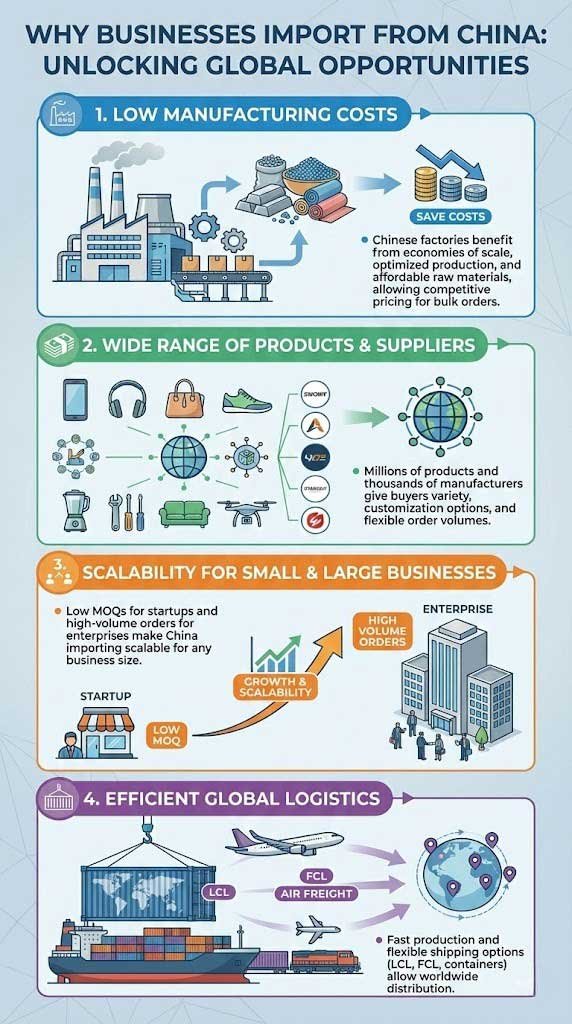
One of the biggest reasons businesses import from China is low manufacturing costs. Chinese factories benefit from economies of scale, optimized production processes, and access to affordable raw materials. This allows them to offer competitive pricing, especially for bulk buying from China.
Lower production costs mean businesses can achieve higher profit margins, even after considering shipping costs from China, import duties, and taxes. This cost advantage is a key factor when calculating China import business profitability, particularly for price-sensitive markets.
Wide Range of Products and Suppliers
China offers an unmatched range of products across almost every industry. From electronics and fashion to industrial equipment and home goods, businesses can find millions of Made in China products through platforms like Alibaba, Global Sources, Made-in-China, and 1688.
In addition to product variety, businesses gain access to thousands of Chinese manufacturers, China wholesale suppliers, and specialized factories. This makes supplier comparison easier and gives buyers more flexibility in terms of pricing, customization, and order volume.
Scalability for Small and Large Businesses
Importing from China is highly scalable, making it suitable for both small startups and large enterprises. Small businesses can start with low minimum order quantities (MOQs), while larger companies can place high-volume orders to further reduce unit costs.
As demand grows, businesses can easily scale production without changing suppliers or redesigning their supply chain. Combined with flexible shipping options such as LCL shipping, FCL shipping, and container shipping, this scalability makes importing from China a long-term and profitable business model..
Is It Really Profitable to Import from China?
Yes, importing from China can be very profitable, but only when costs, risks, and market demand are managed correctly. Many businesses build successful brands by sourcing products from China and selling them at significantly higher prices in their local markets.
The profitability of importing from China depends on understanding the total landed cost, choosing the right products, working with reliable suppliers, and optimizing shipping and customs processes. When these factors are aligned, importing from China is often more profitable than local sourcing.
Average Profit Margin When Importing from China
The average profit margin when importing from China typically ranges between 20% and 60%, depending on the product category, order volume, and target market.
For example:
- Private-label consumer products often achieve 40–60% profit margins
- Generic wholesale products usually fall in the 20–35% range
- High-volume imports with optimized logistics can generate consistent but lower margins
Businesses that calculate their importing from China profit margin correctly including manufacturing, shipping costs, import duties, VAT, and marketing are more likely to maintain sustainable profitability.
Factors That Affect Import Profitability
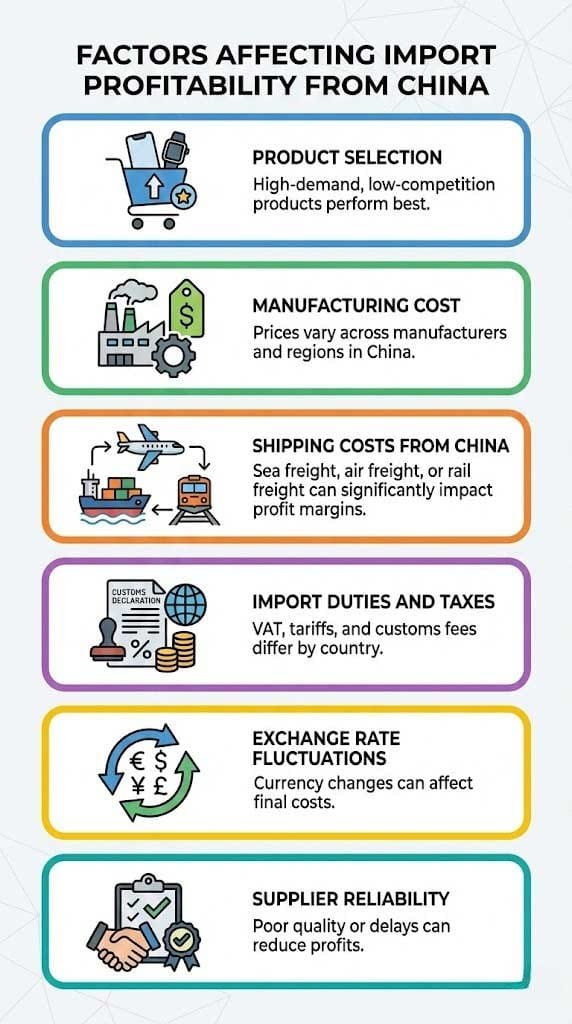
Several key factors determine whether importing from China is profitable or not:
- Product selection: High-demand, low-competition products perform best
- Manufacturing cost: Prices vary across Chinese manufacturers and regions
- Shipping costs from China: Sea freight, air freight, or rail freight significantly impact margins
- Import duties and taxes: VAT, tariffs, and customs fees differ by country
- Exchange rate fluctuations: Currency changes can affect final costs
- Supplier reliability: Poor quality or delays can reduce profits
Understanding these factors helps businesses avoid hidden costs and accurately calculate China import business profitability.
Small Business vs Large-Scale Import Profit
Profitability differs significantly between small-scale and large-scale importers.
Small businesses usually:
- Start with smaller order quantities
- Pay higher unit costs
- Use LCL shipping or air freight
- Focus on higher-margin niche products
- Large-scale importers benefit from:
- Lower manufacturing costs per unit
- FCL shipping and container shipping discounts
- Strong relationships with freight forwarders
- More predictable and stable profit margins
While large businesses often earn more in total profit, small businesses can still achieve high percentage margins by choosing the right products and managing costs efficiently.
Cost Breakdown of Importing from China
To understand whether importing from China is profitable, you must clearly break down all costs involved. Many beginners only focus on product price, but real profitability depends on the total landed cost, including shipping, taxes, and hidden expenses.
A proper cost breakdown helps businesses avoid surprises and accurately calculate importing from China profit margins.
Product Cost and Supplier Pricing
The first and most visible cost is the product price quoted by Chinese manufacturers or wholesale suppliers. Prices vary based on:
- Product type and complexity
- Order quantity (MOQ)
- Material quality and customization
- OEM or ODM requirements
Suppliers on platforms like Alibaba, 1688, and Global Sources often offer lower prices for bulk orders. However, cheaper pricing does not always mean better profitability. Quality, reliability, and production timelines must also be considered when comparing China supplier pricing.
Shipping Costs from China (Sea, Air, Rail)
Shipping costs from China are a major factor in overall import expenses and can significantly impact profit margins.
- Sea freight from China: The most cost-effective option for large shipments, especially using FCL shipping or container shipping
- LCL shipping: Suitable for smaller volumes but often more expensive per unit
- Air freight: Fast but costly, usually used for high-value or urgent goods
- Rail freight: A middle option for Europe, balancing cost and transit time
Choosing the right shipping method depends on product size, weight, urgency, and target market.
Customs Duties, Taxes, and VAT
Every imported shipment must go through customs clearance, which involves several mandatory costs:
- Import duties based on product HS codes
- VAT or sales tax, depending on the destination country
- Possible tariffs or trade-related taxes
These costs vary by country and product category. Many businesses underestimate these charges, which directly affects China import business profitability. Working with a professional freight forwarder or shipping agent helps ensure accurate tax calculations and compliance with China import regulations.
Hidden Costs You Should Know About
Hidden costs are one of the main reasons some businesses believe importing from China is not profitable.
Common hidden expenses include:
- Quality inspections and product testing
- Packaging, labeling, and compliance requirements
- Storage and warehousing fees
- Demurrage and port delays
- Currency exchange rate losses
- Payment fees (TT, LC, bank charges)
Ignoring these costs can quickly reduce profit margins. A full understanding of hidden costs is essential when calculating the real cost of importing goods from China.
How to Calculate Profit When Importing from China
To know if importing from China is profitable, you must calculate profit correctly before placing any order. Many importers fail not because the business model is bad, but because they underestimate costs and overestimate margins.
The key to accurate profit calculation is understanding your landed cost and comparing it with your final selling price.
Landed Cost Explained
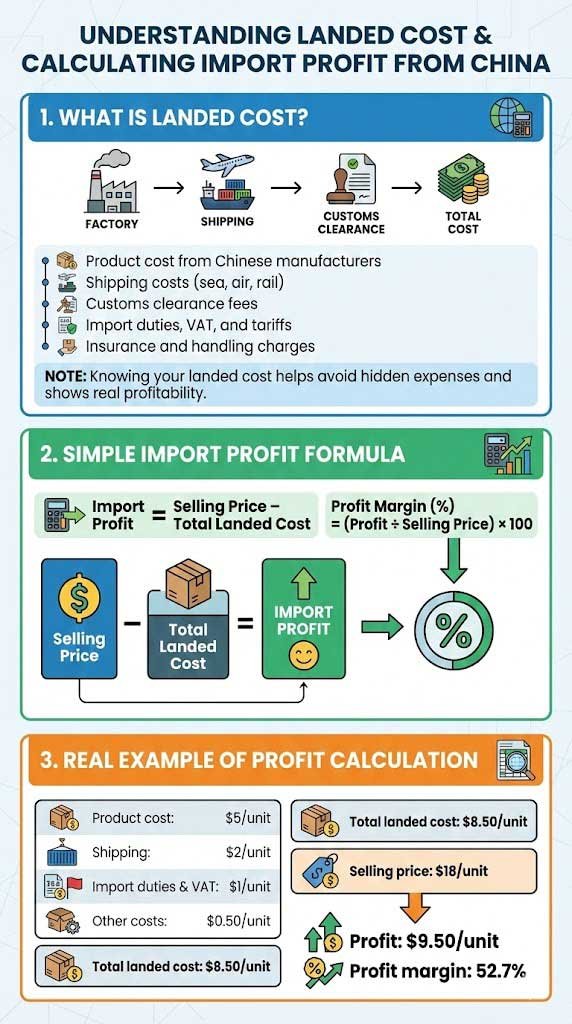
Landed cost is the total cost of a product from the factory in China to your warehouse or customer. It includes:
- Product cost from Chinese manufacturers
- Shipping costs from China (sea, air, or rail freight)
- Customs clearance fees
- Import duties, VAT, and tariffs
- Insurance and handling charges
Knowing your landed cost helps you avoid hidden expenses and gives a clear picture of your real China import business profitability.
Simple Import Profit Formula
Here is a simple and practical formula to calculate import profit:
- Import Profit = Selling Price – Total Landed Cost
- To calculate profit margin, use this formula:
- Profit Margin (%) = (Profit ÷ Selling Price) × 100
This method allows businesses to quickly compare products and decide whether importing from China is worth it.
Real Example of Import Profit Calculation
Let’s look at a simple real-world example:
- Product cost from China: $5 per unit
- Shipping costs from China: $2 per unit
- Import duties and VAT: $1 per unit
- Other costs (inspection, packaging): $0.50 per unit
- Total landed cost per unit = $8.50
- If the product sells for $18 in your market:
- Profit per unit = $18 – $8.50 = $9.50
- Profit margin = (9.5 ÷ 18) × 100 = 52.7%
This example clearly shows that importing from China can be highly profitable when costs are calculated correctly and products are priced strategically.
Best Products to Import from China for Profit
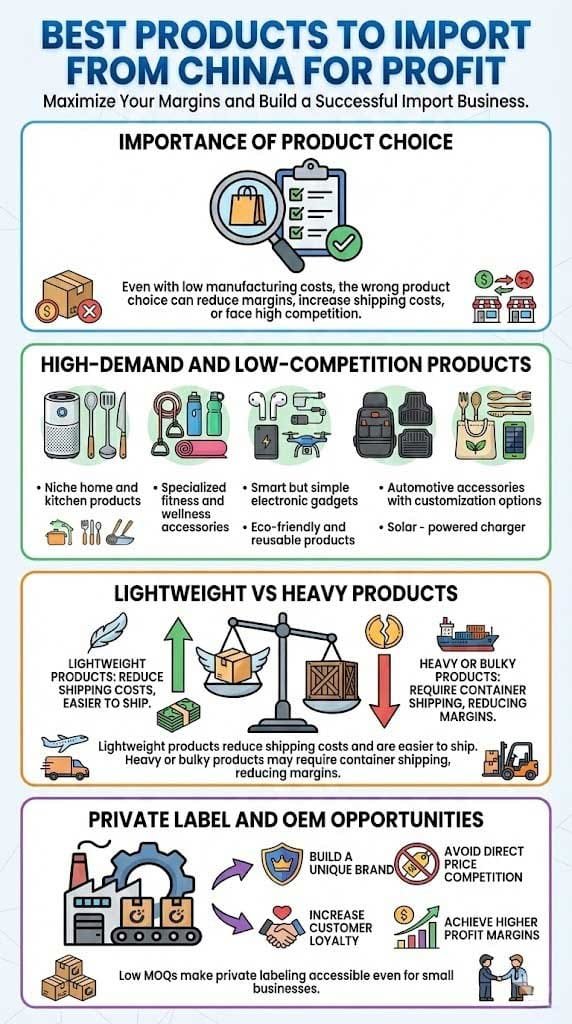
Choosing the right product is one of the most important factors in determining whether importing from China is profitable. Even with low manufacturing costs, the wrong product choice can lead to low margins, high shipping expenses, or intense competition.
Profitable imports usually have strong demand, manageable competition, and favorable shipping characteristics. Businesses that research products carefully are far more likely to succeed in the China import business.
High-Demand and Low-Competition Products
The most profitable products to import from China are those with consistent demand but limited competition in your target market. These products are often not overly saturated and solve a specific problem for customers.
Examples include:
- Niche home and kitchen products
- Specialized fitness and wellness accessories
- Smart but simple electronic gadgets
- Automotive accessories with customization options
- Eco-friendly and reusable products
By sourcing these items from Chinese manufacturers and China wholesale suppliers, businesses can maintain healthy profit margins while avoiding price wars.
Lightweight vs Heavy Products
Product weight and size play a major role in profitability due to shipping costs from China.
- Lightweight products are generally more profitable because they reduce sea freight or air freight costs and are easier to ship
- Heavy or bulky products often require container shipping, increasing logistics expenses and reducing margins
For beginners, lightweight and compact products are usually the safest choice. Experienced importers with access to FCL shipping and negotiated freight rates may find heavy products profitable at scale.
Private Label and OEM Opportunities
One of the biggest advantages of importing from China is access to private label, OEM, and ODM manufacturing. Instead of selling generic products, businesses can customize design, packaging, and branding.
Private label products allow importers to:
- Build a unique brand
- Avoid direct price competition
- Increase customer loyalty
- Achieve higher profit margins
Many OEM suppliers in China offer low minimum order quantities, making private labeling accessible even for small businesses.
Shipping and Logistics Challenges
Shipping and logistics are often the most complex parts of importing from China. Even if product costs are low, poor logistics planning can increase expenses, cause delays, and reduce profit margins.
Understanding shipping methods, working with the right partners, and managing supply chain risks are essential for maintaining China import business profitability.
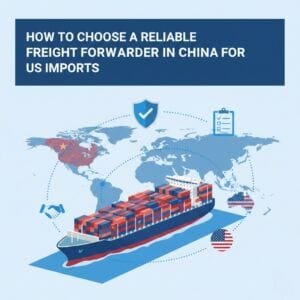
Choosing the Right Freight Forwarder
A reliable freight forwarder in China plays a critical role in successful importing. Freight forwarders manage shipping, documentation, customs clearance, and coordination between suppliers and carriers.
When choosing a freight forwarder, businesses should consider:
- Experience with China freight forwarding companies
- Transparent pricing with no hidden fees
- Knowledge of destination country regulations
- Ability to handle sea freight, air freight, and rail freight
The right shipping agent helps reduce delays, avoid customs issues, and optimize shipping from China costs, directly impacting profit margins.
Incoterms (FOB, CIF, DDP) and Their Impact on Profit
Incoterms define who is responsible for shipping costs, insurance, and risks during transportation. Choosing the wrong Incoterm can significantly affect your total landed cost.
- FOB (Free On Board): Buyer controls shipping after goods leave China; offers better cost transparency
- CIF (Cost, Insurance, Freight): Seller arranges shipping, but costs may be higher
- DDP (Delivered Duty Paid): Seller handles all costs, including customs and taxes; convenient but often more expensive
For many importers, FOB provides the best balance between control and cost efficiency, making it a popular choice for profitable imports.
Delivery Time and Supply Chain Risks
Delivery time is another major challenge when importing from China. Delays can occur due to port congestion, customs inspections, or unexpected disruptions in the China supply chain.
Common supply chain risks include:
- Shipping delays and missed deadlines
- Quality issues requiring rework or replacement
- Sudden changes in freight rates
- Customs clearance problems
To reduce these risks, businesses should plan buffer times, maintain good communication with suppliers, and work with experienced logistics partners.
How to Reduce Import Costs and Increase Profit
Reducing import costs while maintaining product quality is key to maximizing profit when importing from China. Smart strategies in supplier negotiation, shipping, and order size can make a big difference in your final profit margin.
Negotiating with Chinese Suppliers
Negotiation is an essential skill for profitable imports. Even small price reductions per unit can significantly impact overall profit when buying in bulk. Tips for negotiating effectively:
- Compare multiple China wholesale suppliers to get competitive quotes
- Ask for discounts on bulk buying from China
- Negotiate for free or cheaper shipping options
- Discuss flexible payment terms like TT or LC
Building a good relationship with suppliers can also lead to better product quality, faster production, and exclusive offers in the future.
Optimizing Shipping Methods
Shipping costs from China are often the largest portion of landed cost.
Optimizing shipping methods can improve profit margins:
- Use sea freight from China for large volumes to reduce per-unit costs
- Consider air freight only for urgent or high-value shipments
- Explore rail freight for shipments to Europe as a cost-effective alternative
- Consolidate smaller shipments into one container (FCL) to save on per-unit shipping costs
Working with experienced freight forwarders helps identify the most cost-efficient and reliable shipping options.
Bulk Ordering vs Small Orders
Order size greatly affects profitability:
- Bulk orders reduce per-unit cost and shipping expenses, increasing profit margins
- Small orders have higher per-unit costs but lower upfront investment and lower risk for testing new products
- Combining bulk orders for best-sellers and small orders for testing new items can balance profit and risk
By strategically managing order size and shipping, businesses can maximize China import business profitability while minimizing potential losses.
Is Importing from China Worth It in 2025?
Many businesses wonder: “Is importing from China profitable in 2025?” The answer is yes, but success depends on careful planning, cost management, and choosing the right products.
China remains a global manufacturing leader, offering low-cost production, a huge variety of Made in China products, and access to OEM and private label opportunities. Businesses that manage shipping, taxes, and supplier relationships effectively can still earn healthy profits in 2025.
Market Trends and Demand
In 2025, the most profitable products to import from China align with consumer trends and high-demand niches:
- Electronics and smart gadgets
- Eco-friendly and reusable products
- Fitness and wellness accessories
- Specialized home and kitchen items
Products with high demand and low competition offer the best opportunity for strong profit margins. Conducting market research and understanding consumer preferences in your region is key before placing an order.
Impact of Global Shipping Costs
Shipping costs from China in 2025 continue to affect profitability:
- Sea freight remains the most economical for bulk shipments
- Air freight is faster but more expensive for smaller volumes
- Rail freight is a cost-effective option for shipments to Europe
Seasonal fluctuations, port congestion, and fuel costs can impact delivery times and overall costs
Businesses that optimize shipping methods and calculate the total landed cost are more likely to maintain healthy profit margins.
Who Should Import from China?
Importing from China in 2025 is suitable for:
- Small businesses and startups testing niche products with low initial investment
- eCommerce sellers focused on high-margin, private-label items
- Large-scale importers leveraging bulk orders, container shipping, and strong logistics networks
With proper planning, choosing the right products, and managing shipping efficiently, importing from China in 2025 can be a profitable and scalable business model.
Is Importing from China Worth It in 2025?
Many businesses wonder: “Is importing from China profitable in 2025?” The answer is yes, but success depends on careful planning, cost management, and choosing the right products.
China remains a global manufacturing leader, offering low-cost production, a huge variety of Made in China products, and access to OEM and private label opportunities. Businesses that manage shipping, taxes, and supplier relationships effectively can still earn healthy profits in 2025.
Market Trends and Demand
In 2025, the most profitable products to import from China align with consumer trends and high-demand niches:
- Electronics and smart gadgets
- Eco-friendly and reusable products
- Fitness and wellness accessories
- Specialized home and kitchen items
Products with high demand and low competition offer the best opportunity for strong profit margins. Conducting market research and understanding consumer preferences in your region is key before placing an order.
Impact of Global Shipping Costs
Shipping costs from China in 2025 continue to affect profitability:
- Sea freight remains the most economical for bulk shipments
- Air freight is faster but more expensive for smaller volumes
- Rail freight is a cost-effective option for shipments to Europe
- Seasonal fluctuations, port congestion, and fuel costs can impact delivery times and overall costs
Businesses that optimize shipping methods and calculate the total landed cost are more likely to maintain healthy profit margins.
Who Should Import from China?
Importing from China in 2025 is suitable for:
- Small businesses and startups testing niche products with low initial investment
- eCommerce sellers focused on high-margin, private-label items
- Large-scale importers leveraging bulk orders, container shipping, and strong logistics networks
With proper planning, choosing the right products, and managing shipping efficiently, importing from China in 2025 can be a profitable and scalable business model.
Final Thoughts: Should You Import from China?
Importing from China can be highly profitable if done strategically. The key to success lies in choosing the right products, working with reliable suppliers, managing shipping costs, and calculating profit margins accurately.
China remains a top manufacturing hub, offering low-cost production, a wide variety of products, and access to private-label and OEM opportunities. By understanding the total landed cost, optimizing logistics, and mitigating risks, businesses both small and large can maintain strong profitability.
However, importing from China is not risk-free. Hidden costs, supply chain delays, and quality issues can affect margins if not properly managed. Working with trusted freight forwarders, conducting quality inspections, and carefully researching your products and market are essential steps for success.
In short, if you plan carefully, calculate all costs, and choose the right products, importing from China in 2025 (and beyond) can be a worthwhile and profitable business venture.
Frequently Asked Questions About Importing from China
Is importing from China still profitable for beginners?
Yes, importing from China can be profitable for beginners, especially if you start with small orders of high-demand products. Beginners should focus on:
- Choosing low-cost, lightweight products
- Working with reliable China wholesale suppliers
- Calculating total landed costs including shipping, duties, and taxes
- Using platforms like Alibaba or Made in China for sourcing
Starting small allows you to test the market without taking on too much financial risk.
How much money do you need to start importing from China?
The amount depends on the product type, order quantity, and shipping method.
As a general guideline:
- Small-scale orders: $500–$2,000 for testing products
- Medium orders: $2,000–$10,000 for small eCommerce businesses
- Large-scale imports: $10,000+ for bulk shipments and private-label products
Always include costs for shipping from China, customs duties, VAT, and hidden fees when calculating your budget.
What is the biggest risk when importing from China?
The biggest risks include:
- Supplier fraud or poor quality products
- Delays in shipping and customs clearance
- Unexpected hidden costs like inspections, storage, or tariffs
- Exchange rate fluctuations affecting total cost
Mitigating risks involves quality checks, working with trusted freight forwarders, and clear agreements with suppliers.
Can you import from China without a freight forwarder?
Technically yes, but it is not recommended for beginners or large shipments. Freight forwarders handle:
- Shipping coordination and documentation
- Customs clearance and import taxes
- Tracking and resolving delays
Skipping a freight forwarder can save money short-term but often increases the chance of delays, lost shipments, and higher hidden costs, reducing overall profitability.