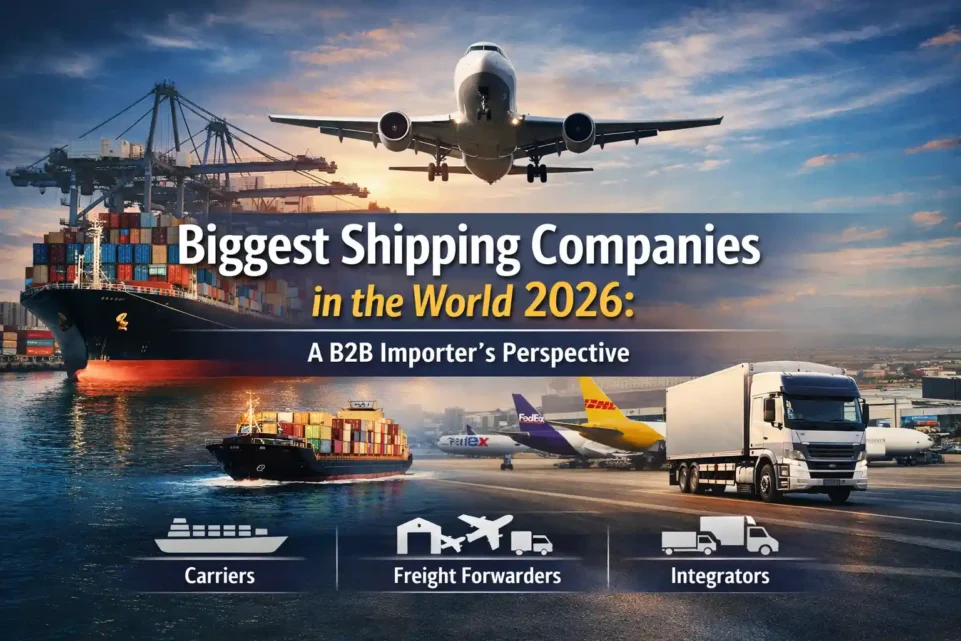
When B2B importers ask about the “biggest shipping companies,” the answer depends on which category matters most to your supply chain. An ocean carrier with 6 million TEU (twenty-foot equivalent units) of capacity is enormous by fleet size, but that metric says nothing about customs clearance coordination or door-to-door service execution capabilities critical to wholesalers, Amazon sellers, and registered companies importing goods from China to the USA, Canada, Netherlands (Port of Rotterdam), or UK.
This article defines three distinct categories of commercial shipping companies ocean container carriers, freight forwarders (3PLs), and express integrators and ranks the biggest players within each by the metrics that actually drive their scale. It’s written for B2B importers only; this is not about personal parcels or household moves.
Three Categories of “Biggest” And Why They Matter
The global commercial shipping industry operates through three fundamentally different business models. Each serves specific roles in moving containerized freight, air cargo, or time-critical shipments from origin to destination. Understanding these distinctions is essential before evaluating size rankings.
Carrier vs Forwarder vs Integrator
| Category | What They Do | “Big” Metric | Typical B2B Use-Cases | Common Misunderstanding |
|---|---|---|---|---|
| Ocean Container Carriers | Own/operate ships; transport containers on scheduled liner services between ports | TEU capacity (total container slots on operated fleet) | FCL (full container load) and LCL (less than container load) ocean freight; transpacific/transatlantic lanes | Many assume “biggest carrier” = best service fit, ignoring schedule frequency, port pairs, and documentation standards that matter more for reliability |
| Freight Forwarders / 3PLs | Coordinate multi-modal logistics: book carrier space, arrange inland transport, manage customs, consolidate LCL, orchestrate door delivery | Multi-metric: gross logistics revenue + ocean TEUs handled + air metric tons handled | Door-to-door shipping, DDP (delivered duty paid), cargo consolidation from China suppliers, customs brokerage, China warehousing, factory inspection | Often confused with carriers; forwarders don’t own ships or planes they aggregate shipper demand and negotiate carrier capacity, then layer on value-added services |
| Express Integrators | Own aircraft, sorting hubs, and last-mile delivery fleets; provide end-to-end time-definite express parcel and document services globally | Revenue and network reach (not ocean/air freight tons they’re parcel-focused) | Urgent documents, small high-value shipments, samples for approval; NOT commercial freight pallets or LCL consolidations | B2B freight importers mistakenly try to ship commercial cartons via integrators; integrators optimize for parcels <50kg, not pallet-quantity wholesale goods |
Key Insight: For commercial importers shipping cartons, pallets, or containers from China to North America or Europe, freight forwarders are typically the right partner. Ocean carriers provide the vessel capacity, but forwarders handle booking, documentation, customs, and delivery capabilities most importers need but carriers don’t provide directly.
Biggest Ocean Container Carriers (TEU Capacity)
Ocean container carriers are ranked by TEU capacity the total number of twenty-foot equivalent container slots available on their operated fleet. TEU capacity reflects the carrier’s ability to move boxes globally, but it does NOT guarantee service quality, sailing frequency on your specific trade lane, or documentation discipline.
Why TEU Capacity Matters (and Doesn’t) to B2B Importers
What TEU capacity DOES indicate:
- Network reach: Larger fleets typically serve more port pairs globally
- Market share: Top carriers control vessel space on major trade lanes (Asia-North America, Asia-Europe)
- Space access during peak seasons: Bigger fleets may have more rolling capacity when demand surges
What TEU capacity DOESN’T guarantee:
- Sailing frequency on your origin-destination pair (e.g., Shenzhen to Rotterdam weekly)
- Schedule reliability (on-time arrival at destination port)
- Service fit for LCL consolidations (carriers sell FCL slots; LCL coordination is a forwarder function)
- Transparent documentation and customs-ready paperwork (varies widely by carrier and trade lane)
Top 10 Ocean Container Carriers by TEU Capacity
Source: Alphaliner Top 100 rankings (data as of August 2025, per Container News and mfame.guru reports citing Alphaliner)
| Rank | Carrier | TEU Capacity | Market Share | Why It Matters to Importers |
|---|---|---|---|---|
| 1 | MSC (Mediterranean Shipping Company) | 6.75 million TEU | 20.6% | Largest global capacity; strong presence on Asia-USA, Asia-Europe lanes. Known for aggressive fleet expansion via acquisitions and newbuilds. |
| 2 | Maersk Line | 4.59 million TEU | 14.0% | Former #1 (until 2022); reputation for digital integration and supply chain visibility tools. Strong North America and Europe service networks. |
| 3 | CMA CGM | 4.02 million TEU | 12.3% | French carrier with robust Asia-Europe services; includes APL brand for transpacific routes. Growing presence in logistics/forwarding via CEVA acquisition. |
| 4 | COSCO Shipping Group | 3.4 million TEU* | ~10% | Chinese state-owned; includes OOCL and COSCO brands. Dominant on Asia-North America routes; strong schedule reliability on some lanes. |
| 5 | Hapag-Lloyd | 1.8+ million TEU | ~6% | German carrier; known for quality service on transatlantic and Asia-Europe routes. Includes former UASC fleet. |
| 6 | Ocean Network Express (ONE) | 1.8+ million TEU | ~6% | Japanese consortium (NYK, MOL, K Line); reliable service on Asia-North America lanes; strong schedule integrity. |
| 7 | Evergreen Line | 1.8+ million TEU | ~6% | Taiwan-based; operates ultra-large container vessels. Strong Asia-Europe and transpacific services. |
| 8 | HMM (Hyundai Merchant Marine) | 900,000+ TEU | ~3% | South Korean carrier; focuses on ultra-large vessels for long-haul routes. Smaller fleet but competitive on key lanes. |
| 9 | ZIM Integrated Shipping | 800,000+ TEU | ~2.5% | Israeli carrier; lean model with focus on niche and digital-first operations. Known for agility on Asia-USA routes. |
| 10 | Yang Ming Marine Transport | 700,000+ TEU | ~2% | Taiwan-based; smaller fleet but maintains strategic alliances for Asia-Pacific and transpacific coverage. |
*Figures rounded; capacity includes operated fleet (owned + chartered vessels). Alphaliner updates rankings daily; these figures reflect August 2025 snapshot.
Important Note for Importers: The top 7 carriers all exceed 1.5 million TEU capacity. Combined, the Top 10 control approximately 84% of global liner fleet capacity. For B2B importers, this concentration means most FCL bookings will route through one of these carriers but you’ll typically book through a freight forwarder who negotiates rates and manages documentation, not directly with the carrier.
Biggest Freight Forwarders / 3PLs (Multi-Metric Ranking)
Freight forwarders are ranked by a combined metric that averages their standings across three dimensions: gross logistics revenue, ocean TEUs handled, and air metric tons handled. This multi-metric approach (used by Armstrong & Associates) reflects the breadth of a forwarder’s global operations better than any single number.
Why Forwarders Matter to B2B Importers
Freight forwarders orchestrate complex logistics that ocean carriers and airlines don’t handle:
- LCL consolidation: Combine your 5 pallets with other shippers’ cargo into one container to reduce costs
- Customs coordination: Prepare commercial invoice, packing list, ISF filing (USA), EORI registration (EU), and coordinate customs clearance at destination
- Door-to-door delivery: Book ocean/air transport, arrange trucking from your supplier’s factory in Shenzhen to origin port, coordinate destination port pickup, and schedule final delivery to your warehouse/FBA center
- DDP (Delivered Duty Paid) services: Forwarder acts as importer of record, pays duties/taxes upfront, delivers cleared goods to your door
- China warehousing and cargo consolidation: Store goods from multiple Chinese suppliers, consolidate into one shipment
- Factory inspection and sample testing: Verify quality before goods ship
For registered companies importing commercial quantities (not <10kg parcels), forwarders are typically essential partners—especially when shipping from China to USA/Canada/Netherlands/UK.
Top 15 Global Freight Forwarders (Multi-Metric Ranking)
Source: Armstrong & Associates Top 25 Global Freight Forwarders List (updated October 9, 2025, ranking by 2024 data)
| Rank | Forwarder | HQ | Gross Logistics Revenue (2024, USD millions) | Ocean TEUs | Air Metric Tons | Best-Fit Shipper Profile |
|---|---|---|---|---|---|---|
| 1 | Kuehne + Nagel | Switzerland | 30,283 | 4,310,000 | 1,897,830 | Large-volume B2B importers needing global reach; strong in contract logistics and integrated supply chain solutions |
| 2 | DHL Supply Chain & Global Forwarding | Germany | 33,542 | 3,314,000 | 1,785,000 | Multi-national corporations; highest revenue but not #1 in every sub-metric; excellent air freight network |
| 3 | DSV | Denmark | 23,335 | 2,686,009 | 1,398,398 | Fast-growing via acquisitions; strong Europe-Asia services; competitive pricing on ocean and air |
| 4 | DB Schenker | Germany | 19,970 | 1,810,000 | 1,050,000 | German manufacturing exporters/importers; robust land transport integration in Europe |
| 4 | Sinotrans | China | 14,465 | 4,872,248 | 1,028,000 | China-origin shippers; state-owned with deep China network; high ocean TEU volume reflects China export strength |
| 5 | Nippon Express | Japan | 17,005 | 1,850,979 | 921,531 | Japanese manufacturers; strong Asia-Pacific presence; reliable service on Japan-North America lanes |
| 6 | CEVA Logistics | France | 18,300 | 1,900,000 | 750,000 | Mid-large importers; acquired Bolloré Logistics in 2024 (CMA CGM ownership); strong contract logistics |
| 7 | C.H. Robinson | USA | 15,647 | 1,428,200 | 311,700 | North American importers; strong domestic trucking network; less dominant in international air/ocean vs competitors |
| 7 | Expeditors | USA | 10,601 | 846,800 | 875,500 | SME importers and Amazon sellers; known for customer service and transparency; strong Asia-USA NVOCC operations |
| 8 | KLN (formerly Kerry Logistics) | Hong Kong | 7,506 | 1,238,108 | 734,496 | Asia-focused importers; rebranded 2025; backed by SF Holding; strong e-commerce fulfillment integration |
| 9 | UPS Supply Chain Solutions | USA | 11,165 | 567,000 | 830,000 | High-tech, medical, retail/consumer goods shippers; integrated with UPS parcel network for speed-to-market |
| 10 | Maersk Logistics | Denmark | 14,920 | 660,000 | 327,000 | Maersk carrier clients transitioning to integrated logistics; growing air/ocean forwarding to complement carrier base |
| 11 | Hellmann Worldwide Logistics | Germany | 3,952 | 955,000 | 595,000 | Full-service 3PL; strong European presence; balanced air/ocean/road services |
| 12 | GEODIS | France | 10,475 | 787,000 | 294,000 | French exporters/importers; strong contract logistics; part of SNCF Group (French railways) |
| 13 | Kintetsu World Express | Japan | 5,199 | 723,227 | 512,081 | Japanese export/import logistics; strong presence in Asia-Pacific trade lanes |
| 14 | LX Pantos | South Korea | 5,900 | 1,569,000 | 119,000 | South Korean manufacturers; high ocean volume relative to revenue (bulk commodity focus) |
| 15 | Yusen Logistics | Japan | 5,157 | 632,000 | 280,320 | Japanese automotive and industrial shippers; integrated land/ocean/air services |
Note: Revenues converted to USD using December 31, 2024 exchange rates. Freight forwarders are ranked by combined overall average of their individual rankings across all three metrics (revenue, ocean TEUs, air tons). This means a forwarder ranked #2 overall might be #1 in revenue but #4 in ocean TEUs—the combined ranking balances these.
Critical Clarification for TopShipping Scope: TopShipping is a freight forwarder, not a global 3PL network. We do NOT offer worldwide rail networks, domestic trucking across Europe/USA, or multi-continent warehousing. Our services are limited to: China/South Korea origin → USA/Canada/Netherlands (Rotterdam)/UK destination, via sea freight (FCL/LCL) or air freight, with door-to-door delivery, customs clearance, China warehousing, cargo consolidation, DDP, and factory inspection/sample testing. We do not compete with the Top 15’s global scale; we specialize in Asia-to-Western-markets lanes for B2B commercial importers.
Biggest Express Integrators (Contextual, Not Freight-Focused)
Express integrators own their own aircraft, sorting hubs, and delivery fleets to provide time-definite parcel and document delivery globally. They are massive by revenue and network reach, but they optimize for parcels (typically <50kg per piece), not commercial freight pallets or LCL consolidations.
Top 3 Express Integrators by Revenue
Sources: FedEx fiscal 2024 annual report (year ending May 31, 2024); UPS 2024 annual data via ShipMatrix and industry reports; DHL Group (Deutsche Post) 2024 annual report
| Company | 2024 Revenue (USD) | What They’re Best At | Where They Fit in B2B Logistics |
|---|---|---|---|
| UPS (United Parcel Service) | $91 billion* (2024 calendar year estimate) | Domestic USA parcel delivery; international express parcels; integrated supply chain solutions for high-value goods | Samples, urgent documents, small high-value shipments; NOT commercial freight pallets. UPS Supply Chain Solutions (ranked #9 among forwarders) handles larger freight, but core UPS is parcel-focused. |
| FedEx Corporation | $88 billion (fiscal 2024) | International express air cargo; USA domestic parcels; FedEx Freight (LTL trucking) | Same as UPS: urgent parcels, documents, samples. FedEx Trade Networks offers freight forwarding, but core FedEx Express is parcel/express-optimized. |
| DHL Group (Deutsche Post) | €84.2 billion (~$90.6 billion USD, 2024) | International express parcels (DHL Express division); also includes DHL Global Forwarding (ranked #2 among forwarders) and DHL Supply Chain | DHL Express: international parcels <50kg. DHL Global Forwarding: legitimate freight forwarding (ocean/air tons, customs). These are separate divisions under one corporate parent. |
*Revenue figures vary by fiscal year definition; UPS and DHL follow calendar year, FedEx follows May fiscal year-end.
Hard Line for B2B Freight Importers: If you’re importing 20 cartons of wholesale goods, 10 pallets of electronics, or a full container of inventory from a Chinese supplier, do NOT use UPS/FedEx/DHL Express parcel services. They price by dimensional weight and chargeable weight formulas designed for small parcels, making them prohibitively expensive for commercial freight. Use ocean freight forwarders for containers/pallets, or air freight forwarders for urgent multi-carton shipments not express integrators.
This article is about commercial freight decision-making for registered B2B importers, not personal parcel shipping.
How to Interpret “Big” as a B2B Importer
Size rankings are directional, but your freight needs determine the right partner. Here’s a practical decision framework based on common B2B import scenarios:
If You Ship FCL or LCL from China to USA/Canada/UK/Rotterdam:
What you care about:
- Sailing frequency: Weekly departures from your origin port (e.g., Shenzhen/Yantian) to your destination port (e.g., Los Angeles, Rotterdam, Felixstowe)
- Port pair coverage: Direct service or minimal transshipment on your specific lane
- Schedule reliability: On-time vessel arrival at destination (carriers publish schedule reliability metrics quarterly)
- Documentation discipline: Accurate Bill of Lading (B/L), timely Arrival Notice, clear cargo release process
- Carrier financial stability: Avoid carriers at risk of bankruptcy (Hanjin 2016 example)
Why “biggest carrier” doesn’t always win: A smaller carrier (e.g., Yang Ming) might offer better weekly schedule on Shenzhen-Long Beach than a larger carrier (e.g., MSC) that prioritizes Asia-Europe routes. Your forwarder’s carrier relationships matter more than carrier size.
If You Ship Urgent Air Freight from China to USA/Canada/UK/Rotterdam:
What you care about:
- Chargeable weight calculation: Air freight pricing uses the greater of actual weight or volumetric weight (length × width × height ÷ 6000 for cm, or ÷ 166 for inches). Understand this before quoting.
- Airport cutoff times: When cargo must arrive at origin airport for same-day departure (critical for time-sensitive shipments)
- Commodity compliance: Lithium batteries, liquids, temperature-controlled goods require special handling/documentation
- Customs readiness: Air freight moves fast; your commercial invoice, packing list, and HS codes must be accurate BEFORE goods arrive to avoid clearance delays
Why “biggest forwarder” doesn’t always win: Smaller specialized air freight forwarders may have better airline contracts on your specific route (e.g., Hong Kong-Chicago) than a top-5 global forwarder that prioritizes Europe-Asia lanes.
If You Need Door-to-Door or DDP Service from China to USA/Canada/UK/Rotterdam:
What you care about:
- Clear commercial documentation: Accurate commercial invoice with correct HS codes, unit values, supplier details—errors cause customs delays
- Importer-of-record clarity: For DDP, your forwarder acts as IOR and pays duties/taxes; ensure terms are explicit in contract
- Delivery appointment coordination: Final-mile trucking to your warehouse or Amazon FBA center requires scheduling
- Incoterm understanding: DDP means seller/forwarder pays all costs to destination; DAP means buyer pays import duties; FOB means buyer arranges/pays from origin port—know which you’re quoting
Why “biggest forwarder” doesn’t always win: DDP execution quality depends on destination customs expertise, not global scale. A forwarder with deep USA customs knowledge may outperform a larger competitor with weaker USA clearance operations.
Example Lane Considerations (TopShipping Service Markets):
- China → USA: Focus on West Coast ports (Los Angeles, Long Beach) for speed; East Coast ports (New York, Savannah) for Midwest/East Coast final destinations. ISF (Importer Security Filing) must be filed 24 hours before vessel departure from China—non-negotiable USA CBP requirement.
- China → Canada: Vancouver and Toronto are primary gateways; CBSA (Canada Border Services Agency) clearance process differs from USA—ensure forwarder has Canadian customs broker license.
- China → Netherlands (Rotterdam): Europe’s largest port; strong transshipment hub for onward rail to Germany/Poland; EORI number (EU registration) required for customs clearance.
- China → UK: Post-Brexit, UK customs clearance is separate from EU; goods entering UK from China require UK EORI and customs declaration even if previously in EU.
Where TopShipping Fits (Informational, Not Salesy)
TopShipping is a freight forwarder, not an ocean carrier. We do not own ships or operate liner services. We are not a global 3PL with warehouses on every continent. We are a specialized B2B freight coordination partner for importers shipping commercial goods from Asia to specific Western markets.
Our Service Scope (Only):
Origins:
- China (primary operational origin: Shenzhen; we also handle Shanghai, Ningbo, Qingdao, Xiamen, Guangzhou)
- South Korea (secondary origin)
- EU office: Luxembourg (coordination only; not a service origin)
Destinations:
- USA (all states)
- Canada (all provinces)
- Netherlands (Port of Rotterdam focus)
- United Kingdom
Services:
- Sea Freight: FCL (full container load), LCL (less than container load)
- Air Freight: Standard and express air cargo
- Door-to-Door Shipping: Factory pickup in China + ocean/air transport + destination port clearance + final delivery to your warehouse/FBA center
- Customs Clearance: USA CBP, Canadian CBSA, Dutch customs (Rotterdam), UK HMRC—full customs brokerage and documentation
- China Warehousing: Store goods from multiple suppliers, consolidate before shipment
- Supplier/Cargo Consolidation: Combine orders from different factories into one container/air shipment
- DDP (Delivered Duty Paid): We act as importer of record, pay duties/taxes, deliver cleared goods to your door
- Factory Inspection & Sample Testing: Pre-shipment quality verification
Restrictions (What We Don’t Handle):
- Shipments under 10kg (use express couriers)
- Personal/household goods or moving services (B2B only)
- Illegal, restricted, or undocumented goods
- Shipments with unclear commercial information (we need accurate invoices, HS codes, supplier details)
- Destinations outside USA/Canada/Netherlands/UK
Quote-Ready Checklist
Before contacting TopShipping for a quote, prepare the following information. Incomplete details delay quotes and may result in inaccurate pricing.
Required Information:
- Cargo type/description: “Wireless headphones,” “kitchen utensils,” “machine parts”—NOT vague terms like “general cargo”
- Number of cartons/pallets: Exact count
- Dimensions per carton: Length × Width × Height (in cm or inches)
- Weight per carton and total weight: Gross weight (kg or lbs)
- Pickup city in China: “Shenzhen,” “Shanghai,” “Ningbo,” etc.
- Destination details: City, ZIP/postal code, or Amazon FBA warehouse code (e.g., “ONT8”)
- Incoterm preference: FOB (buyer arranges from origin port), CIF (seller pays freight to destination port), DDP (seller pays all to final destination)
- Commodity flags: Lithium batteries? Liquids? Temperature-controlled? Regulated goods (FDA, EPA, FCC)? Declare upfront.
- Required timeline: “Need delivery by [date]” or “standard transit acceptable”
Optional but Helpful:
- HS code if known (6-digit harmonized tariff code for your goods)
- Supplier contact in China (for factory pickup coordination)
- Special packaging requirements (e.g., “must palletize,” “fragile extra wrapping”)
Conclusion
The “biggest shipping companies” in 2026 vary by category: MSC leads ocean carriers by TEU capacity, Kuehne + Nagel and DHL Global Forwarding top freight forwarders by multi-metric ranking, and UPS leads express integrators by revenue. For B2B importers shipping commercial goods from China to USA/Canada/Netherlands/UK, the right partner is typically a freight forwarder—not a carrier or integrator—because forwarders orchestrate door-to-door coordination, customs clearance, and cargo consolidation that carriers don’t provide.
When evaluating forwarders, size matters less than service fit: Does the forwarder have deep expertise on your origin-destination lane? Do they handle your commodity type (e.g., lithium batteries, temperature-controlled goods)? Can they execute DDP if needed? Do they communicate proactively about delays and documentation?
TopShipping specializes in B2B freight from China/South Korea to USA/Canada/Netherlands/UK via sea and air, with door-to-door, customs, consolidation, and DDP services. We’re not the biggest global forwarder, but we focus on doing Asia-to-Western-markets lanes well for registered importers, wholesalers, Amazon sellers, and trade agents.
Frequently Asked Questions (FAQs)
1. Are ocean carriers and freight forwarders the same thing?
No. Ocean carriers own/operate ships and sell container space on scheduled liner services between ports. Freight forwarders coordinate logistics: they book space on carriers’ vessels, arrange inland transport, manage customs, and handle delivery. Most B2B importers work with forwarders because carriers don’t provide door-to-door coordination, LCL consolidation, or customs brokerage.
2. Why do rankings differ between TEU, revenue, and air tons?
Because they measure different capabilities. TEU capacity (ocean carriers) measures vessel space. Revenue (forwarders) measures total business size. Air tons (forwarders) measures air cargo volume. A forwarder ranked #1 in revenue might be #4 in ocean TEUs because they focus on air freight. Combined rankings (like A&A’s Top 25) average these metrics to show overall scale.
3. Should Amazon sellers work directly with an ocean carrier?
Rarely. Ocean carriers sell FCL/LCL space port-to-port; they don’t arrange factory pickup in China, customs clearance at destination, or delivery to Amazon FBA centers. Amazon sellers typically need door-to-door DDP service—a forwarder function. Some large Amazon sellers negotiate carrier contracts through forwarders, but direct carrier relationships make sense only for very high volumes (50+ containers/month).
4. What information do I need to get an accurate freight quote?
See Section F’s “Quote-Ready Checklist.” At minimum: cargo description, carton count, dimensions, weights, pickup city (e.g., Shenzhen), destination city/ZIP/FBA code, Incoterm target (FOB/DDP), commodity flags (batteries, liquids, etc.), and timeline. Without accurate details, quotes are estimates only and may change significantly when actual cargo details are confirmed.
5. What’s the difference between FCL and LCL?
- FCL (Full Container Load): You rent the entire container (20ft or 40ft). Your goods are the only cargo inside. Faster, lower per-unit cost for larger shipments, but you pay for the full container even if not filled.
- LCL (Less than Container Load): Your goods share a container with other shippers’ cargo. The forwarder consolidates multiple LCL shipments into one container. Slower (consolidation/deconsolidation time), higher per-unit cost, but economical for smaller shipments (e.g., 5 pallets instead of 20).
Rule of thumb: If your cargo fills >60% of a 20ft container (~10-12 pallets), FCL is usually cheaper than LCL.
6. How long does sea freight take from China to USA/Canada/UK/Rotterdam?
Typical transit times (port-to-port, not including inland/customs):
- China → USA West Coast (Los Angeles/Long Beach): 14–18 days
- China → USA East Coast (New York/Savannah): 25–35 days (via Panama Canal or Suez+transshipment)
- China → Canada West Coast (Vancouver): 14–18 days
- China → Canada East Coast (Montreal): 28–35 days
- China → Rotterdam: 28–35 days (via Suez Canal; longer if rerouted around Africa due to Red Sea disruptions)
- China → UK (Felixstowe/Southampton): 30–38 days
Add 3–7 days for inland pickup in China, 2–5 days for customs clearance and destination delivery. Total door-to-door: 20–45 days depending on lane and Incoterm.
7. What’s DDP, and should I use it?
DDP (Delivered Duty Paid): The seller (or forwarder acting as seller) pays all costs—ocean/air freight, insurance, import duties, taxes, and delivery to your door. You receive cleared goods; you pay one all-inclusive price upfront.
When to use DDP:
- You’re new to importing and don’t want to handle customs yourself
- You prefer predictable total costs (no surprise duty bills)
- Your accountant prefers simple invoicing (one supplier invoice, duties included)
When NOT to use DDP:
- You have a USA customs bond and prefer to file ISF/customs entries yourself (more control)
- You want to use your own customs broker (cheaper than forwarder’s markup)
- You’re importing duty-free goods under trade agreements (e.g., USMCA) paying a forwarder for DDP makes no sense if duties are zero
8. Can I ship lithium batteries from China to USA/UK?
Yes, but with restrictions. Lithium batteries are classified as dangerous goods (DG) and require special documentation, packaging, and carrier approval. Key rules:
- Air freight: Must comply with IATA DG Regulations (UN3480 for batteries alone, UN3481 for batteries packed with equipment). Many airlines restrict lithium battery shipments; limited quantities allowed per carton.
- Sea freight: Fewer restrictions than air, but still requires DG declaration and proper packaging.
- Amazon FBA: Amazon has strict lithium battery requirements (MSDS, UN test summary, proper labeling). Declare upfront to your forwarder; undeclared batteries risk shipment rejection or confiscation.
9. What happens if my cargo description is inaccurate?
Customs will flag the shipment for inspection, causing delays (3–10+ days). If the declared value is too low (undervaluation), customs may assess penalties and adjust duties owed. If the HS code is wrong, you may pay incorrect duty rates. Worst case: cargo seizure for prohibited goods or fraud suspicion. Always provide accurate descriptions, values, and HS codes.
10. Why are freight rates so volatile?
Ocean and air freight rates fluctuate based on supply (carrier capacity) and demand (shipper volumes). Key drivers:
- Peak season (Aug–Oct for ocean, Nov–Dec for air): Rates spike as retailers stock for holidays; container/air space becomes scarce.
- Fuel costs: Bunker fuel (ships) and jet fuel surcharges adjust monthly.
- Geopolitical disruptions: Red Sea Houthi attacks (2023–2024) forced carriers to reroute around Africa, adding 10–14 days and increasing costs 30–50%.
- Capacity management: Carriers blank sailings (cancel voyages) in low-demand periods, reducing available space and supporting rates.
Advice: Get quotes 2–4 weeks before your shipment date; lock rates with a booking confirmation. Spot market rates can change daily.