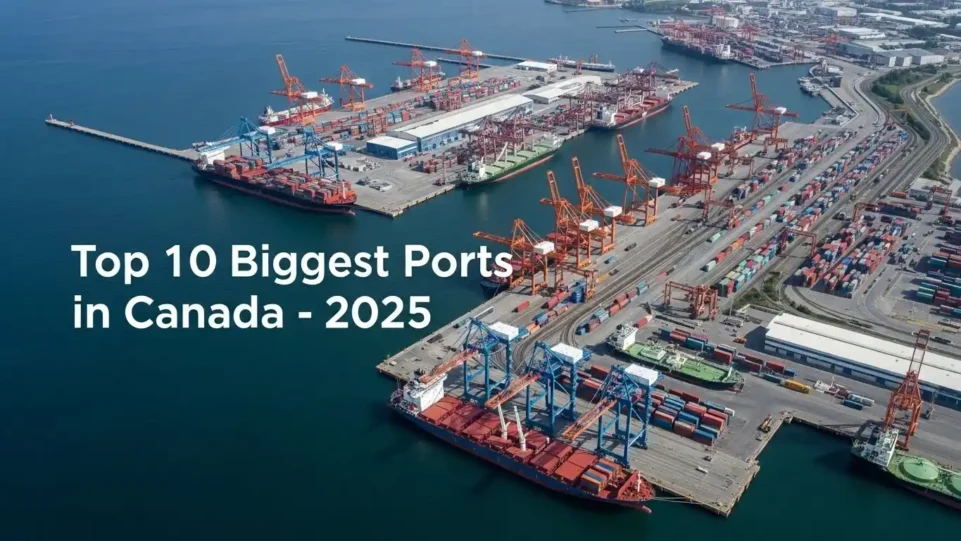
Canada’s shipping ports form the backbone of the nation’s international trade, handling over 340 million tonnes of cargo annually and connecting Canadian businesses to global markets across six continents. From the Pacific coast terminals of Vancouver to the Atlantic gateways of Halifax, Canada’s port infrastructure supports industries ranging from agriculture and manufacturing to natural resources and consumer goods.
This comprehensive guide covers everything you need to know about shipping ports across Canada: their locations, capabilities, cargo volumes, and strategic importance in North American and global supply chains. Whether you’re researching port options for freight logistics, analyzing trade corridors, or simply seeking to understand Canada’s maritime infrastructure, you’ll find detailed information on all major ports, regional hubs, and specialized facilities.
Overview of Canada’s Port System
What Are Shipping Ports and Why They Matter
Shipping ports are designated coastal or inland locations equipped with infrastructure to load, unload, and transfer cargo between vessels and land-based transportation. In Canada, ports function as critical nodes in supply chains, facilitating the import of consumer goods, industrial materials, and energy products while enabling the export of agricultural commodities, natural resources, and manufactured goods.
Canadian ports handle three primary categories of cargo:
- Containerized cargo: Standardized shipping containers measured in TEUs (Twenty-foot Equivalent Units), carrying everything from electronics to apparel
- Bulk cargo: Unpackaged commodities like grain, coal, potash, and petroleum products
- Breakbulk and specialized cargo: Oversized items, machinery, vehicles, and project cargo requiring specialized handling
The efficiency and capacity of Canada’s port system directly impact trade competitiveness, regional economic development, and the cost of goods for Canadian consumers and businesses.
Types of Ports in Canada (Sea Ports, Container Ports, Cargo Ports)
Canada’s port infrastructure includes several distinct categories:
Sea ports are located on ocean coastlines the Pacific, Atlantic, and Arctic providing direct access to international shipping lanes. These include Vancouver, Montreal, Halifax, and Prince Rupert, which serve as primary gateways for transoceanic trade.
Inland ports operate on the Great Lakes and St. Lawrence Seaway system, handling both domestic cargo and international shipments via the seaway’s connection to the Atlantic. Thunder Bay, Hamilton, and Toronto represent major inland port facilities.
Container ports specialize in handling standardized shipping containers, offering intermodal terminals where containers transfer seamlessly between ships, trains, and trucks. Canada’s largest container ports Vancouver, Montreal, and Prince Rupert collectively handle over 6 million TEUs annually.
Bulk cargo ports focus on raw materials and commodities, featuring specialized equipment like grain elevators, coal terminals, and liquid bulk facilities. Many Canadian ports handle mixed cargo types, combining container operations with bulk and breakbulk capabilities.
How Many Shipping Ports Does Canada Have?
Canada operates over 500 port facilities nationwide, ranging from major commercial gateways to small regional harbors. However, the number of significant commercial shipping ports those handling substantial cargo volumes and international trade totals approximately 20 to 25 facilities.
The 18 ports administered by Canada Port Authorities under federal jurisdiction account for the vast majority of cargo tonnage, handling roughly 340 million tonnes annually. These federally-managed ports include all major container terminals and bulk cargo facilities serving international trade.
Beyond federally-administered ports, provincial ports, private terminals, and regional harbors serve specialized industries, domestic shipping, and local economies. The Great Lakes-St. Lawrence Seaway system alone includes dozens of ports connecting Canada’s industrial heartland to global markets.
Canada’s Strategic Position in Global Trade
Canada’s geographic position provides natural advantages for international shipping:
Pacific access connects Canadian exporters directly to Asia-Pacific markets the world’s largest consumer base and manufacturing center. West coast ports like Vancouver and Prince Rupert serve as the shortest North American route to major Asian economies, offering 1-2 day time savings over U.S. competitors.
Atlantic proximity to European markets positions Halifax and Montreal as efficient gateways for trans-Atlantic trade. The St. Lawrence Seaway extends ocean shipping 3,700 kilometers inland, bringing international vessels directly to Ontario and Quebec industrial centers.
North American integration through CUSMA (Canada-United States-Mexico Agreement) makes Canadian ports essential links in continental supply chains. Cross-border freight flows between Canada and the U.S. exceed $900 billion annually, with ports facilitating vehicle manufacturing, energy trade, and agricultural commerce.
Arctic potential represents Canada’s emerging frontier as climate change opens northern shipping routes. While still developing, Arctic ports may eventually provide significantly shorter routes between Europe and Asia, positioning Canada at the center of future polar trade corridors.
Major Shipping Ports in Canada
Largest Ports by Cargo Volume and Container Traffic
Canada’s port system concentrates cargo handling at a handful of major facilities that dominate national and regional trade:
By total cargo tonnage, the Port of Vancouver leads decisively, handling over 140 million tonnes annually roughly 40% of Canada’s total port cargo. Vancouver’s dominance stems from its Pacific gateway position, deep-water harbors, and extensive rail connections to Canadian and U.S. inland markets.
By container volume (measured in TEUs), Vancouver again ranks first with approximately 3.5 million TEUs, followed by Montreal at 1.8 million TEUs and Prince Rupert at 1.3 million TEUs. These three ports collectively account for over 90% of Canada’s containerized cargo.
Bulk cargo leadership varies by commodity type. Vancouver dominates grain exports, while Quebec and Atlantic ports handle significant mineral and petroleum volumes. Sept-Îles in Quebec ranks as Canada’s largest iron ore port, shipping over 25 million tonnes annually.
The concentration of cargo at major ports reflects economies of scale. Larger facilities attract shipping lines through better service frequency, while investments in automation and capacity expansion reinforce their competitive advantages.
Port of Vancouver: Canada’s Busiest Gateway
The Port of Vancouver operates as Canada’s largest and most diversified port, stretching 370 kilometers along the British Columbia coastline from Roberts Bank to the Fraser River. Managed by the Vancouver Fraser Port Authority, the port encompasses over 25 major terminals handling containers, bulk commodities, breakbulk cargo, cruise ships, and automobiles.
Vancouver’s container terminals including Deltaport, Vanterm, and Fraser Surrey Docks provide direct rail connections to major Canadian cities and U.S. Midwest markets. The port’s on-dock rail capabilities allow containers to move directly from ship to train, reducing drayage costs and transit times for importers and exporters.
The port serves as Canada’s primary gateway for Asian trade, with regular service from major shipping lines connecting to China, Japan, South Korea, and Southeast Asian nations. Vancouver handles approximately 60% of all goods traded between Canada and Asia, making it indispensable for retailers, manufacturers, and resource exporters.
Key commodities moving through Vancouver include grain and agricultural products, forestry products, coal, potash, containers, and automobiles. The port supports over 115,000 jobs across British Columbia and generates $12.8 billion in economic activity annually.
Port of Montreal: Eastern Canada’s Commercial Hub
The Port of Montreal stands as Canada’s second-largest container port and the only container facility serving the Great Lakes-St. Lawrence Seaway system. Located on the St. Lawrence River in Quebec, Montreal provides ocean access to the industrial heartland of Ontario and Quebec, where 60% of Canada’s population and manufacturing capacity reside.
Montreal handles diverse cargo including containers, liquid bulk (petroleum products, chemicals), dry bulk (grain, sugar), and general cargo. The port’s container terminals at Viau and Racine offer automated operations and direct rail connections to Toronto, Western Canada, and the U.S. Midwest.
The port’s strategic position creates a natural advantage for European trade, with shorter ocean transit times to major European ports compared to U.S. East Coast alternatives. Montreal also serves as a critical supply chain link for automotive manufacturing in Ontario, handling vehicle imports and automotive parts.
Montreal’s containerized cargo totals approximately 1.8 million TEUs annually, while total cargo volume exceeds 40 million tonnes. The port operates year-round despite winter ice conditions, utilizing icebreakers and specialized equipment to maintain service continuity.
The Montreal Port Authority manages the port under federal jurisdiction, coordinating with Transport Canada, customs authorities, and private terminal operators to ensure efficient cargo flow.
Port of Prince Rupert: Pacific Corridor Expansion
The Port of Prince Rupert has emerged as North America’s fastest-growing container port, leveraging its position as the closest North American port to Asia. Located in northern British Columbia, Prince Rupert sits two days closer to major Asian markets than southern California ports, providing significant time and fuel savings for trans-Pacific shippers.
Prince Rupert’s Fairview Container Terminal operates as a highly automated facility with direct on-dock rail service via Canadian National Railway. Containers arriving at Prince Rupert can reach Chicago in four days faster than through any competing West Coast port making it particularly attractive for time-sensitive imports like perishable goods and retail merchandise.
The port handles approximately 1.3 million TEUs annually, with capacity expansion projects underway to accommodate growing trade volumes. Beyond containers, Prince Rupert’s Ridley Island facilities handle coal, grain, and wood pellets for export markets.
Prince Rupert’s deep natural harbor accommodates the largest container vessels operating in trans-Pacific service, while its northern location avoids the congestion challenges affecting larger southern ports. These advantages have attracted major shipping lines and cargo owners seeking reliable, efficient West Coast gateway options.
The port generates substantial economic benefits for northwestern British Columbia, supporting thousands of direct and indirect jobs in a region with limited alternative economic drivers.
Port of Halifax: Atlantic Gateway Operations
The Port of Halifax serves as Atlantic Canada’s primary container port and a critical gateway for European and Mediterranean trade. Located on one of the world’s largest natural harbors, Halifax offers ice-free, deep-water berthing year-round, accommodating the largest container vessels serving the Atlantic trade.
Halifax handles approximately 500,000 TEUs annually through its container terminals operated by PSA Halifax and Oceanex. The port’s proximity to major European ports provides the shortest ocean route from Europe to North America, with transit times one to two days faster than competing U.S. East Coast ports.
Halifax’s intermodal rail connections link the port to Montreal, Toronto, and the U.S. Midwest, positioning it as an alternative to congested ports further south. During peak shipping seasons or when supply chain disruptions affect other ports, Halifax absorbs diverted cargo, providing supply chain resilience for importers.
Beyond containers, Halifax handles automobiles (imports and exports), breakbulk cargo, cruise passengers, and military vessels through Canadian Forces Base Halifax. The port’s diverse operations support Nova Scotia’s economy while serving as a strategic national asset for defense and emergency response.
The Halifax Port Authority coordinates with federal agencies, terminal operators, and shipping lines to maintain service quality and expand capacity. Recent infrastructure investments include terminal automation, improved rail access, and enhanced security systems.
Comparison Table: Top 5 Canadian Ports by TEU and Tonnage
| Port | Annual TEUs | Total Cargo (Tonnes) | Primary Cargo Types | Key Markets Served |
|---|---|---|---|---|
| Vancouver | 3.5 million | 140+ million | Containers, grain, coal, forestry | Asia-Pacific, U.S. Midwest |
| Montreal | 1.8 million | 40+ million | Containers, liquid bulk, grain | Europe, U.S. East, Great Lakes |
| Prince Rupert | 1.3 million | 30+ million | Containers, coal, grain | Asia-Pacific, U.S. Midwest |
| Halifax | 500,000 | 10+ million | Containers, automobiles, breakbulk | Europe, Mediterranean, U.S. East |
| Saint John | 200,000 | 28+ million | Containers, dry bulk, liquid bulk | U.S. East, Caribbean, Europe |
This table illustrates the dominance of Pacific coast ports in container volume, while showing how cargo tonnage varies based on bulk commodity handling. Montreal’s inland position delivers unique access to Canada’s manufacturing heartland, while Halifax provides Atlantic trade efficiency.
Shipping Ports by Region
Pacific Coast Ports (British Columbia)
British Columbia’s Pacific coastline hosts Canada’s highest-volume ports, collectively handling over 180 million tonnes of cargo annually. The region’s ports serve as primary gateways for Asian trade, leveraging geographic proximity and deep-water harbors to capture trans-Pacific cargo flows.
Port of Vancouver dominates regional operations, with facilities extending from Vancouver proper through the Fraser River delta to Roberts Bank. The port’s multiple terminals specialize in different cargo types, creating an integrated system that handles everything from grain to luxury automobiles.
Port of Prince Rupert provides northern access to Asian markets with time advantages over southern competitors. The port’s modern container terminal and bulk facilities serve resource industries across northern British Columbia and Alberta.
Port of Nanaimo on Vancouver Island handles forest products, dry bulk, and cruise vessels. While smaller than Vancouver or Prince Rupert, Nanaimo serves Vancouver Island industries and provides an alternative gateway for certain cargo types.
Port Alberni specializes in forest products, serving the pulp, paper, and lumber industries. The port’s deep-water channel accommodates ocean-going vessels, connecting Vancouver Island forestry operations to global markets.
British Columbia’s ports benefit from extensive rail infrastructure, with both Canadian Pacific and Canadian National railways providing direct service. This rail connectivity extends the ports’ reach deep into the Canadian prairies and the U.S. Midwest, making BC ports competitive for cargo destined far inland.
Great Lakes and St. Lawrence Seaway Ports (Ontario & Quebec)
The Great Lakes-St. Lawrence Seaway system creates a marine highway extending 3,700 kilometers inland from the Atlantic Ocean, enabling ocean vessels to reach ports in Ontario and Quebec. This unique geographic advantage allows ocean-going ships to deliver cargo directly to Canada’s manufacturing and agricultural heartland.
Port of Montreal serves as the seaway’s primary container and general cargo hub, handling the majority of containerized imports destined for central Canada. The port’s location provides manufacturers in Ontario and Quebec with ocean access without the added costs and delays of trucking or rail transfers from coastal ports.
Port of Hamilton on Lake Ontario specializes in steel production inputs and finished steel products. The port handles iron ore, coal, and stone for Hamilton’s steel mills while shipping finished steel to manufacturers across the Great Lakes region. Hamilton processes over 10 million tonnes of cargo annually, making it one of Canada’s busiest Great Lakes ports.
Port of Thunder Bay on Lake Superior serves as a critical grain export gateway. Western Canadian grain arrives by rail and loads onto lake vessels for shipment through the seaway to ocean vessels or directly to Great Lakes markets. Thunder Bay handles over 8 million tonnes of grain annually, connecting prairie farmers to global buyers.
Port of Toronto offers unique urban access, operating multiple terminals serving construction materials, liquid bulk, and occasional cruise vessels. While smaller than other Great Lakes ports, Toronto provides direct service to Canada’s largest metropolitan market.
Port of Windsor handles specialized cargo serving automotive manufacturing, with particular emphasis on bulk materials and project cargo for industrial operations in southwestern Ontario.
Quebec City and Trois-Rivières on the St. Lawrence River handle bulk commodities, forest products, and general cargo. These ports serve Quebec’s resource industries while providing alternative capacity when Montreal faces congestion.
The seaway system operates seasonally, typically from late March through December, with winter ice preventing navigation during the coldest months. Ports coordinate shipping schedules around these seasonal constraints, using the navigation season to move a full year’s worth of certain commodities.
Atlantic Coast Ports (Nova Scotia, New Brunswick, Newfoundland)
Atlantic Canada’s ports provide year-round ice-free access to European, Caribbean, and U.S. East Coast markets. These ports serve regional industries while offering strategic positions for containers and bulk cargo moving between Europe and North America.
Port of Halifax leads Atlantic Canadian port operations, handling containers, automobiles, and general cargo as detailed in previous sections. Halifax’s natural harbor and modern terminals position it as Atlantic Canada’s primary commercial gateway.
Port of Saint John in New Brunswick operates Canada’s only container terminal east of Montreal with direct rail service to central Canada. Saint John handles approximately 200,000 TEUs annually while also serving as a major oil refining center, with petroleum products representing a significant portion of port tonnage.
Port of Belledune in northern New Brunswick specializes in bulk commodities serving mining and mineral processing industries. The port handles zinc, lead concentrates, and other minerals exported from regional mining operations.
Port of Sydney in Cape Breton, Nova Scotia, handles general cargo, marine services, and occasional cruise vessels. While cargo volumes remain modest, Sydney provides essential marine services for regional industries and fisheries.
Port of St. John’s, Newfoundland, serves as a critical supply hub for offshore oil and gas operations on the Grand Banks. The port handles supply vessels, offshore equipment, and seafood processing, supporting Newfoundland’s primary marine industries.
Atlantic ports face unique challenges including smaller populations, limited industrial hinterlands, and competition from larger ports in the U.S. Northeast. However, their strategic locations for trans-Atlantic trade and European proximity create niches where they compete effectively against larger southern competitors.
Does Toronto Have a Shipping Port? Nearest Options Explained
Toronto does have a shipping port, though it operates at a much smaller scale than Canada’s major ocean gateways. The Port of Toronto, managed by PortsToronto, handles approximately 2 million tonnes of cargo annually, primarily construction materials, bulk commodities, and occasional cruise vessels.
Located on Toronto’s downtown waterfront on Lake Ontario, the port serves as a marine access point for Canada’s largest metropolitan region. The port’s terminals handle cement, aggregates (sand and gravel), sugar, salt, and liquid bulk products. These materials arrive by ship from other Great Lakes ports or through the St. Lawrence Seaway from ocean vessels.
However, Toronto’s port does not handle ocean containers or operate as a major international shipping gateway. For containerized cargo, businesses in the Toronto region rely primarily on the Port of Montreal (575 kilometers away) or the Port of Hamilton (75 kilometers away).
The nearest major shipping alternatives for Toronto-area businesses include:
Port of Hamilton provides the closest access to Great Lakes shipping for bulk materials and serves as an intermodal connection point for cargo moving through the Great Lakes system.
Port of Montreal serves as the primary gateway for containerized imports and exports, with direct rail and truck connections to Toronto taking 6-8 hours for surface transportation.
Port of Oshawa, located 60 kilometers east of Toronto, handles general cargo, bulk commodities, and serves as an alternative for certain shipments avoiding Toronto’s higher costs and congestion.
For Toronto businesses engaged in international trade, the choice between Montreal and Hamilton depends on cargo type, destination, and supply chain requirements. Bulk commodities and materials destined for regional use often move through Hamilton or Toronto itself, while manufactured goods and containerized cargo typically route through Montreal.
Container and Cargo Port Infrastructure
Container Terminal Capabilities Across Canada
Canada’s container terminals represent the most technologically advanced segment of the nation’s port infrastructure, incorporating automation, intermodal connections, and capacity optimization to compete globally.
Automated operations have transformed major terminals, particularly at Vancouver and Montreal. Automated stacking cranes move containers within terminal yards, while automated gate systems expedite truck entry and exit. These technologies reduce labor costs, improve safety, and increase operational hours, allowing terminals to process more containers per acre than conventional facilities.
On-dock rail capabilities distinguish leading Canadian terminals from many U.S. competitors. Vancouver’s major terminals feature direct rail connections allowing containers to transfer from ship to railcar without intermediate truck movement. This reduces drayage costs, port congestion, and carbon emissions while improving supply chain velocity.
Terminal capacity varies significantly across Canadian ports. Vancouver’s combined container terminals can handle over 4 million TEUs annually, with expansion projects underway to reach 5 million TEUs. Montreal’s capacity approaches 2 million TEUs, while Halifax and Prince Rupert each operate with capacity exceeding their current volumes, providing room for growth without immediate infrastructure constraints.
Vessel size accommodation reflects infrastructure investments in deep-water berths and super post-Panamax cranes. Major Canadian terminals now accommodate vessels carrying 14,000+ TEUs the largest ships in regular trans-Pacific service. These larger vessels deliver better per-container economics for shipping lines, making ports that accommodate them more attractive for carrier service.
Gate efficiency determines how quickly containers can enter and exit terminals via truck. Advanced terminals use pre-arrival information, RFID technology, and automated processing to reduce truck turn times to 30-45 minutes. Efficient gate operations reduce local traffic congestion and improve service reliability for trucking companies serving the ports.
Specialized Cargo Handling Facilities (Bulk, Breakbulk, Ro-Ro)
Beyond containers, Canadian ports operate specialized facilities handling diverse cargo types requiring unique equipment and handling procedures.
Grain terminals represent Canada’s most distinctive port infrastructure, reflecting the nation’s position as a major agricultural exporter. Vancouver operates multiple grain terminals with combined capacity exceeding 10 million tonnes of annual exports. These facilities feature rail-car unloading systems, massive storage silos, and vessel loading equipment moving grain from prairie farms to Asian, African, and Middle Eastern buyers.
Coal terminals at Vancouver and Prince Rupert export metallurgical coal from British Columbia and Alberta to steelmakers in Asia. These facilities use conveyor systems to transfer coal from rail cars to vessels, with dust suppression systems to minimize environmental impacts.
Potash and fertilizer facilities handle bulk exports of these critical agricultural inputs mined in Saskatchewan. Vancouver’s potash terminals ship millions of tonnes annually to global agricultural markets, supporting food production worldwide.
Liquid bulk terminals process petroleum products, chemicals, and vegetable oils through specialized storage tanks and pipeline systems. These facilities require extensive safety systems, spill containment, and environmental controls to prevent contamination.
Breakbulk facilities handle oversized cargo like heavy machinery, industrial equipment, and project cargo for mining and energy developments. These operations use specialized cranes and open storage areas, with logistics teams coordinating complex cargo moves.
Roll-on/Roll-off (Ro-Ro) terminals serve automobile imports and exports, with vessels driving vehicles directly on and off ships via internal ramps. Halifax, Vancouver, and Montreal operate Ro-Ro facilities serving automotive manufacturers and dealers across Canada.
Intermodal Connections: Rail and Highway Access
Intermodal connectivity the seamless transfer of cargo between ships, trains, and trucks determines port competitiveness in serving inland markets.
Class I railway service distinguishes Canadian ports, with both Canadian National and Canadian Pacific railways providing direct service to Vancouver, Montreal, and Prince Rupert. These rail connections extend port reach across Canada and into the U.S. Midwest, competing for cargo originating or destined for Chicago, Memphis, and beyond.
On-dock rail infrastructure at major terminals eliminates the need for trucks to move containers between terminals and rail yards. Containers crane directly from vessel to railcar, reducing costs by $100-200 per container while cutting 1-2 days from transit times. Vancouver’s Deltaport and Prince Rupert’s Fairview Terminal exemplify this capability.
Truck access remains critical for regional cargo, with highway connections determining how efficiently ports serve nearby markets. Montreal’s direct access to Highway 20 and Highway 40, Vancouver’s connections to the Trans-Canada Highway, and Halifax’s links to Highway 102 ensure efficient truck movements.
Intermodal terminals near ports facilitate container transfers between rail and truck, serving as distribution hubs for cargo moving to final destinations. Terminals in Brampton (serving Toronto), Calgary, and Winnipeg connect to ports via rail, then distribute cargo locally via truck.
Cross-border infrastructure enables Canadian ports to serve U.S. markets. Rail connections from Vancouver and Prince Rupert to Chicago, Memphis, and other U.S. destinations compete against U.S. West Coast ports. Similarly, Montreal and Halifax compete for U.S. Northeast cargo by offering border-crossing efficiencies and rail service reliability.
Largest Container Ports and Their Capacity
Canadian container port capacity and utilization rates determine whether ports can accommodate growth or face constraints requiring expansion.
Port of Vancouver operates with capacity approaching 4 million TEUs across its terminal network, with current utilization around 85-90%. The Roberts Bank Terminal 2 project, currently under regulatory review, would add 2.4 million TEUs of capacity when completed, extending Vancouver’s leadership well into the 2030s.
Port of Montreal utilizes approximately 90% of its current 2 million TEU capacity, with the Contrecœur terminal project planned to add 1.15 million TEUs. This expansion would position Montreal to capture growing European trade and accommodate larger vessels that currently bypass the port due to capacity constraints.
Port of Prince Rupert operates below its designed capacity, providing immediate room for growth without infrastructure expansion. Current volume of 1.3 million TEUs operates within a terminal designed for 1.6 million, with expansion potential to 2+ million TEUs through operational optimization and additional terminal phases.
Port of Halifax handles approximately 500,000 TEUs with capacity for 700,000-800,000, positioning the port to absorb growth from increasing European trade or cargo diversions from congested U.S. ports. Terminal optimization and equipment upgrades could extend capacity further without major infrastructure investment.
Capacity constraints at Canadian ports remain less severe than at many U.S. competitors, reflecting Canada’s smaller population and cargo volumes. However, strategic capacity expansions align with trade growth projections, ensuring Canadian ports maintain competitiveness as Asia-Pacific trade expands.
International Shipping Through Canadian Ports
Key Trade Lanes and Global Connections
Canadian ports connect to global markets through established trade lanes serving specific geographic corridors and cargo types.
Trans-Pacific trade lanes dominate Canadian port volumes, connecting Vancouver and Prince Rupert to China, Japan, South Korea, Taiwan, Vietnam, and other Asian manufacturing centers. These lanes carry consumer goods imports (electronics, apparel, furniture, toys) westbound and Canadian agricultural products, forestry products, and minerals eastbound.
Trans-Atlantic routes link Montreal and Halifax to European ports including Rotterdam, Hamburg, Antwerp, and Mediterranean facilities. These lanes handle manufactured goods, automotive parts, consumer products, and specialized industrial equipment moving in both directions.
North-South routes connect Canadian ports to Latin America, the Caribbean, and the U.S. East and Gulf Coasts. Montreal and Halifax serve as transshipment points for Caribbean cargo, while Vancouver handles limited Central and South American trade.
Intra-North American shipping moves between Canadian ports and U.S. facilities via coastal shipping, supporting automotive, agricultural, and resource industries. Short-sea shipping between Halifax and U.S. Northeast ports provides alternatives to truck and rail for certain cargo types.
Emerging Arctic routes remain in early development stages, with occasional voyages through the Northwest Passage demonstrating technical feasibility. As Arctic ice continues receding, these routes may eventually connect Canadian ports to European and Asian markets via polar navigation, though commercial viability remains decades away.
Shipping line service determines actual connectivity, with major carriers including MSC, Maersk, COSCO, CMA CGM, and Hapag-Lloyd providing regular service to Canadian ports. Shipping lines adjust routes, vessel sizes, and service frequencies based on cargo demand, port efficiency, and competitive positioning.
Canada-US Freight Shipping Corridors
Canadian ports serve not only Canadian markets but also compete for U.S.-origin and U.S.-destined cargo through integrated North American supply chains.
Pacific Northwest corridor sees Vancouver and Prince Rupert competing with Seattle, Tacoma, and Portland for cargo moving to and from the U.S. Midwest. Canadian ports offer faster rail service to Chicago the largest intermodal market in North America giving them competitive advantages for time-sensitive cargo despite border crossings.
Great Lakes corridor allows Canadian and U.S. manufacturers to ship between regional ports without ocean transit. Automotive parts, steel, grain, and construction materials move between Canadian ports like Hamilton and Thunder Bay and U.S. ports in Cleveland, Detroit, Toledo, and Duluth.
Northeast corridor positions Montreal and Halifax to serve U.S. markets in New York, Pennsylvania, and the broader Northeast. Rail service from Montreal to U.S. destinations competes with trucking from New York/New Jersey ports, particularly for cargo where border crossing delays are minimal.
Cross-border trucking handles substantial cargo volumes between Canadian ports and nearby U.S. distribution centers. Vancouver cargo often trucks to Washington and Oregon, while Montreal cargo serves Vermont, New York, and other Northeast states.
Customs and border efficiency determines whether Canadian ports compete effectively for U.S. cargo. Programs like FAST (Free and Secure Trade), PIP (Partners in Protection), and CSA (Customs Self Assessment) expedite border crossings for approved shippers, reducing border delays that might otherwise disadvantage Canadian routing.
The integrated North American supply chain means Canadian port success depends partly on serving U.S. markets. Railways actively promote Canadian ports to U.S. shippers, while U.S. importers evaluate Canadian ports based on total landed costs, transit times, and supply chain reliability.
Port Codes and Customs Requirements
International shipping relies on standardized port identification codes facilitating documentation, customs clearance, and cargo tracking.
UN/LOCODE system assigns five-character codes to ports worldwide, with Canadian ports using CA as the country prefix. Key codes include CAVAN (Vancouver), CAMTR (Montreal), CAHAL (Halifax), CAPRU (Prince Rupert), and CASJF (Saint John). Shippers and freight forwarders use these codes on bills of lading, customs documents, and shipping instructions.
Port of loading and discharge information on shipping documents must match official port codes to ensure proper customs processing. Errors or inconsistencies can delay cargo clearance, resulting in detention charges and supply chain disruptions.
Harmonized System (HS) codes classify cargo for customs purposes, determining duties, taxes, and regulatory requirements. Canadian importers must accurately classify goods using HS codes, with classification errors potentially triggering audits or penalties from the Canada Border Services Agency (CBSA).
Customs clearance procedures require importers to submit documentation including commercial invoices, packing lists, bills of lading, and certificates of origin (when claiming preferential tariff treatment under trade agreements). CBSA reviews documentation and may physically inspect cargo before releasing it for domestic distribution.
Import duties and taxes apply based on commodity classification, country of origin, and applicable trade agreements. CUSMA (Canada-United States-Mexico Agreement) provides duty-free treatment for qualifying goods originating in North America, while goods from other regions face tariffs ranging from 0% to 20+ percent depending on commodity type.
Importer requirements include obtaining business numbers from the Canada Revenue Agency, registering for GST/HST collection, and establishing customs broker relationships for documentation processing. First-time importers should consult licensed customs brokers to ensure compliance and avoid costly delays.
Canada Port Authorities: Governance and Oversight
Canadian ports operate under a distinctive governance model balancing commercial efficiency with public policy objectives.
Canada Port Authorities (CPAs) manage the nation’s 18 largest ports under the Canada Marine Act. CPAs function as federally-incorporated, financially self-sufficient entities that operate commercially while serving broader national transportation and economic development goals.
Transport Canada provides federal oversight, setting safety regulations, environmental standards, and strategic priorities for port development. Transport Canada reviews major port expansion projects, approves CPA business plans, and ensures ports align with national transportation policy.
Public ownership, private operations characterizes the Canadian model. Port authorities own and develop infrastructure—berths, terminals, channels, rail connections while private companies operate terminals, handle cargo, and provide marine services. This structure leverages private sector efficiency while retaining public control over strategic assets.
Financial self-sufficiency requirements mean CPAs must generate revenues covering operating costs, infrastructure maintenance, and capital investments without government subsidies. Revenues derive from wharfage fees, leases to terminal operators, and charges for port services.
Local port authorities beyond the CPA system manage smaller facilities serving regional industries, fisheries, and recreational boating. Provincial governments and municipalities oversee these ports, with varying governance structures and funding models.
Stakeholder engagement involves port authorities coordinating with federal agencies (Transport Canada, CBSA, Environment and Climate Change Canada), provincial governments, municipal authorities, Indigenous communities, terminal operators, shipping lines, railways, trucking companies, and local residents. Balancing these diverse interests requires ongoing consultation and relationship management.
The Canadian port governance model has attracted international attention for successfully balancing commercial performance with public accountability, environmental responsibility, and community engagement. While not without challenges, the system has enabled Canadian ports to invest in modernization while maintaining service quality.
Port Maps and Location Resources
Interactive Map of Major Canadian Shipping Ports
Understanding Canadian port geography requires visualizing how ports distribute across the nation’s extensive coastline and inland waterways.
Pacific Coast concentration shows Vancouver, Prince Rupert, and smaller British Columbia ports clustered along a relatively short coastline. This concentration reflects geographic constraints BC’s mountainous terrain limits port development sites and the commercial logic of consolidating cargo at major gateways serving Asia-Pacific trade.
St. Lawrence Seaway system creates a linear arrangement of ports extending from the Gulf of St. Lawrence through Quebec City, Montreal, and into the Great Lakes. This geography reflects the natural waterway connecting ocean access to inland industrial centers.
Great Lakes distribution spreads ports across Thunder Bay, Sault Ste. Marie, Hamilton, Toronto, Windsor, and other cities rimming the lakes. Ports locate near resource production (Thunder Bay for grain), manufacturing centers (Hamilton for steel), or major consumption markets (Toronto for construction materials).
Atlantic coast spacing positions Halifax as the dominant gateway, with Saint John, Sydney, and Newfoundland ports serving regional industries and providing alternative capacity. Atlantic geography creates longer distances between ports compared to Pacific or Great Lakes clustering.
Northern and Arctic ports remain limited to seasonal operations supporting mining developments, community resupply, and research activities. Churchill (Manitoba) on Hudson Bay represents the most significant Arctic-accessible port, though operations remain constrained by ice season limitations.
Detailed port maps showing terminal locations, access routes, and nearby transportation infrastructure are available through individual port authority websites, Transport Canada publications, and marine chart services.
Complete List of Sea Ports by Province
Canada’s port distribution across provinces reflects regional geography, economic activities, and access to different ocean basins.
British Columbia:
- Port of Vancouver (Fraser River Delta and Burrard Inlet)
- Port of Prince Rupert
- Port of Nanaimo
- Port Alberni
- Fraser River ports (New Westminster, Fraser Surrey)
- Port of Victoria
- Campbell River
- Powell River
Ontario:
- Port of Toronto
- Port of Hamilton
- Port of Windsor
- Port of Oshawa
- Port of Thunder Bay
- Ports in Sarnia, Nanticoke, Goderich
Quebec:
- Port of Montreal
- Port of Quebec City
- Port of Trois-Rivières
- Port of Sept-Îles
- Port of Baie-Comeau
- Port of Saguenay
- Port of Gaspé
- Port of Matane
Nova Scotia:
- Port of Halifax
- Port of Sydney
- Port of Sheet Harbour
- Strait of Canso Superport
- Ports serving smaller communities
New Brunswick:
- Port of Saint John
- Port of Belledune
- Port of Dalhousie
- Ports serving Bay of Fundy communities
Newfoundland and Labrador:
- Port of St. John’s
- Port of Corner Brook
- Port of Argentia
- Ports supporting offshore oil operations
Prince Edward Island:
- Port of Charlottetown
- Ports in Summerside and Georgetown
Manitoba:
- Port of Churchill (Hudson Bay)
This list includes major commercial ports and significant regional facilities, though many smaller harbors serve local fisheries, marine services, and community needs.
How to Identify the Nearest Port to Your Location
Businesses and individuals seeking port access should consider multiple factors beyond simple distance when identifying optimal port options.
Geographic proximity provides a starting point, with businesses typically preferring ports within reasonable trucking or rail distance. Toronto businesses commonly use Montreal (575 km) or Hamilton (75 km), while Calgary shippers rely on Vancouver (975 km) or Prince Rupert (1,150 km by rail).
Transportation mode influences port selection. Companies with rail access may prefer ports offering direct rail service even if farther away than truck-accessible alternatives. Conversely, small shippers without rail access prioritize nearby ports accessible by truck.
Cargo type determines which ports can handle specific shipments. Container cargo requires ports with container terminals, bulk commodities need specialized handling equipment, and oversized cargo requires breakbulk facilities and heavy-lift cranes.
Trade lane considerations affect port choice based on cargo origin or destination. Asian imports typically arrive through Vancouver or Prince Rupert, while European imports route through Montreal or Halifax. Shippers should use ports where their shipping lines offer direct service to relevant markets.
Service frequency and reliability matter more than distance for time-sensitive cargo. A port with weekly direct service to a needed destination may outperform a closer port requiring transshipment or offering only monthly service.
Total landed cost including ocean freight, port charges, inland transportation, and border crossing costs (if applicable) determines true port competitiveness. Sometimes a more distant port delivers lower total costs through better rail rates or more efficient terminal operations.
Port search tools available from Transport Canada, industry associations, and logistics service providers help businesses identify appropriate ports based on location, cargo type, and service requirements. Freight forwarders and customs brokers can provide guidance on optimal port selection for specific supply chain needs.
Conclusion
Canada’s network of shipping ports represents critical infrastructure connecting the nation to global markets while supporting domestic industries and regional economies. From Vancouver’s position as the Asia-Pacific gateway handling 140 million tonnes annually to specialized facilities serving resource industries across all regions, Canadian ports deliver the maritime access essential for trade-dependent economies.
The concentration of container traffic at Vancouver, Montreal, and Prince Rupert reflects shipping line preferences for large-scale terminals offering frequent service and efficient intermodal connections. These major gateways compete successfully against U.S. alternatives through geographic advantages, rail efficiency, and terminal productivity, capturing cargo moving to and from both Canadian and U.S. markets.
Regional ports across the Great Lakes, Atlantic coast, and smaller Pacific facilities provide specialized services supporting local industries, offering alternatives when major ports face congestion, and ensuring maritime access reaches beyond the largest metropolitan centers. This distributed network creates resilience and options for shippers with varying requirements.
Future developments including terminal expansions at Montreal and Vancouver, continued automation of cargo handling, and potential Arctic route emergence will shape Canadian port competitiveness in coming decades. Investment in port infrastructure, rail connections, and technology adoption determines whether Canadian facilities maintain their position in increasingly competitive global shipping markets.
Understanding Canada’s port system locations, capabilities, governance, and trade connections enables businesses to make informed logistics decisions, helps policymakers evaluate infrastructure priorities, and provides insight into how this geographically vast nation maintains connections to global commerce. Whether you’re shipping grain from Saskatchewan, importing consumer goods for Toronto retailers, or analyzing supply chain options, Canada’s ports provide the gateways making international trade possible.
Frequently Asked Questions
What is the main port in Ontario?
The Port of Hamilton serves as Ontario’s largest port by cargo tonnage, handling over 10 million tonnes annually, primarily serving the steel industry with iron ore, coal, and finished steel products. However, Toronto businesses requiring container shipping typically use the Port of Montreal rather than Ontario ports, as Hamilton and Toronto focus on bulk cargo rather than containerized freight.
Hamilton’s specialization in bulk materials reflects the port’s location near steel mills and industrial facilities requiring raw materials. The port’s deep-water berths on Lake Ontario accommodate large lake vessels and ocean-going ships navigating the St. Lawrence Seaway.
For container imports and exports, the Port of Montreal functions as the de facto gateway for Ontario businesses despite its location in Quebec. Montreal’s container terminals, intermodal rail connections, and regular shipping line service provide Ontario importers and exporters with reliable access to global markets.
What is Canada’s largest inland port?
The Port of Montreal holds the distinction as Canada’s largest inland port, located approximately 1,600 kilometers from the Atlantic Ocean via the St. Lawrence Seaway. Montreal handles over 40 million tonnes of cargo annually, including 1.8 million TEUs of containerized cargo, making it second only to Vancouver in national port rankings.
Montreal’s inland position provides strategic advantages rather than limitations. Ocean vessels navigate the St. Lawrence Seaway directly to Montreal’s terminals, eliminating the need for cargo transfers or coastal feeder services. This direct ocean access serves manufacturers and distributors in Ontario and Quebec 60% of Canada’s population and industrial capacity without the added transportation costs of trucking or rail from coastal ports.
The Port of Thunder Bay on Lake Superior represents another significant inland port, specializing in grain exports. Thunder Bay ships over 8 million tonnes of western Canadian grain annually via lake vessels to the seaway system, connecting prairie agriculture to global markets through this inland waterway route.
Which Canadian port handles the most international shipping?
The Port of Vancouver handles the most international shipping by total cargo volume, processing over 140 million tonnes annually and accounting for roughly 40% of all cargo moving through Canadian ports. Vancouver’s position as Canada’s Asia-Pacific gateway delivers consistent growth as Asian trade expands.
Vancouver’s container volume of 3.5 million TEUs represents nearly 50% of Canada’s containerized cargo, with the vast majority involving international trade with Asian economies including China, Japan, South Korea, and Southeast Asian nations. The port’s bulk cargo operations similarly focus on international exports, shipping Canadian grain, coal, potash, and forestry products to global buyers.
Montreal ranks second in overall cargo volume at 40+ million tonnes, with its 1.8 million TEUs of container traffic primarily serving European and transatlantic trade. Prince Rupert’s 1.3 million TEUs focuses exclusively on trans-Pacific Asian trade, positioning it as Canada’s third-largest international container gateway.
All major Canadian ports focus predominantly on international shipping, as Canada’s export-oriented economy and relatively small population create trade patterns emphasizing global connections over domestic cargo movements.
Where are the ports of entry in Canada?
The term “ports of entry” in a Canadian context typically refers to border crossings where people and cargo enter the country, administered by the Canada Border Services Agency (CBSA). These include land border crossings with the United States, international airports, and seaports receiving international vessels.
Major seaport ports of entry where cargo clears customs include:
- Vancouver (Pacific Gateway)
- Prince Rupert (Northern BC)
- Montreal (St. Lawrence Gateway)
- Halifax (Atlantic Gateway)
- Saint John (Atlantic)
- Toronto (Great Lakes)
- Hamilton (Great Lakes)
All commercial seaports handling international cargo operate as ports of entry with CBSA officers processing customs documentation and inspecting shipments. Border clearance occurs at the first Canadian port where cargo arrives, whether on the Pacific, Atlantic, or through the St. Lawrence Seaway.
Land border ports of entry between Canada and the United States include major crossings at Windsor-Detroit, Fort Erie-Buffalo, Lacolle-Champlain (Montreal region), Pacific Highway (Vancouver region), and hundreds of smaller crossings. Commercial cargo crossing by truck clears customs at these locations before proceeding to final destinations.
Airport ports of entry in Toronto, Montreal, Vancouver, and other cities process international air cargo and passengers, complementing seaport cargo with time-sensitive and high-value shipments requiring air freight service.