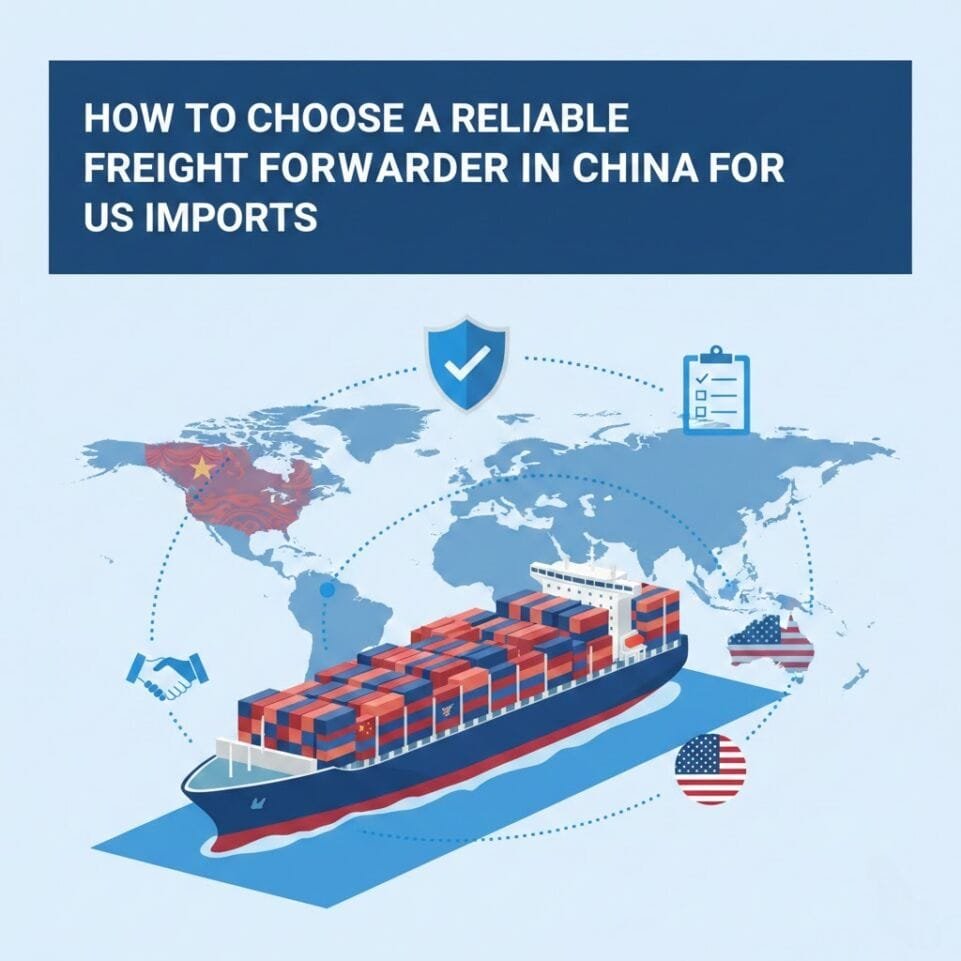
In the high-stakes world of global trade, especially when Importing from China to USA, the distance between a successful shipment and a financial nightmare is often measured by the quality of your logistics partner. Many importers treat shipping as a commodity a line item where the lowest price wins. However, seasoned veterans know that a cheap quote from an unreliable Shipping Agent in China often leads to “hidden costs” that can swallow your entire profit margin.
Choosing a Reliable Shipping Agent in China isn’t just about moving boxes; it’s about risk management. Whether it’s navigating the volatile Sea freight rates, avoiding peak-season congestion at the Port of Los Angeles, or ensuring your cargo doesn’t get stuck in a weeks-long Customs clearance audit, your forwarder is the pilot of your capital.
The Hidden Architect of Your Supply Chain
A China to US Freight Forwarder acts as the essential bridge between your manufacturer’s factory floor and your customer’s doorstep. In the complex logistics corridor between the East and West, they play several critical roles:
The Regulatory Shield: They ensure all Incoterms (International Commercial Terms) are correctly applied, preventing legal disputes between you and your supplier.
The Cost Optimizer: By choosing between Air freight vs Sea freight based on your specific timeline and volume, they balance speed with expenditure.
The Last-Mile Specialist: For e-commerce giants, a forwarder providing FBA prep China and Door to door shipping ensures that products arrive at Amazon warehouses shelf-ready, without you ever touching the inventory.
Understanding the Players: Freight Forwarder vs Shipping Agent
In the logistics world, terms are often thrown around interchangeably, which can lead to confusion for importers. However, understanding the nuance between a Shipping Agent and a Freight Forwarder is crucial for your legal and financial protection.
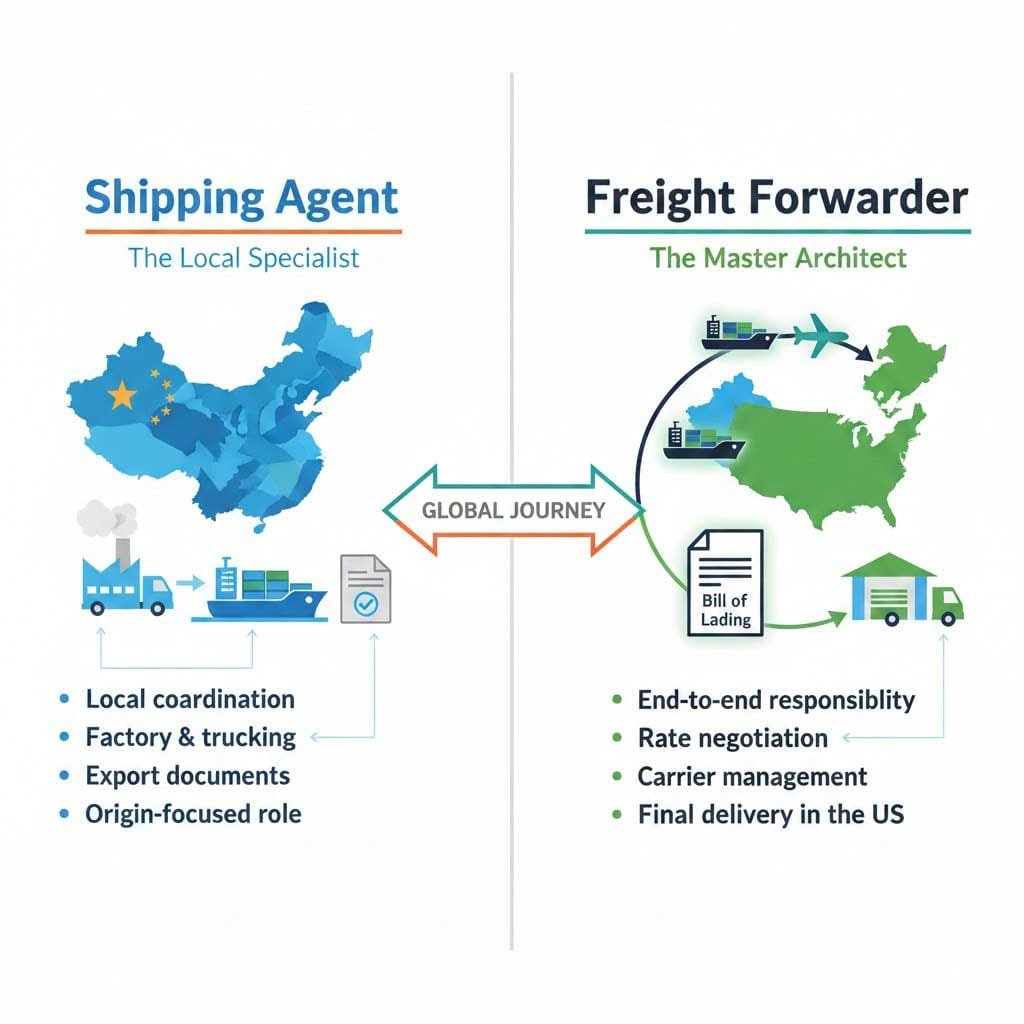
The Shipping Agent: The Local Specialist
A Shipping Agent in China typically acts as a local representative. Their primary focus is on the “ground game” within China. They coordinate with the factory, handle local trucking to the port, and manage the export documentation required by Chinese authorities. Think of them as your eyes and ears at the origin point.
The Freight Forwarder: The Master Architect
A China to US Freight Forwarder has a much broader scope. They take full responsibility for the cargo’s journey from point A to point B. They don’t just book space on a ship; they act as a travel agent for your freight, negotiating rates with carriers, managing the Bill of Lading, and overseeing the transition from ocean or air to the final truck delivery in the US.
| Feature | Shipping Agent | Freight Forwarder |
|---|---|---|
| Primary Focus | Local logistics & Port operations | End-to-end supply chain management |
| Liability | Often limited to local handling | Often issues their own House Bill of Lading |
| Service Scope | Factory pickup & Export docs | Global routing, Customs, & Last-mile |
| Best For | Simple port-to-port moves | Door to door shipping & FBA Prep |
Why the China-USA Route Demands a Specialist
The shipping lane from China to the United States is one of the most complex in the world. Using a generalist instead of a specialist is a gamble you don’t want to take. Here is why you need a dedicated China to US Freight Forwarder:
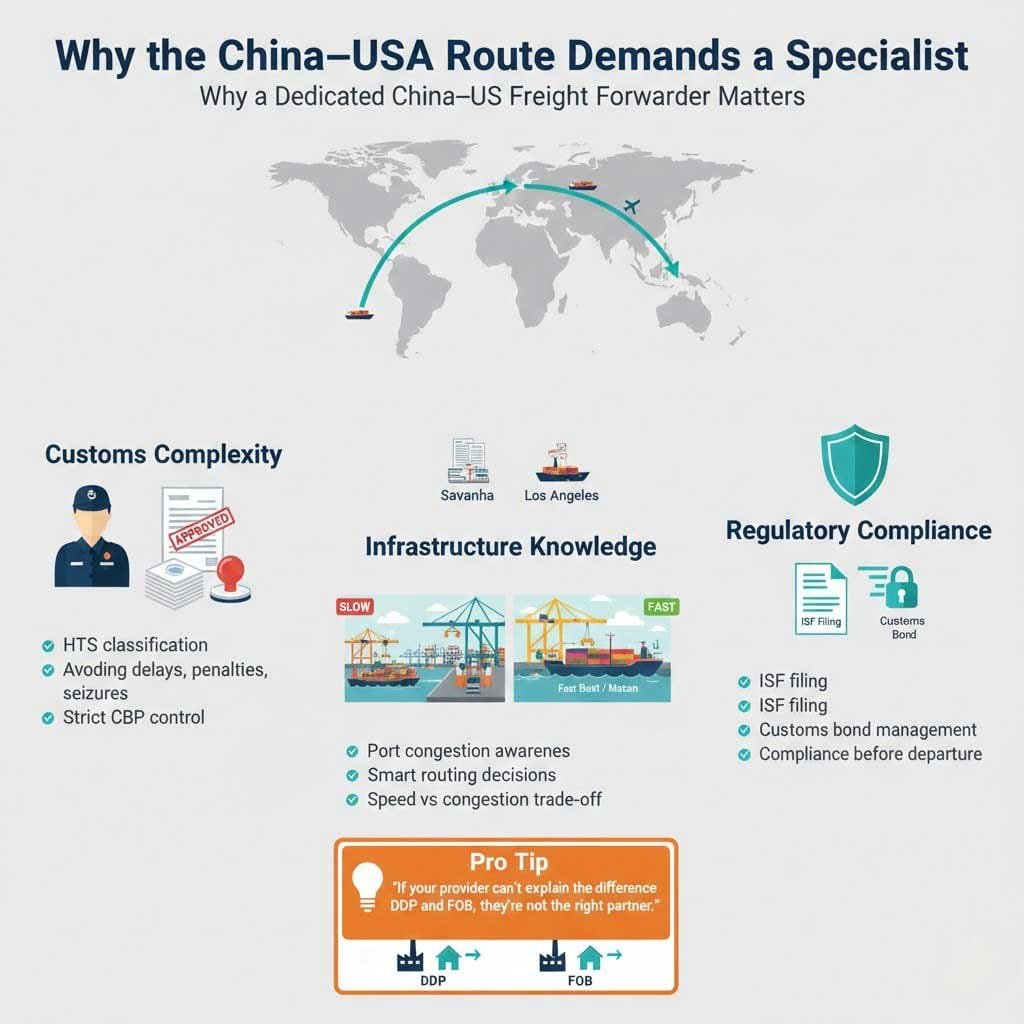
- Customs Complexity: US Customs (CBP) is notoriously strict. A specialist knows exactly how to classify your goods under the Harmonized Tariff Schedule (HTS) to avoid unnecessary duties or seizures at the Port of Savannah or Los Angeles.
- Infrastructure Knowledge: A specialist understands the current congestion levels at West Coast vs. East Coast ports. They might advise you to use “Fast Boat” services like Matson to bypass the chaos at larger terminals.
- Regulatory Compliance: From ISF (Importer Security Filing) to annual Customs Bonds, a specialist ensures you are compliant with US laws before the ship even leaves the Chinese coast.
- Pro-Tip: If your provider cannot explain the difference between DDP (Delivered Duty Paid) and FOB (Free On Board) in their sleep, they aren’t the right partner for your China-USA trade.
The Credibility Audit: How to Vet a China to US Freight Partner
When you are Importing from China to USA, you aren’t just hiring a logistics company; you are hiring a guardian for your capital. A mistake in paperwork or a lapse in licensing can result in thousands of dollars in fines or even the seizure of your goods by CBP (U.S. Customs and Border Protection).
To separate the amateurs from the professionals, you must evaluate three non-negotiable pillars of credibility.
1. Proven Experience in the China-US Lane
The logistics corridor between China and the US is unique due to its massive volume and complex trade regulations. A generalist forwarder might handle European routes well but struggle with the specific demands of China to US Freight.
- Lane Specialization: Ask for case studies involving specific US ports. Does the forwarder understand the difference in “free time” (demurrage) policies at the Port of Los Angeles versus Savannah?
- Commodity Expertise: If you are shipping electronics, toys, or textiles, your forwarder must know the specific safety standards and “Partner Government Agency” (PGA) requirements (like the FDA or FCC) that apply to those goods upon US entry.
2. Licenses & Credentials (The FMC and NVOCC Advantage)
This is the most critical technical check. For any company to legally provide China to US Freight services involving ocean transport, they should hold specific credentials:
- FMC License: The Federal Maritime Commission (FMC) regulates ocean-borne transportation in the US. A reliable forwarder should be a licensed Ocean Freight Forwarder or a registered NVOCC (Non-Vessel Operating Common Carrier).
- NVOCC Status: An NVOCC can issue its own Bill of Lading, giving you more control over the cargo and often more competitive Sea freight rates.
- WCA Membership: Membership in the World Cargo Alliance (WCA) is a strong indicator of financial stability and global networking.
3. A Robust Network of Physical Assets
In global logistics, a “virtual” company is a liability. You need a partner that has “boots on the ground” at both the origin and the destination.
Chinese Presence: Your forwarder should have offices or long-term partners in major hubs like Shenzhen, Ningbo, or Shanghai to coordinate directly with your factory and manage FBA prep China if needed.
US Infrastructure: Once your China to US Freight hits American soil, the journey isn’t over. A partner with a strong US network can secure “chassis” (the trailers used to move containers) during peak season—a common bottleneck that causes massive delays for smaller players.
Featured Snippet: The Forwarder Vetting Checklist
Use this checklist before signing any contract to ensure your shipment is in safe hands:
- Check FMC License: Verify their status on the FMC.gov website.
- Verify Physical Address: Ensure they have a registered office in the US and China, not just a “virtual” presence.
- Ask for a Reference: Request a contact for a current client importing similar goods to yours.
- Incoterm Expertise: Ask them to explain the risk transition point for FOB vs. EXW.
- Customs Bond Assistance: Can they help you secure a Continuous Customs Bond?
Specialized Services: Moving Beyond Standard Logistics
In the competitive landscape of China to US Freight, a “one-size-fits-all” approach often leads to inefficiencies and extra costs. To truly optimize your supply chain, your partner must offer high-value, specialized services that address the specific hurdles of the China-USA trade route.
1. Customs Brokerage Expertise: Your Shield Against Fines
The most critical part of the journey isn’t crossing the ocean; it’s crossing the border. Customs clearance in the US is a legal process governed by the CBP. A professional forwarder provides in-house or closely integrated customs brokerage.
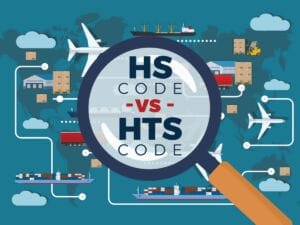
- HS Code Accuracy: Every product has a specific Harmonized System (HS) code that determines its duty rate. An error here can lead to overpaying taxes or, worse, an audit for “misclassification.”
- Bond Management: They should assist you in securing a Continuous Customs Bond, which is mandatory for frequent importers and significantly speeds up the release of your China to US Freight.
- Compliance Guidance: From Section 301 tariffs on Chinese goods to Anti-Dumping duties, a specialist keeps you informed so there are no “surprise” invoices after the goods have landed.
2. Warehousing & Consolidation: Maximizing Every Cent
Many importers buy from multiple manufacturers across China. Shipping five small orders separately is a recipe for financial waste.
- LCL Consolidation: A Reliable Shipping Agent in China will provide warehouse space to collect your goods from different factories (e.g., in Guangzhou and Ningbo) and consolidate them into a single Full Container Load (FCL). This drastically reduces your China to US Freight costs.
- Quality Inspection: Some forwarders offer basic inspection services at the warehouse before the container is sealed—your last chance to catch a mistake before it crosses the Pacific.
3. Amazon FBA Knowledge: The Gold Standard of E-commerce
If you are an e-commerce seller, your China to US Freight must meet Amazon’s notoriously strict requirements. One mistake in labeling can lead to your entire shipment being rejected at the warehouse door.
- FBA Prep China: This includes professional palletizing, applying FNSKU labels, and ensuring cartons meet Amazon’s weight and size limits.
- Direct-to-FBA Shipping: A specialist understands the appointment-based delivery system (Carrier Central) required by Amazon fulfillment centers, ensuring your stock is live and “Prime-ready” without delays.
Strategic Comparison: Which Service Do You Need?
| Feature | Standard Freight | Specialized Logistics |
|---|---|---|
| Customs | Basic filing only | Deep HS Code optimization & Audit protection |
| Sourcing | Single factory pickup | Multi-supplier Consolidation |
| E-commerce | Delivery to a warehouse | FBA Prep & Amazon compliance |
| Efficiency | Slower, manual tracking | Integrated dashboard & automated alerts |
Transparency in Pricing: Avoiding the “Low-Price” Trap
In the China to US Freight industry, the most expensive quote you can receive is often the one that looks the cheapest on paper. Logistics is a business of hard costs—fuel, labor, and port fees. If a quote seems too good to be true, it’s usually because the provider is hiding costs that you will be forced to pay under duress once your cargo is already at sea.
The Danger of “Loss-Leader” Quotes
Some unscrupulous agents offer “teaser rates” to secure your booking. Once your goods are loaded, they may hold your Bill of Lading hostage until you pay “emergency surcharges” or “handling fees” that were never mentioned. A professional China to US Freight partner provides an itemized breakdown, not just a lump sum.
Understanding Potential “Hidden” Costs
To protect your bottom line, you must be aware of these three common cost-drivers that often appear after the initial quote:
- Destination Charges: These are fees incurred once the ship reaches the US. They include DTHC (Destination Terminal Handling Charges), chassis split fees, and warehouse handling. If your quote is only “Port-to-Port,” these costs will be billed to you separately at the destination.
- Demurrage and Detention: If your container sits at the Port of Los Angeles or Savannah longer than the “free days” allowed (usually 4-7 days), you will be charged daily fines. A reliable forwarder helps you plan your trucking in advance to avoid these $200–$500 per day penalties.
- Section 301 Tariffs: Often referred to as “Trump Tariffs,” these are additional duties on many Chinese imports. Your forwarder should proactively inform you if your HS Code falls under these categories, as they can add an extra 7.5% to 25% to your total cost.
Common Red Flags to Watch For
| Red Flag | What it actually means |
|---|---|
| No Itemized Breakdown | They are likely hiding “Destination Charges” to make the initial price look lower. |
| Refusal to share FMC/NVOCC info | They might be an unlicensed “middleman” with no legal standing if things go wrong. |
| Extremely low “All-In” rates | You will likely be hit with “Port Congestion Surcharges” or “Fuel Adjustments” later. |
| Vague transit times | They are probably using a slow “budget” carrier that is prone to 2-3 week delays. |
Pro-Tip: Always ask your agent: “Is this quote inclusive of all destination charges, or is it only for the ocean leg?” Their answer will tell you everything you need to know about their transparency.
Technology & Tracking: Your Eyes Across the Ocean
In the modern era of China to US Freight, information is just as valuable as the cargo itself. The days of “calling and waiting” for an update from your agent are over. For a professional importer, real-time visibility is not a luxury—it is a requirement for managing inventory and customer expectations.
The Importance of 24/7 Real-Time Visibility
When your capital is tied up in a container somewhere in the middle of the Pacific, “blind spots” are your biggest enemy.
A forwarder utilizing modern tracking systems provides you with a digital dashboard that offers:
- Live GPS Tracking: Knowing exactly where the vessel is located between China and the US.
- Milestone Alerts: Automated notifications when your cargo clears Customs or arrives at the Port of Los Angeles.
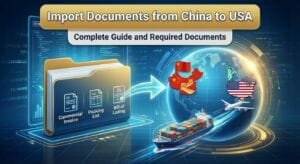
- Document Management: A centralized portal where you can download your Bill of Lading, Commercial Invoice, and Packing List anytime.
Why “Manual Updates” Are a Risk Factor
If your current Shipping Agent in China relies solely on manual emails to give you updates, you are at risk. Manual systems are prone to human error and delays. In contrast, a technology-driven China to US Freight partner integrates directly with carrier data (EDI/API), ensuring that the data you see is the “single source of truth.”
Predictive Analytics: Avoiding the Congestion
The best logistics platforms don’t just tell you where your bar is; they tell you when it might be late. Modern systems analyze port congestion data at hubs like Savannah or New York to predict delays before they happen. This allows you to:
- Adjust Marketing Plans: If a shipment is delayed, you can pause ad spend to avoid “out of stock” issues.
- Optimize Inland Trucking: Schedule your “last-mile” delivery precisely when the container is ready for pickup, avoiding expensive wait times for drivers.
- Consultant’s Note: In your next meeting with a potential forwarder, ask to see a demo of their client portal. If they don’t have one, they aren’t equipped to handle the fast-paced demands of 2026 global trade.
Final Checklist for Your Next Shipment
To wrap up this guide, remember these core pillars for a successful China to US Freight experience:
- Verify Credentials: Ensure they have an FMC license and NVOCC status.
- Demand Transparency: Get an itemized quote that includes Destination Charges.
- Prioritize Tech: Choose a partner with a digital tracking platform.
- Compliance First: Ensure they are experts in US Customs (CBP) regulations.
Conclusion: Securing Your Supply Chain for Long-Term Success
Navigating the complexities of China to US Freight is a journey that requires more than just a boat and a box. As we have explored, the difference between a profitable venture and a logistical nightmare lies in the details: the FMC licensing, the accuracy of HS Codes, and the transparency of the pricing model.
By moving away from “cheap” teaser rates and toward a partnership built on expertise and technology, you protect your margins and your brand’s reputation. Remember, a Reliable Shipping Agent in China is not an expense—they are an investment in your business’s scalability.