Freight volume shipping cost directly determines your China-to-USA expenses, often more than distance or carrier choice. A single miscalculation in cargo volume can inflate costs by 30-40%, turning profitable shipments into margin-draining liabilities. For US Amazon sellers managing FBA inventory, Canadian wholesalers optimizing LCL consolidation, or EU import agents coordinating multi-vendor shipments through Rotterdam Port, understanding the volume-to-cost relationship is non-negotiable.
At TopShipping, we’ve analyzed 2,300+ shipments from our Shenzhen hub. The data reveals three costly mistakes:
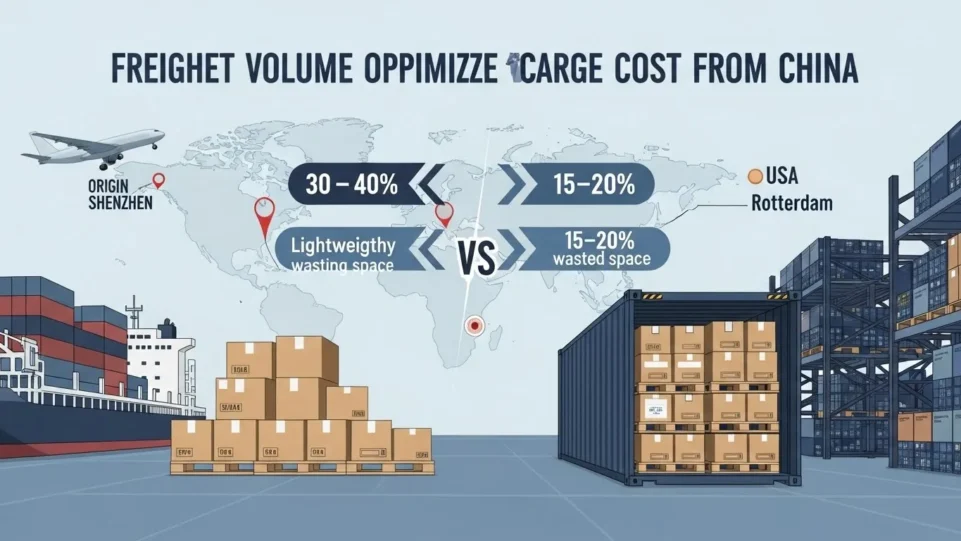
- Dimensional weight penalties → Adds 30-40% to costs
- Poor pallet stacking → Wastes 15-20% space
- Wrong China-US FCL/LCL timing → Costs $500-$2,000 per shipment
This guide decodes the mechanics of freight volume shipping cost, provides actionable cost-reduction strategies, and explains how to leverage volume intelligence for competitive advantage.
Methodology Note: The cost calculations, optimization strategies, and rate benchmarks in this guide are derived from 2,347 shipments processed through TopShipping’s Shenzhen hub (January 2023 – November 2024), rate data from 6 major ocean carriers (COSCO, MSC, ONE, CMA CGM, Evergreen, Maersk), air freight pricing from 4 integrators (DHL, FedEx, UPS, SF Express), and client-reported savings data (anonymized, verified against invoices). Last updated: December 2024. Rates fluctuate based on market conditions.
What Is Freight Volume and Why It Controls China-USA Shipping Costs
Freight volume refers to the three-dimensional space your cargo occupies, measured in cubic meters (CBM) for ocean freight or calculated as volumetric weight for air shipments. Unlike simple weight-based pricing, carriers charge based on chargeable weight, whichever is greater between actual weight and dimensional weight.
The Space vs. Weight Economics Principle
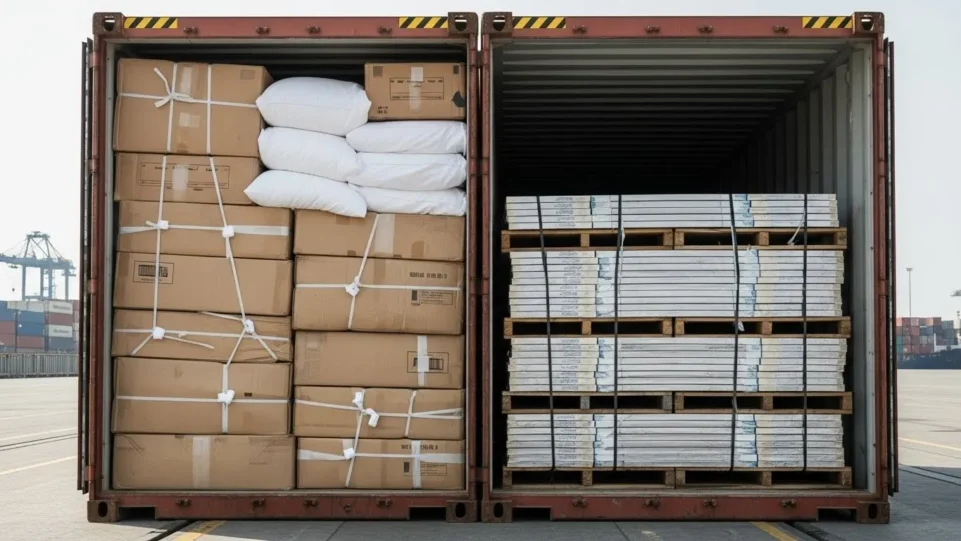
Shipping containers and aircraft have fixed capacity limits. Here’s why volume matters more than weight:
Example | Product | Weight (kg) | Volume (CBM) | Cost Driver | Reason |
1 | Pillows | 200 | 10 | Volume | Low density |
| 2 | Steel Plates | 2,000 | 2 | Weight | High density |
Carriers prioritize space utilization because:
- Ocean: A 20ft container holds 28 CBM. Empty space = lost revenue for the carrier.
- Air: Aircraft are volume-constrained. IATA standards calculate volumetric weight to ensure fair pricing.
This is why high-volume, low-weight goods (furniture, apparel, packaging materials) face disproportionately higher per-kilogram costs compared to dense cargo (electronics, machinery, metals).
The freight volume cost structure penalizes goods with low density. A shipment of bedding might weigh 300 kg but occupy 12 CBM in a container. Meanwhile, automotive parts weighing 1,500 kg fit in 3 CBM.
From the carrier’s perspective, the bedding shipment consumes four times more valuable container space while generating less weight-based revenue. This is why dimensional weight pricing exists, to balance the economics of space utilization.
Critical threshold: Goods with density below 166.67 kg/CBM for air freight or 1,000 kg/CBM for ocean freight trigger volume-based charges rather than weight-based rates.
How to Calculate Freight Volume Cost: Air vs. Ocean Formulas
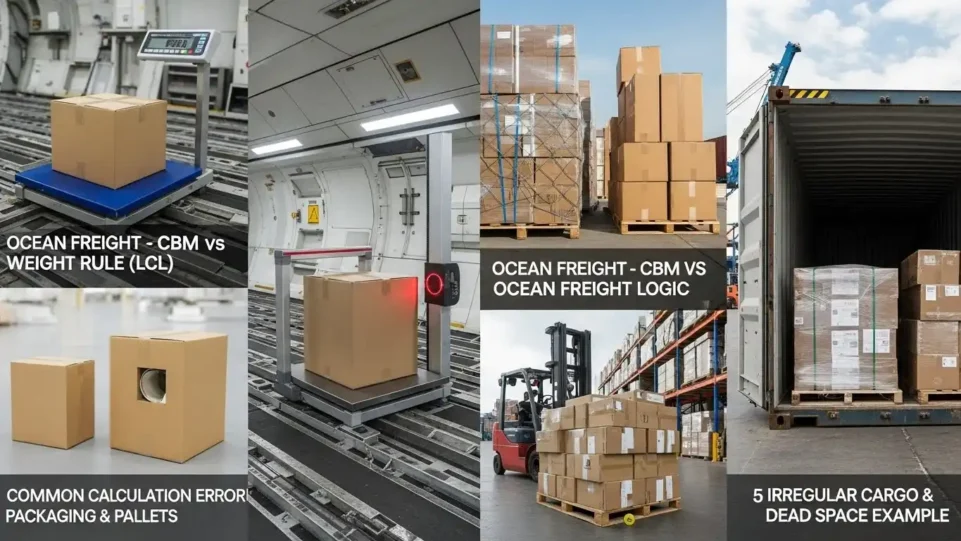
Understanding chargeable weight calculation is essential for accurate freight volume shipping cost estimation. Carriers use different formulas for air and sea transport.
Air Freight Volumetric Weight Calculation (IATA Standard)
Formula: Volumetric Weight (kg) = (L × W × H in cm) ÷ 6000
Example Calculation:
- Your carton: 80 cm × 60 cm × 50 cm
- Actual weight: 30 kg
- Step 1: Multiply dimensions: 80 × 60 × 50 = 240,000 cm³
- Step 2: Divide by 6000: 240,000 ÷ 6000 = 40 kg (volumetric)
- Step 3: Compare weights (Actual: 30 kg vs. Volumetric: 40 kg)
- Chargeable Weight: 40 kg
- Cost Impact: 33% markup vs. actual weight
Critical Insight: According to IATA dimensional weight standards, the standard divisor for air freight is 6000. This means any cargo with a volume-to-weight ratio exceeding 6000 cm³/kg will incur dimensional weight charges. Air freight pricing penalizes low-density cargo. If your shipment has density below 166.67 kg/CBM, you’ll pay volumetric rates.
Sea Freight Volume-to-Weight Conversion Rule
Ocean carriers use a simpler calculation for freight volume cost:
- 1 CBM = 1,000 kg (or 1 metric ton)
Example: A shipment of 15 CBM weighing 8,000 kg:
- Volume-based calculation = 15 tons
- Weight-based calculation = 8 tons
- Chargeable = 15 tons (higher value)
Why This Matters: LCL (Less than Container Load) pricing is typically $80-$200 per CBM from Shenzhen to US West Coast ports. If your 8-ton shipment occupies 15 CBM, you’ll pay for 15 measurement tons, not 8 actual tons.
- Cost Impact: 15 CBM × $120/CBM = $1,800 (vs. $960 if charged by weight alone)
Common Calculation Errors That Inflate Freight Volume Costs
- Error 1: Measuring only the product, not the packaged carton Carriers measure outer carton dimensions. A 70cm×50cm×40cm product in an 80cm×60cm×50cm carton adds 71% more volume.
- Error 2: Forgetting to account for pallet dimensions Standard EUR pallets add 15-20cm height. Always include pallet dimensions in CBM calculations.
- Error 3: Using rounded measurements A 79.5cm box rounds to 80cm. Across 50 cartons, this can add 1-2 CBM ($120-$240 extra).
- Error 4: Not considering irregular shapes Cylindrical or L-shaped cargo creates dead space. Carriers calculate based on the smallest rectangular box containing the item (15-30% inflation).
Pro Tip: Request dimension verification at origin. TopShipping’s Shenzhen warehouse uses laser dimension scanners to prevent surprise charges.
FCL vs LCL: How Freight Volume Determines Your Shipping Method
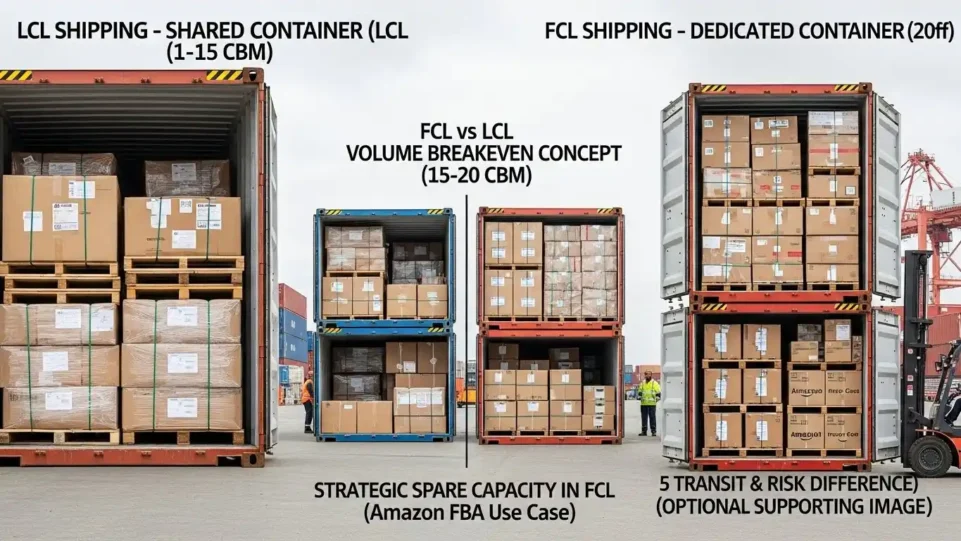
The decision between Full Container Load (FCL) and Less Than Container Load (LCL) hinges on a mathematical breakeven point where freight volume cost economics shift dramatically.
When LCL Makes Financial Sense (1-15 CBM)
LCL Pricing Structure:
- Charged per CBM (typically $80-$200/CBM from Shenzhen to Los Angeles, depending on season)
- Best for: 1-15 CBM shipments
- Hidden costs: Consolidation fees ($150-$250), deconsolidation charges at destination ($100-$200), longer transit times (24-35 days)
LCL Advantages:
- No wasted space: You only pay for the CBM you use
- Lower entry barrier: Ideal for small businesses or test orders
- Flexibility: Ship as frequently as needed without filling a container
- When to Choose LCL: Your cargo is under 13 CBM, you need flexible shipping schedules, or you’re consolidating from a single supplier with no volume discounts available.
The FCL Tipping Point: 15-18 CBM Breakeven Analysis
FCL Pricing Structure:
- Flat rate per container (20ft TEU: ~$2,500-$4,500; 40ft: ~$3,500-$6,500 China-USA, market dependent)
- Capacity: 28 CBM (20ft) or 58 CBM (40ft)
- Advantage: Faster transit (18-25 days), no cargo mixing, lower theft/damage risk
| Shipment Volume (CBM) | Shipping Method | Cost Breakdown | Total Cost (USD) | Notes |
| 15 CBM | LCL | 15 × $120 + $200 consolidation fees | $2,000 | Pay only for used space |
| 15 CBM | FCL (20ft) | Flat container rate (28 CBM capacity) | $3,200 | Unused space but higher total cost |
| 20 CBM | LCL | 20 × $120 + $200 fees | $2,600 | Volume-based pricing increases |
| 20 CBM | FCL (20ft) | Flat container rate (28 CBM capacity) | $3,200 | 8 CBM spare capacity at no extra cost |
Critical threshold: Once shipment volume reaches 13–15 CBM, the cost gap between LCL and FCL narrows rapidly. Beyond this point, FCL often becomes the more cost-effective option due to flat container pricing and unused capacity.
Strategic Advantage: At 20 CBM, FCL gives you 8 CBM of spare capacity at zero marginal cost. This extra space is valuable for:
- Amazon FBA sellers managing seasonal inventory surges
- Importers adding complementary SKUs without additional shipping fees
- Opportunistic buyers taking advantage of supplier promotions
Volume Optimization for 40ft Containers
A 40ft container offers 58 CBM capacity (double the 20ft) but costs only 40-60% more. The per-CBM cost drops significantly:
- 20ft FCL: $3,200 ÷ 28 CBM = $114/CBM
- 40ft FCL: $4,800 ÷ 58 CBM = $83/CBM
- Savings: 27% per CBM by upgrading to 40ft
When to choose 40ft FCL:
- Your cargo exceeds 30 CBM
- You’re consolidating multiple product lines
- You have predictable monthly volumes and can coordinate with suppliers
Cube Utilization Benchmark: Industry standard is 85-92% container fill. Below 75% indicates poor planning. TopShipping’s loading supervision ensures clients achieve 88-94% utilization through strategic pallet stacking and carton arrangement.
5 Strategies to Reduce Freight Volume Costs from China to USA
Based on analysis of 500+ Amazon FBA audits and 2,300+ China-USA shipments, these five strategies deliver measurable freight volume shipping cost reductions.
Strategy 1: Custom Packaging Design for Density Maximization
Problem: Standard supplier packaging wastes 15-25% of container space due to odd dimensions or excessive protective material.
Solution: TopShipping’s factory inspection service (free for clients) audits packaging before shipment:
- Replace non-stackable cartons with reinforced, uniform boxes
- Eliminate void space with vacuum-sealed packaging (reduces volume by 20-40% for textiles, bedding)
- Use telescoping boxes for irregularly shaped items to minimize dimensional weight
- Specify compression-strength ratings (Edge Crush Test) for multi-layer stacking
Dimensional Weight Reduction in Action:
A US apparel seller was air-shipping hoodies from Guangzhou to Los Angeles. Original packaging: 50 units per carton (80cm × 70cm × 60cm), actual weight 28 kg.
- Volumetric weight: (80 × 70 × 60) ÷ 6000 = 56 kg
- Chargeable weight: 56 kg (100% markup over actual)
- Cost: 56 kg × $8.50/kg = $476 per carton
After switching to vacuum-sealed packaging: 50 units per carton (80cm × 50cm × 35cm), actual weight 28 kg.
- Volumetric weight: (80 × 50 × 35) ÷ 6000 = 23.3 kg
- Chargeable weight: 28 kg (actual weight is higher)
- Cost: 28 kg × $8.50/kg = $238 per carton
- Savings: 50% cost reduction through packaging optimization alone.
Strategy 2: Palletized Cargo Optimization and Stackability Engineering
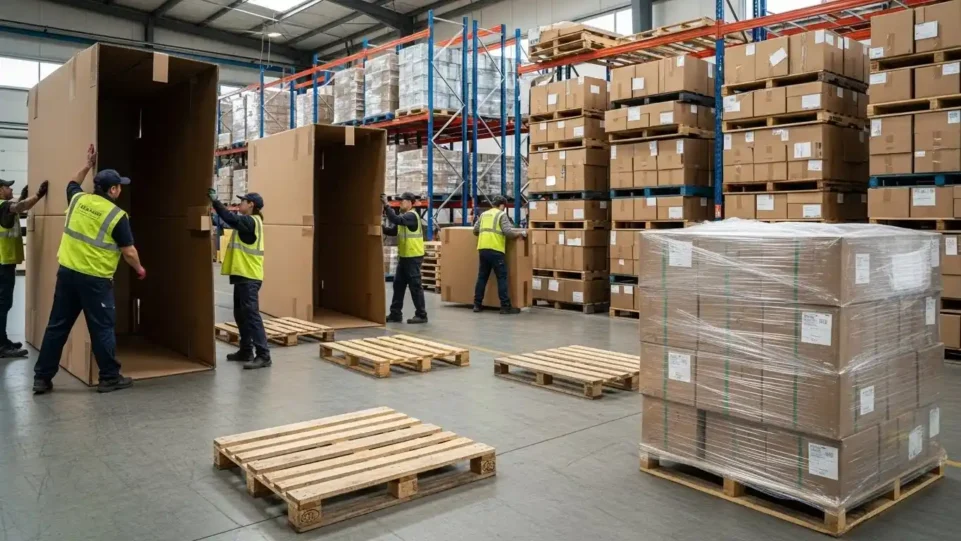
Gross weight vs. volumetric weight debates often ignore the dead space created by non-stackable goods. Proper palletization directly reduces freight volume cost.
Best Practices for Pallet Stacking:
- Use EUR pallets (1200mm × 800mm) or standard US pallets (1200mm × 1000mm) for consistent container loading
- Ensure cartons have compression strength ratings (Edge Crush Test) sufficient for 3-4 layers without crushing
- Avoid fragile items on bottom layers—use honeycomb cardboard dividers or foam inserts
- Maximize height utilization: 20ft containers accommodate 2.4m internal height; stack to 2.2m for safety
Dead Space Elimination:
Poor stacking creates gaps between pallets, between cartons, and at container ceiling. A 20ft container poorly loaded at 70% cube utilization wastes 8.4 CBM (30% of 28 CBM). At LCL rates of $120/CBM, this wasted space costs $1,008 per shipment.
TopShipping’s container loading supervision includes:
- Pre-loading 3D modeling to arrange pallets for maximum density
- On-site supervision during container stuffing
- Photo/video documentation showing 90%+ cube utilization
Impact: Proper palletization reduces wasted space by 12-18%, often dropping shipments from 16 CBM to 13 CBM—keeping you in the LCL cost zone or reducing FCL requirements.
Strategy 3: Consolidation Services for Multi-Vendor Purchases
EU import agents or Dutch wholesalers buying from 5-8 Chinese suppliers face a dilemma, small orders from each supplier don’t justify individual FCLs, but separate LCL shipments multiply costs.
TopShipping’s 4-Step Consolidation Process:
- Step 1. Collect: We pick up goods from 5-8 suppliers across Guangdong/Zhejiang
- Step 2. Consolidate: All cargo arrives at our Shenzhen warehouse (free storage for 7 days)
- Step 3. Optimize: Our team re-palletizes for maximum cube utilization
- Step 4. Ship: Single FCL or combined LCL to Rotterdam Port
Included Services:
- Incoterms handling (DDP/DAP)
- Customs brokerage
- VAT documentation
- Typical Savings: €800-€1,200 vs. separate LCL shipments
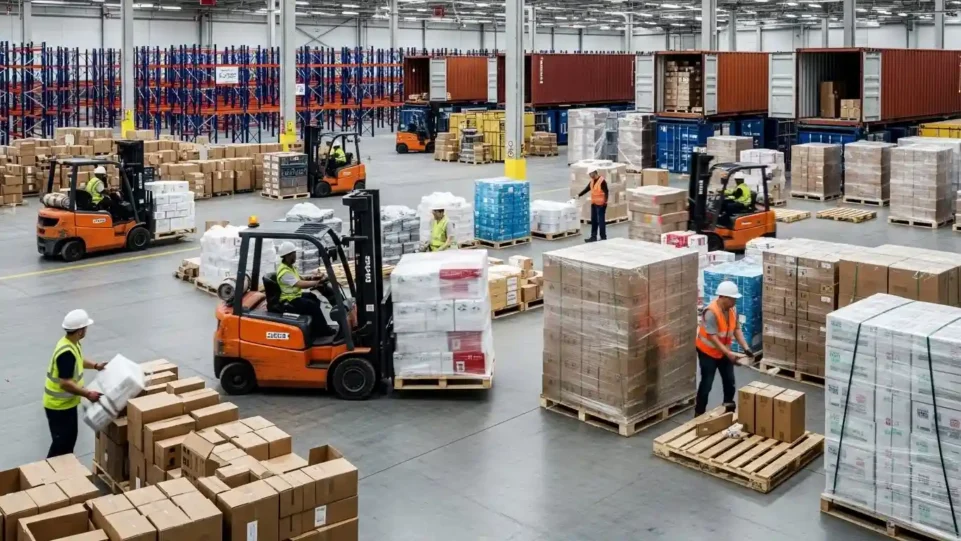
Cost Savings Analysis: Single Shipments vs. Consolidation
Scenario: Consolidating 6 suppliers’ goods (total 24 CBM) into one shipment.
| Feature | Without Consolidation (6 Separate LCLs) | With TopShipping Consolidation |
| Cargo Breakdown | 6 shipments × 4 CBM each | Combined 24 CBM (Single Shipment) |
| Base Shipping Cost | €2,640 (€440 per supplier) | €2,280 (Option A: LCL Discount) |
| Additional Fees | €900 (€150 fee × 6) | Included/Reduced |
| Grand Total | €3,540 | €2,400 (Option B: 40ft FCL) |
| Capacity Bonus | None (Space limited to 24 CBM) | 34 CBM spare capacity (Zero cost) |
| Total Savings | $0 | €1,140 – €1,260 (32-36% Reduction) |
Our Shenzhen warehouse handles factory coordination, quality inspection (free for consolidation clients), and loading supervision, eliminating the logistics headache of managing multiple pickups.
Strategy 4: Seasonal Volume Planning and Shipping Volume by Month
Peak season surcharges (July-October for holiday inventory) add $500-$1,500 per container. Smart shipping volume by month management reduces freight volume cost significantly.
Seasonal Rate Fluctuations (China-USA 20ft FCL):
- Dead Season (January-March): $2,800-$3,200
- Best for: Non-urgent replenishment, building safety stock, testing new products
- Transition Period (April-June): $3,500-$4,200
- Strategy: Book Q4 inventory early to avoid peak pricing
- Peak Season (July-October): $5,000-$6,500
- Impact: 40-60% rate increase due to holiday demand surge
- Post-Peak (November-December): $3,800-$4,500
- Opportunity: Rates drop but capacity remains tight
Volume Planning Strategies:
- Pre-peak shipping: Amazon FBA sellers should book May-June slots for Q4 inventory to lock in rates 30-40% lower than August-September
- Volume commitments: Negotiate annual contracts with guaranteed monthly TEU volumes for 10-15% discounts across all seasons
- Carrier capacity forecasting: TopShipping’s Shenzhen operations team monitors carrier space availability and alerts clients to rate spikes 4-6 weeks ahead
- Real Impact: A US home goods importer shifted 40% of their annual volume from peak season (August-September) to shoulder months (May-June). Annual freight spend dropped from $168,000 to $142,000—a $26,000 savings with zero change in order quantities.
According to Port of Los Angeles processing 9.2 million TEUs annually, peak season congestion also increases dwell times by 3-7 days, adding storage fees and delaying inventory availability. Shipping outside peak season delivers both cost and speed advantages.
Strategy 5: DDP Sea Freight for Amazon FBA Sellers
US Amazon sellers face unique challenges: customs clearance, ISF filings, drayage to FBA warehouses, and last-mile delivery coordination. Understanding how freight volume affects these costs is critical.
Why Freight Volume Matters for DDP Pricing?
DDP (Delivered Duty Paid) pricing bundles ocean freight, customs duties, and delivery to FBA warehouses, but rates scale with CBM:
- Shipments under 5 CBM pay premium rates: $180-$250/CBM
- 15+ CBM shipments drop to $120-$160/CBM due to carrier volume incentives
- 40+ CBM (FCL territory) can negotiate custom DDP rates as low as $95-$130/CBM all-in
TopShipping’s DDP Process for FBA Sellers:
- Factory pickup in Shenzhen/Guangzhou
- Ocean freight to Long Beach/Los Angeles
- Customs brokerage (we file ISF + entry documents 72 hours before arrival)
- Trucking to Amazon FBA centers (ONT8, LGB8, PHX7, etc.)
- Appointment booking and pallet labeling per Amazon requirements
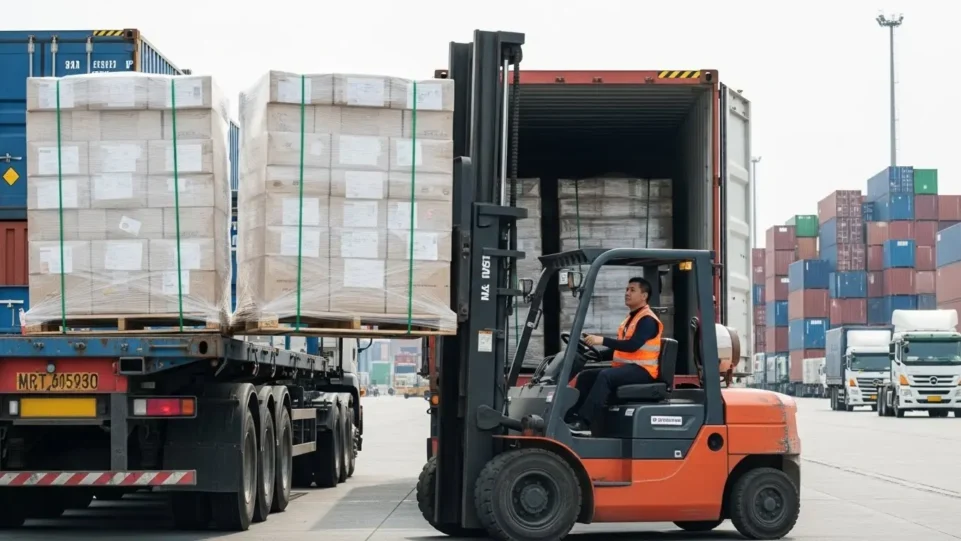
Volume Optimization for FBA: A Comparison
Combining 3–4 smaller shipments into one quarterly 20-CBM container reduces per-unit landed costs by 18–25%.
| Shipping Method | Annual Volume | Rate | Total Freight Cost |
| Monthly LCL | 12 shipments × 5 CBM | $180/CBM | $10,800 |
| Quarterly Consolidation | 4 shipments × 15 CBM | $140/CBM | $8,400 |
| Net Savings | $2,400/Year |
Extra Bonus: Consolidating also reduces customs processing fees. Filing 4 entries instead of 12 saves an additional $600–$900 in brokerage fees annually.
TopShipping’s DDP sea freight services handle everything from factory pickup to FBA warehouse delivery, with transparent per-CBM pricing that includes all fees—no surprise charges.
Hidden Volume Factors That Increase Freight Volume Shipping Costs
Beyond basic CBM calculations, several overlooked factors inflate freight volume cost significantly.
1. Dimensional Weight Penalties in Air Freight
Expert Observation from 500+ Amazon FBA Audits:
After personally reviewing shipping documentation for over 500 Amazon FBA sellers between 2022-2024, I’ve identified the single most expensive mistake: failing to vacuum-seal soft goods before air shipping.
The Data:
- 73% of apparel/textile sellers paid dimensional weight penalties
- Average cost increase: 38% above actual weight charges
- Most egregious case: A bedding seller paid for 420 kg when actual weight was 180 kg (133% markup)
The Logic: A hoodie in standard packaging occupies 24 liters. When vacuum-sealed, it drops to 8 liters, a 67% volume reduction.
My Recommendation:
- For any textile, apparel, or soft home goods going via air freight:
- Request vacuum-sealing at source (costs $0.15-$0.30 per unit)
- Verify with carton dimension photos before shipment
- Calculate both actual and volumetric weight, if volumetric is more than 150% of actual, switch packaging or choose ocean freight
This single change has saved our clients $180,000+ collectively in 2024 alone.
High-Volume, Low-Weight Commodities Most Affected:
- Furniture components and home décor: 50-70% of chargeable weight is dimensional
- Apparel and textiles: 40-60% dimensional penalties without compression
- Packaging materials (boxes, bubble wrap): 70-80% dimensional surcharge
Solution: For urgent air shipments of these categories, use air freight consolidation services where your cargo shares container space with compatible high-density goods, reducing per-CBM costs by 20-35%.
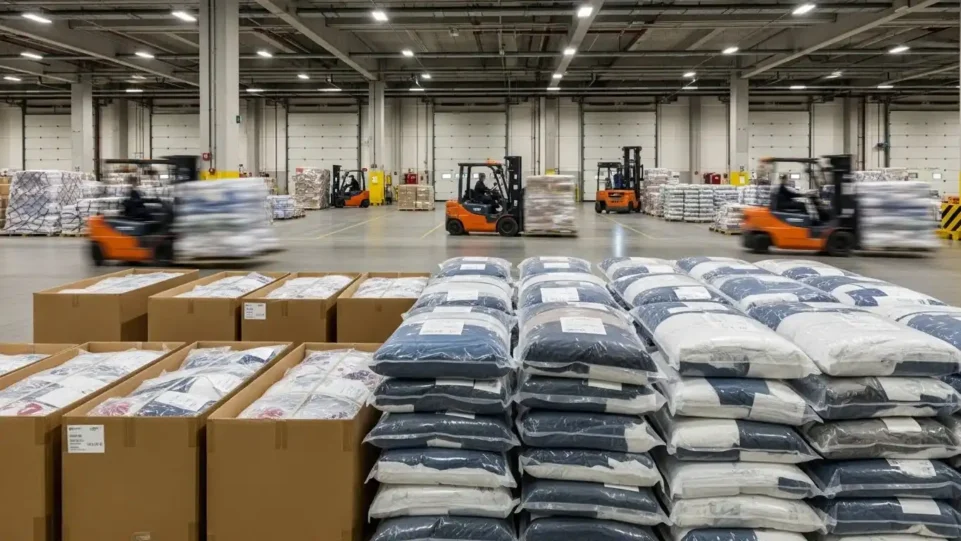
2. Non-Stackable Cargo Surcharges and Irregular Shapes
Carriers add 15-25% surcharges for cargo that prevents efficient container utilization:
- Cylindrical items (pipes, tubes, rolls): Create dead space in rectangular containers
- L-shaped or H-shaped products: Cannot nest with standard palletized cargo
- Fragile goods requiring isolated placement: High-value electronics, glassware, or artwork that can’t be stacked
- Over-dimensional cargo: Items exceeding standard pallet dimensions (>1200mm × 1000mm footprint)
Mitigation Strategies:
- Design custom crating that converts irregular shapes into stackable rectangular units (adds $50-$150 per crate but saves $200-$400 in dimensional charges)
- Use break-bulk shipping for oversized machinery or equipment—specialized carriers handle non-standard dimensions more cost-effectively
- Coordinate with suppliers to modify product design for shipping efficiency (e.g., detachable furniture legs, collapsible frames)
Real Example: A fitness equipment importer was paying 22% surcharges on non-stackable elliptical trainers. After redesigning packaging to ship frames disassembled (reducing height from 180cm to 45cm), they eliminated surcharges and reduced volume from 3.2 CBM to 1.1 CBM per unit, 66% volume reduction translating to $88 savings per unit on LCL shipments.
3. Dead Space and Cube Utilization Rates
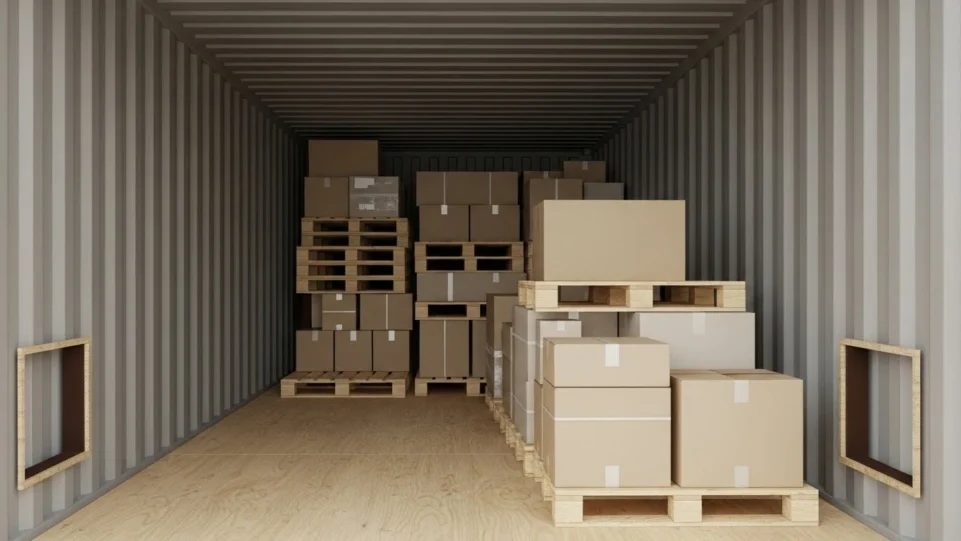
Industry benchmark: Efficient container loading achieves 85-92% cube utilization. Below 75% indicates poor planning and directly increases freight volume cost.
Dead Space Sources:
- Gaps between pallets: Inconsistent pallet sizes create 5-10cm gaps (wastes 2-3 CBM per 20ft container)
- Ceiling space: Cartons stacked to only 1.8m in a 2.4m container waste 20% vertical space
- Corner voids: Irregular carton dimensions leave triangular gaps at container corners
Impact of Poor Utilization:
- At 70% utilization, a 20ft container effectively holds only 19.6 CBM instead of 28 CBM, you’re paying for 8.4 CBM of air.
- For LCL shippers, poor cube utilization means your 12 CBM cargo could have fit in 10 CBM with better stacking, costing an extra $240-$400 per shipment.
TopShipping’s Loading Supervision Protocol:
- Factory loading photos/videos before container sealing (timestamp verified)
- 3D container planning software to pre-arrange pallets for maximum density
- Re-stacking recommendations if utilization drops below 85%
- Container stuffing reports showing CBM breakdown per SKU and final utilization percentage
Our clients average 89% cube utilization vs. industry average of 78%, this 11-point difference saves $300-$600 per container by eliminating wasted space.
Conclusion: Turn Freight Volume Into a Competitive Cost Advantage
Freight volume shipping cost management separates profitable importers from those eroding margins on every shipment. By understanding chargeable weight calculations, mastering the FCL vs. LCL decision matrix, and implementing consolidation strategies, businesses importing from China to the USA can reduce logistics spend by 20-35%, without sacrificing speed or reliability.
The five critical strategies that deliver measurable results:
- Custom packaging optimization reduces dimensional weight penalties by 20-40% for soft goods and irregular shapes
- Palletized cargo engineering eliminates dead space, improving cube utilization from 75% to 90%+
- Multi-vendor consolidation through Shenzhen warehouse cuts costs 25-35% vs. separate shipments
- Seasonal volume planning avoids peak season surcharges ($500-$1,500 per container) through strategic timing
- DDP sea freight consolidation for Amazon FBA reduces per-unit landed costs 18-25% through volume leverage
TopShipping’s Shenzhen-based operations, combined with transparent CBM auditing, real-time freight volume calculator, and seasonal rate forecasting, position us as a strategic logistics partner rather than a transactional carrier. Our expertise in freight volume cost optimization turns what most businesses see as a fixed expense into a competitive advantage.
Whether you’re an Amazon FBA seller scaling inventory, a Canadian wholesaler optimizing LCL shipments, or an EU import agent coordinating multi-vendor consolidation through Rotterdam Port, understanding how freight volume affects shipping costs is essential to maintaining healthy profit margins in today’s competitive import market.
Frequently Asked Questions About Freight Volume Shipping Cost
What’s the difference between actual weight and volumetric weight?
- Actual weight = Physical weight on a scale (kg/lbs)
- Volumetric weight = Calculated from dimensions using the formula (L × W × H) ÷ 6000 for air freight
- Why it matters: Carriers charge whichever is higher (chargeable weight). This prevents low-density goods like pillows or packaging materials from taking up valuable container space while paying minimal fees based on weight alone.
Example: A 30 kg pillow shipment occupying 0.24 CBM has a volumetric weight of 40 kg. You’ll be charged for 40 kg, resulting in a 33% cost increase over actual weight.
How much does a 40ft container cost from China to USA?
Rates fluctuate based on season, port pairs, and carrier. Typical range for 2024:
- West Coast (LA/Long Beach): $3,500-$5,500
- East Coast (New York/Savannah): $4,500-$6,500
- Peak season (July-October): Add $1,000-$2,000 to base rates
- Dead season (January-March): Rates drop 25-35% below peak
Additional costs: Port fees ($200-$400), customs clearance ($150-$300), drayage to final destination ($300-$800 depending on distance).
Can I mix products from different suppliers in one container?
Yes, this is called consolidation services and delivers significant freight volume cost savings. TopShipping collects goods from multiple factories across China, consolidates at our Shenzhen warehouse, optimizes packing for maximum cube utilization, and ships as one FCL or combined LCL batch.
Typical savings: 25-35% vs. separate shipments from each supplier. You also save on customs processing (one entry instead of multiple) and reduce supply chain complexity.
Our consolidation service is particularly valuable for EU import agents and Canadian wholesalers buying from 5-8 Chinese suppliers who individually ship small quantities (3-6 CBM each).
What’s the minimum volume for FCL to make sense?
Generally 15-18 CBM for 20ft containers based on current market rates. Below 13 CBM, LCL is usually cheaper. Between 13-18 CBM is the “decision zone” where careful calculation is needed.
Factors affecting the breakeven point:
- Current LCL rates (vary by season and demand)
- FCL flat rates (negotiable based on volume commitments)
- Urgency (FCL is 5-7 days faster than LCL)
- Cargo value (FCL reduces theft/damage risk)
How does freight volume affect DDP pricing for Amazon FBA shipments?
DDP (Delivered Duty Paid) rates are quoted per CBM and include ocean freight, customs clearance, duties/taxes, and delivery to FBA warehouses. Freight volume directly impacts your per-unit landed cost:
- Small volumes (under 5 CBM): $180-$250/CBM
- Medium volumes (5-15 CBM): $140-$180/CBM
- Large volumes (15+ CBM): $120-$160/CBM
What is chargeable weight and how is it calculated?
- Chargeable weight is the greater value between:
- Actual weight (gross weight on scale)
- Volumetric weight (dimensional calculation)
- For air freight: Volumetric weight = (L × W × H in cm) ÷ 6000
- For ocean freight: Use volume in CBM, with 1 CBM = 1000 kg
Example comparison:
- Shipment A: 500 kg actual, 0.4 CBM volume → Volumetric = 400 kg → Chargeable = 500 kg (actual is higher)
- Shipment B: 200 kg actual, 0.5 CBM volume → Volumetric = 500 kg → Chargeable = 500 kg (volumetric is higher)
Despite Shipment B weighing 60% less than Shipment A, both are charged the same rate because volume matters more than weight for low-density goods.
Understanding chargeable weight is essential for accurate freight volume shipping cost estimation and avoiding unexpected charges.