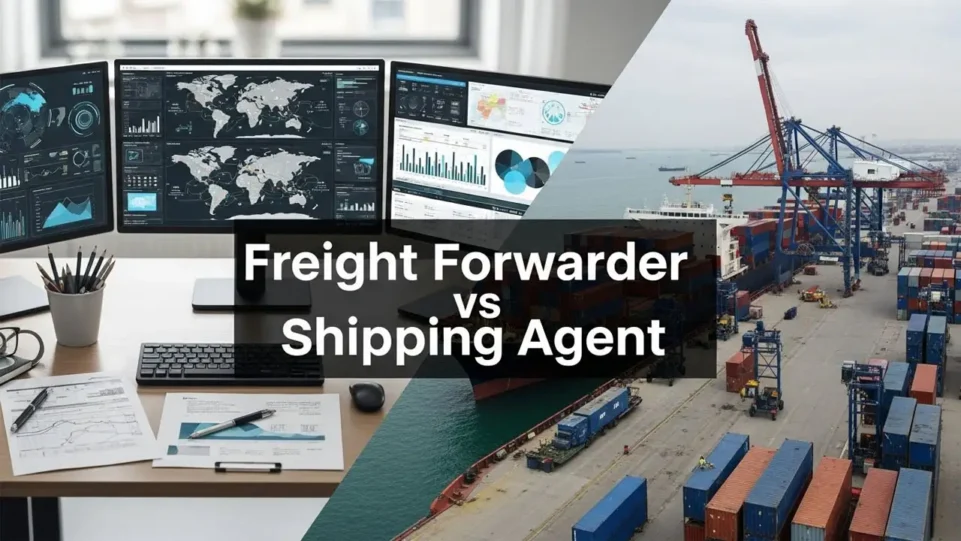
In the complex world of international shipping and global logistics, two terms frequently cause confusion: freight forwarder and shipping agent. While both play critical roles in moving cargo across borders, their responsibilities, scope of work, and the parties they represent differ significantly. Understanding these distinctions is essential for businesses engaged in cross-border shipping, whether you’re importing goods from China to the United States or managing a global supply chain.
This comprehensive guide breaks down the core differences between a freight forwarder vs shipping agent, explores their operational workflows, and helps you determine which service provider your business needs for optimal supply chain management.
Understanding the Core Definitions: Freight Forwarder vs Shipping Agent
Who Is a Freight Forwarder?
A freight forwarder is a third-party logistics (3PL) provider that acts as an intermediary between shippers and various transportation services. Freight forwarders organize and coordinate the entire shipment process on behalf of the cargo owner, handling everything from documentation services to customs clearance and final delivery coordination.
The freight forwarder represents the shipper’s interests and takes responsibility for moving cargo from origin to destination. They don’t own vessels or aircraft but leverage relationships with ocean carriers, shipping lines, and other freight carriers to secure space and competitive freight rates for their clients.
Key responsibilities of freight forwarders include:
- Cargo consolidation and LCL shipping services
- Booking space with ocean carriers for FCL shipping or air freight
- Preparing export documentation and import documentation
- Customs brokerage and customs compliance
- Arranging freight insurance and cargo insurance
- Coordinating door-to-door shipping and last mile delivery
- Managing warehousing services and inventory management
- Providing shipment visibility through real-time tracking systems
- Handling freight settlement, demurrage charges, and detention charges
Many freight forwarders also function as NVOCC (Non-Vessel Operating Common Carrier), meaning they issue their own House Bill of Lading (HBL) and assume carrier liability without operating vessels themselves.
What Is a Shipping Agent?
A shipping agent, also known as a ship’s agent or vessel agent, represents the shipowner’s or vessel operator’s interests at ports. Their primary focus is facilitating port operations and ensuring the vessel completes its port call efficiently and in compliance with local regulations.
Shipping agents work directly for steamship lines like Maersk, Evergreen, or OOCL, handling administrative and logistical tasks related to vessel operations rather than individual cargo shipments.
Key responsibilities of shipping agents include:
- Arranging berthing arrangements and coordinating with port authorities
- Managing crew transfers and shore leave documentation
- Handling port compliance and regulatory documentation
- Coordinating cargo inspection and loading and unloading operations
- Processing vessel clearance with customs and immigration authorities
- Arranging ship supplies, fuel, and maintenance services
- Managing communication between vessel and port stakeholders
- Handling emergency situations and vessel repairs
- Processing Master Bill of Lading (MBL) on behalf of the carrier
The shipping agent’s client is the vessel owner or operator, not the cargo owner, which represents a fundamental distinction from freight forwarders.
Side-by-Side Comparison: Freight Forwarder vs Shipping Agent
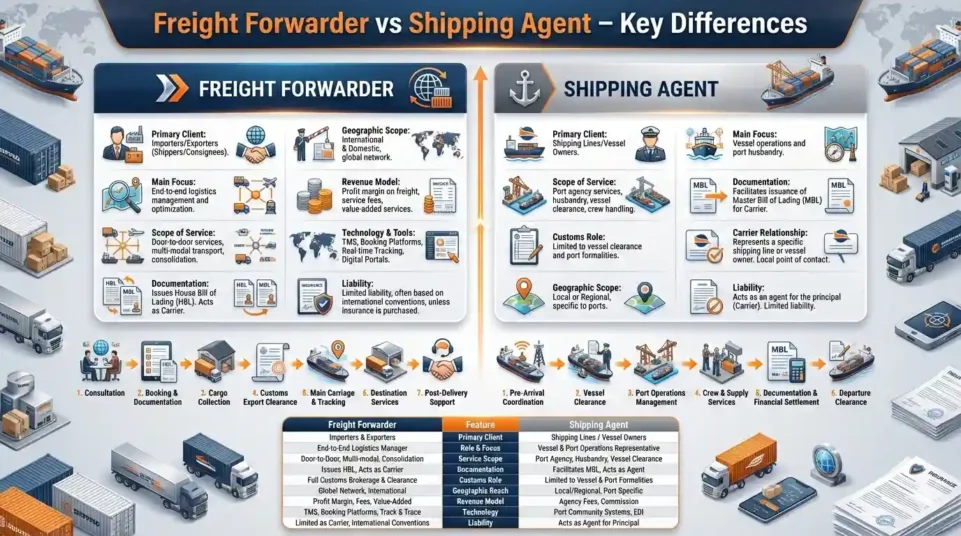
The table below provides a concise, side-by-side comparison illustrating the fundamental differences between a freight forwarder and a shipping agent, focusing on their clients, primary responsibilities, legal roles, and technological tools.
| Aspect | Freight Forwarder | Shipping Agent |
|---|---|---|
| Primary Client | Shipper/Cargo Owner (Exporter/Importer) | Shipowner/Vessel Operator (Carrier) |
| Main Focus | Cargo movement from origin to destination | Vessel operations at port |
| Scope of Service | End-to-end logistics including customs, warehousing, delivery | Port-specific operations and vessel facilitation |
| Documentation | Issues House Bill of Lading (HBL), handles export/import docs | Processes Master Bill of Lading (MBL), vessel clearance |
| Customs Role | Handles customs clearance, customs brokerage for cargo | Facilitates vessel customs clearance, not cargo |
| Carrier Relationship | Books space with multiple carriers, negotiates rates | Represents one specific carrier at port |
| Geographic Scope | Global network, manages door-to-door service | Local to specific port or region |
| Revenue Model | Margin on freight rates, service fees | Commission from vessel operator |
| Cost & Time Management | Route optimization, consolidation, multimodal planning, freight savings | Reduced port fees, minimized demurrage, efficient vessel operations |
| Technology | TMS, WMS, tracking platforms, digital freight marketplace | Port operations systems, vessel scheduling software |
| Liability | Can assume carrier liability as NVOCC | Limited to agency duties, no cargo liability |
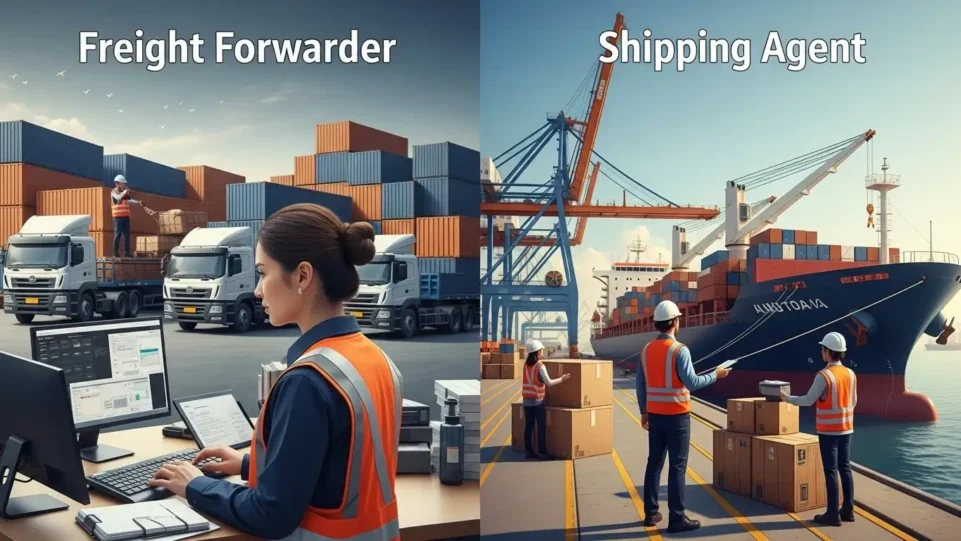
Operational Workflows: How Each Functions in Practice
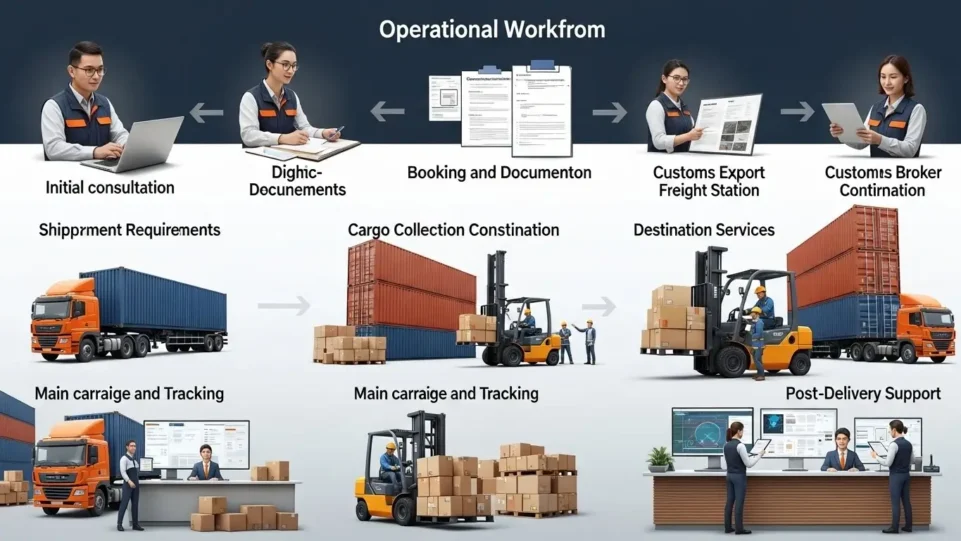
Freight Forwarder Workflow
When a business needs to ship goods internationally, the freight forwarder manages the entire supply chain execution process:
1. Initial Consultation and Rate Negotiation
The freight forwarder assesses shipment requirements, recommends the best mode of transport (ocean freight, air freight, or multimodal transportation), and provides freight rates based on volume, route, and service level.
2. Booking and Documentation
Once contracted, the forwarder books container space with ocean carriers or air cargo capacity. For LCL shipping, they consolidate multiple shippers’ cargo at a Container Freight Station (CFS). They prepare all necessary documentation including the Commercial invoice, Packing list, and Certificate of Origin.
3. Cargo Collection and Consolidation
The freight forwarder arranges pickup from the shipper’s location, handles cargo stuffing into containers, and manages freight consolidation point operations for groupage shipments.
4. Customs Export Clearance
Working as a clearing agent or with customs brokers, the forwarder files all export documentation, ensures trade compliance, and obtains necessary clearances.
5. Main Carriage and Tracking
The cargo moves via the booked carrier while the forwarder provides real-time tracking and shipment visibility through their Transportation Management System (TMS) or digital freight platform.
6. Destination Services
Upon arrival, the freight forwarder handles customs filing at destination, pays applicable duties, arranges deconsolidation for LCL cargo, and coordinates last mile delivery to the consignee’s door.
7. Post-Delivery Support
The forwarder manages freight audit and payment, resolves any claims, and provides proof of delivery (POD) documentation.
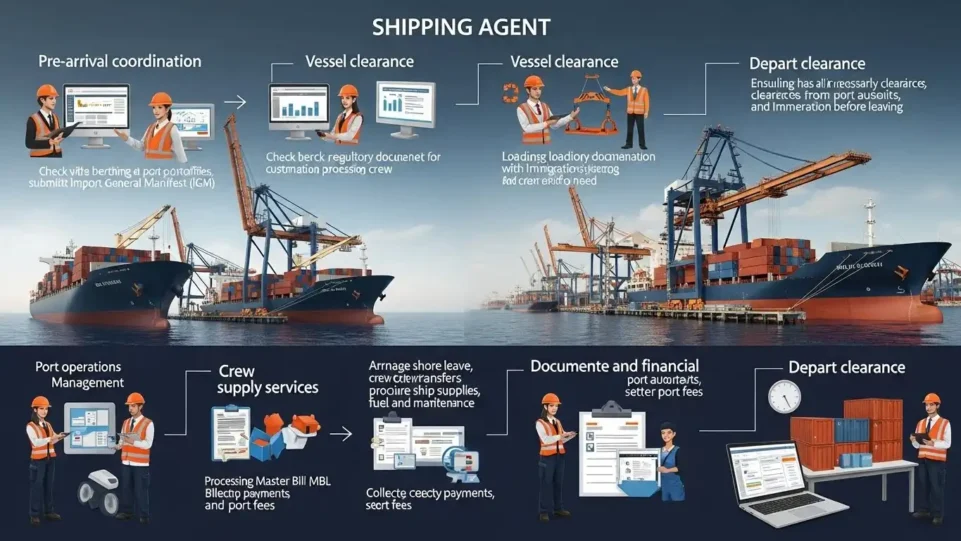
Shipping Agent Workflow
When a vessel approaches a port, the shipping agent’s work begins:
1. Pre-Arrival Coordination
The vessel agent receives advance notification from the steamship line and begins coordinating with port authorities for berthing arrangements. They submit the Import General Manifest (IGM) and arrange for pilot services.
2. Vessel Clearance
The agent manages all regulatory documentation for port compliance, including customs clearance for the vessel itself, immigration processing for crew transfers, and health/safety inspections.
3. Port Operations Management
During the vessel’s stay, the agent coordinates loading and unloading operations with terminal operators, arranges cargo inspection if required, and ensures efficient cargo handling to minimize port turnaround time.
4. Crew and Supply Services
The shipping agent facilitates shore leave arrangements, manages crew transfers, and procures necessary ship supplies, fuel, and maintenance services.
5. Documentation and Financial Settlement
The agent processes the Master Bill of Lading (MBL) for cargo loaded, collects freight payments when necessary, and settles terminal handling charges and other port fees on behalf of the vessel operator.
6. Departure Clearance
Before the vessel departs, the agent obtains all necessary clearances from port authorities, customs, and immigration, ensuring the vessel can leave on schedule.
When Do You Need a Freight Forwarder?
Businesses should engage a freight forwarder when they need comprehensive supply chain management for their cargo. Freight forwarders are essential for:
International Trade Operations
If your company regularly imports or exports goods, a freight forwarder becomes your logistics partner, managing the complexities of cross-border shipping, regulatory compliance, and multi-country documentation requirements.
Complex Supply Chain Requirements
When shipments involve multiple transportation modes (intermodal transport), require warehousing services, or need specialized handling, freight forwarders provide the coordination and expertise necessary.
Small to Medium Shipment Volumes
Companies shipping LCL volumes benefit significantly from freight consolidation services, where the forwarder combines multiple shippers’ cargo to achieve better freight rates and regular sailing schedules.
Limited In-House Logistics Expertise
Businesses without dedicated logistics teams rely on freight forwarders for their knowledge of Incoterms, customs compliance, and carrier selection to navigate international shipping complexities.
Need for Door-to-Door Service
When you require end-to-end logistics from factory pickup to final destination delivery, freight forwarders manage the entire shipment lifecycle including drayage services and last mile delivery.
Technology and Visibility Requirements
Modern freight forwarders offer cloud-based logistics platforms with API connectivity, providing real-time tracking, automated freight booking, and integration with your Enterprise Resource Planning (ERP) systems.

When Do You Need a Shipping Agent?
Shipping agents serve vessel operators rather than cargo owners, so direct engagement is less common for shippers. However, understanding their role helps in specific scenarios:
If You Operate Your Own Vessels
Companies that charter or own vessels need local port agents at each port of call to handle vessel operations, port compliance, and coordination with local authorities.
When Dealing with Vessel-Related Issues
In cases of vessel delays, cargo damage investigations, or general average declarations, you may interact with the shipping agent as they represent the vessel operator in these matters.
For Charter Party Operations
Businesses engaged in breakbulk shipping or chartering vessels for large project cargo work with shipping agents to coordinate specialized cargo handling and port operations.
Understanding Carrier Operations
While you won’t directly hire a shipping agent for typical shipments, knowing they represent the carrier helps you understand the chain of responsibility when issues arise during maritime transport.

The Relationship Between Freight Forwarders and Shipping Agents
While freight forwarders and shipping agents represent different parties, they frequently interact during the shipping process:
- Coordination at Origin Port: When a freight forwarder delivers cargo to the port for loading, they coordinate with the shipping agent to ensure proper cargo stuffing, documentation transfer, and booking confirmation.
- Documentation Exchange: The freight forwarder provides cargo details and shipping instructions to the shipping agent, who then ensures this information is accurately reflected in the Master Bill of Lading (MBL) issued by the carrier.
- Problem Resolution: If issues arise during vessel operations—such as cargo damage during loading or unloading, or delays due to port congestion—the freight forwarder communicates with the shipping agent to resolve problems and protect their client’s interests.
- Information Flow: Shipping agents provide vessel schedule reliability information, estimated arrival times, and port-specific requirements that freight forwarders use to plan shipment coordination and notify consignees.
Legal Liability and Risk: A Fundamental Distinction
A core difference between the two roles lies in their legal responsibility. Freight forwarders, especially those operating as NVOCCs, often issue their own House Bill of Lading and assume the legal status and liability of a carrier toward the cargo owner. They actively manage and coordinate freight insurance (cargo insurance). Conversely, shipping agents are legally responsible for the vessel’s compliance and operational efficiency while in port; their liability is limited to agency duties and they hold no direct liability for the cargo itself.
Technology and Digital Transformation in Modern Logistics
Both freight forwarders and shipping agents are embracing technology to improve efficiency and provide better service:
Freight Forwarder Technology
Leading freight forwarders have invested heavily in digital freight platforms that offer:
- Transportation Management Systems (TMS) for comprehensive supply chain execution and carrier management
- Real-time tracking systems with IoT tracking devices providing end-to-end visibility
- AI-powered logistics platforms for route optimization and freight rate optimization
- Digital documentation including electronic Bill of Lading and automated customs filing
- API integrations enabling seamless connectivity with clients’ ERP and Order Management Systems (OMS)
- Freight rate benchmarking tools for transparent pricing
- Cloud-native platforms accessible from anywhere for booking, tracking, and documentation
Shipping Agent Technology
Shipping agents utilize specialized port operations technology:
- Vessel scheduling software for coordinating berth assignments and optimizing port turnaround time
- Port community systems for seamless communication with port authorities and customs
- Digital documentation systems for processing vessel clearance and cargo manifests
- Real-time communication platforms for coordinating with vessel captains and operations teams

Cost Considerations: Understanding Freight Rates and Fees
Freight Forwarder Pricing Structure
Freight forwarders generate revenue through various charges:
| Cost Component | Description | Typical Range |
|---|---|---|
| Ocean/Air Freight | Cost of transportation from ocean carriers or airlines | Varies by route, volume, season |
| Origin Charges | Pickup, cargo handling, documentation | $50-$200 per shipment |
| Customs Brokerage | Customs clearance and compliance services | $100-$500 per entry |
| Destination Charges | Port fees, delivery, deconsolidation | $100-$400 per shipment |
| Documentation Fee | Bill of Lading, certificates, filing | $25-$100 per shipment |
| Freight Insurance | Cargo insurance coverage | 0.5-2% of cargo value |
| Warehousing | Storage, inventory management | Varies by duration and volume |
Freight forwarders typically build their margin into the freight rates they quote, rather than charging separate commissions. For LCL shipping, they earn additional revenue through cargo consolidation by purchasing space in bulk and selling it to smaller shippers.
Shipping Agent Revenue Model
Shipping agents earn commission-based fees from vessel operators:
- Agency Commission: Typically 1.25-2.5% of freight revenue collected at the port
- Disbursement Account: Fees for managing port fees, supplies, and services on behalf of the vessel
- Service Fees: Specific charges for crew transfers, emergency services, or special handling
These costs are built into the vessel operator’s overall expenses and are not directly visible to cargo owners.
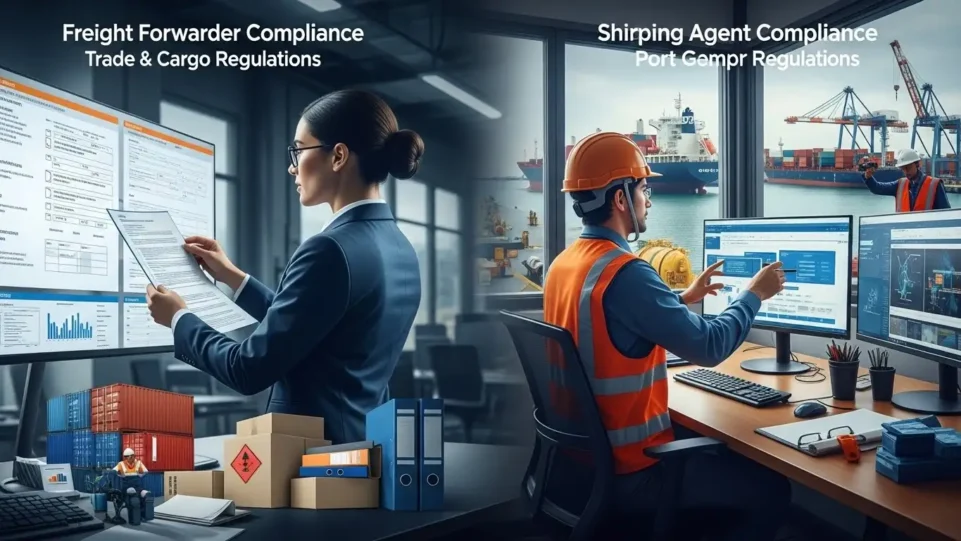
Regulatory Compliance and Industry Standards
Freight Forwarder Regulations
Freight forwarders operating in international trade must comply with various regulations:
United States Compliance
- Federal Maritime Commission (FMC): Freight forwarders acting as NVOCC must register with the FMC and maintain surety bonds
- Federal Motor Carrier Safety Administration (FMCSA): Those providing trucking services need appropriate licensing
- Customs and Border Protection: Must follow customs compliance requirements and maintain accurate documentation
International Standards
- Incoterms: Understanding and applying FOB, CIF, and other International Commercial Terms correctly
- Trade Compliance: Adhering to export controls, sanctions, and trade agreements
- Safety Standards: Following dangerous goods regulations for hazardous cargo
Shipping Agent Regulations
Shipping agents must comply with:
- Port Authority Regulations: Local rules governing vessel operations and port compliance
- Maritime Law: International conventions governing vessel operations and crew welfare
- Environmental Standards: Ballast water management, emissions reporting, and waste disposal
- Security Protocols: ISPS Code compliance and port security requirements
Key Performance Indicators (KPIs) for Logistics Success
Understanding the metrics that define success helps evaluate both freight forwarders and the overall shipping process:
Critical KPIs for Freight Forwarding
| KPI | Description | Industry Benchmark |
|---|---|---|
| On-Time Delivery (OTD) | Percentage of shipments delivered by promised date | 90-95% |
| On-Time In-Full (OTIF) | Shipments delivered on time with correct quantity | 85-90% |
| Transit Time Accuracy | Variance between estimated and actual transit times | ±2 days |
| Customs Clearance Time | Average time to clear customs | 1-3 days |
| Documentation Accuracy | Error-free documentation submission rate | 98%+ |
| Freight Cost Per Unit | Transportation spend divided by units shipped | Varies by industry |
| Claims Ratio | Percentage of shipments with damage/loss claims | <0.5% |
| Customer Satisfaction (CSAT) | Client satisfaction score | 4.0-4.5 out of 5 |
Shipping Agent Performance Metrics
- Port Turnaround Time: Time from vessel arrival to departure
- Vessel Schedule Reliability: On-time departure percentage
- Berth Utilization: Efficiency of berth assignments
- Cargo Handling Efficiency: Containers loaded/unloaded per hour
- Dwell Time: Time cargo remains in port before pickup
- Coordination Success: Accuracy and timeliness of documentation and crew service arrangement
Choosing the Right Logistics Partner: Evaluation Criteria
When selecting a freight forwarder for your supply chain management needs, consider these factors:
- Geographic Coverage and Network Strength: Evaluate whether the forwarder has a strong global network in the regions you ship to and from.
- Service Offerings: Determine if they provide the specific services you need: FCL shipping, LCL shipping, air freight, customs brokerage, warehousing services, or specialized services like temperature-controlled transport.
- Technology Platform: Modern freight forwarders should offer digital freight platforms with real-time tracking, automated freight booking, API connectivity for your ERP integration, and comprehensive shipment visibility.
- Carrier Relationships: Strong relationships with ocean carriers mean better freight rates, guaranteed space during peak seasons, and priority booking.
- Customs Expertise: Verify their customs compliance capabilities, particularly if shipping between China and the United States where regulations are complex and frequently changing.
- Financial Stability: Check for FMC licensing (for NVOCC operations), insurance coverage, and financial stability to ensure they can handle claims and provide freight insurance.
- Communication and Support: Evaluate their customer service responsiveness, dedicated account management, and ability to provide timely updates through their Transportation Management System (TMS).
- Pricing Transparency: Look for clear breakdowns of freight rates, origin charges, destination charges, and all applicable fees. Avoid forwarders with hidden charges or unclear pricing structures.
Industry Trends Shaping the Future
Digital Transformation and Automation
The logistics industry is experiencing rapid digital transformation.
Key technology trends include:
- AI-powered logistics platforms for predictive analytics and demand forecasting
- Blockchain for supply chain providing immutable documentation and enhanced security
- IoT tracking devices offering real-time visibility of cargo conditions
- Machine learning algorithms optimizing route planning and carrier selection
- Automated tendering systems reducing manual work in carrier procurement

Sustainability and Carbon Emissions Tracking
Both shippers and logistics providers are increasingly focused on reducing carbon emissions and improving fuel efficiency. Modern freight forwarders provide detailed CO2 footprint reporting and offer lower-emission transportation options.
Supply Chain Resilience
Recent supply chain disruptions have highlighted the importance of supply chain visibility, multiple carrier relationships, and flexible routing options. Freight forwarders that offer multimodal transportation and alternative routing demonstrate stronger supply chain resilience.
Regulatory Changes
Ongoing changes in trade compliance, customs regulations, and international trade agreements require freight forwarders to stay updated on regulatory compliance requirements across multiple jurisdictions.
Common Challenges and Solutions
Challenges with Freight Forwarding
| Challenge | Solution |
|---|---|
| Detention and Demurrage Charges | Use forwarders with strong warehousing services and efficient drayage services to minimize container dwell time |
| Documentation Errors | Partner with forwarders using digital documentation and automated systems to ensure documentation accuracy |
| Lack of Shipment Visibility | Choose forwarders offering cloud-based logistics platforms with real-time tracking and API connectivity |
| Peak Season Capacity | Work with forwarders maintaining strong carrier relationships and NVOCC status for guaranteed space |
| Customs Delays | Select forwarders with dedicated customs brokerage expertise and pre-clearance capabilities |
Challenges with Vessel Operations
While shipping agents handle these issues, understanding them helps set realistic expectations:
- Port Congestion: Affects vessel schedule reliability and can cause cascading delays
- Weather Disruptions: May require rescheduling of berthing arrangements
- Labor Disputes: Can impact loading and unloading operations
- Equipment Shortages: Container availability affects cargo movement
Real-World Scenarios: Making the Right Choice
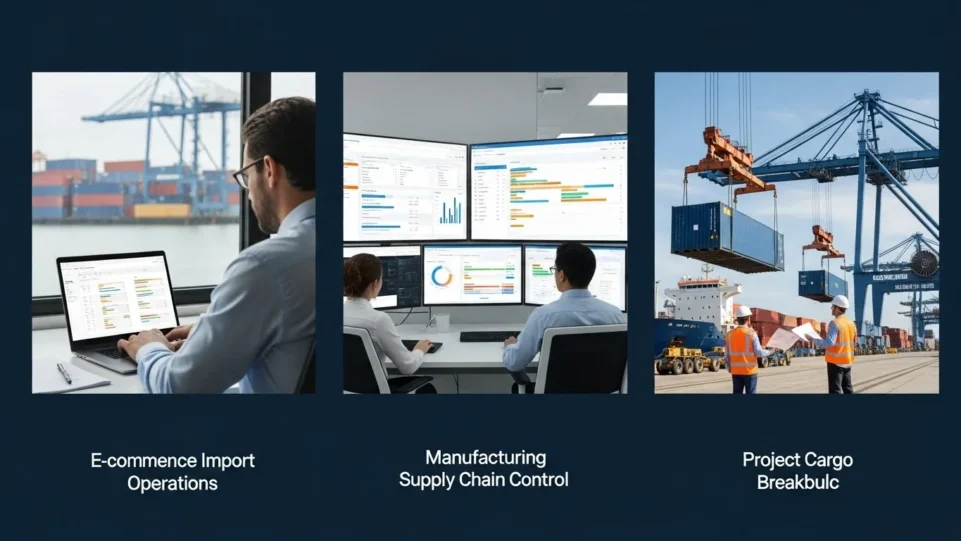
Scenario 1: E-commerce Business Importing from China
Situation: A Los Angeles-based e-commerce company imports consumer goods from Shanghai suppliers.
Recommended Solution: Engage a freight forwarder specializing in China-USA trade lanes who can provide:
- LCL shipping for smaller orders to reduce inventory holding costs
- FCL shipping for larger volumes with better freight rates
- Customs brokerage handling FDA, FCC, or other regulatory requirements
- Warehousing services in Los Angeles for inventory management
- Last mile delivery to fulfillment centers
- Real-time tracking integrated with their Order Management System (OMS)
Shipping Agent Role: Works behind the scenes representing the ocean carrier at Shanghai and Los Angeles ports, ensuring smooth vessel operations.
Scenario 2: Manufacturing Company with Complex Supply Chain
Situation: A manufacturing company sources components from multiple countries, requires just-in-time delivery, and needs comprehensive supply chain visibility.
Recommended Solution: Partner with a fourth-party logistics (4PL) provider or advanced freight forwarder offering:
- Transportation Management System (TMS) with ERP integration
- Multimodal transportation options combining ocean freight and air freight
- Cargo consolidation at strategic freight consolidation points
- Supply chain execution with KPI tracking for on-time delivery (OTD)
- Cross-docking capabilities to minimize warehousing costs
- Load optimization to maximize container utilization
Scenario 3: Project Cargo or Breakbulk Shipping
Situation: A construction company needs to ship oversized equipment requiring specialized handling.
Recommended Solution: Work with freight forwarders specializing in breakbulk shipping who can:
- Charter appropriate vessels or secure specialized space
- Coordinate with shipping agents at loading and discharge ports for specialized cargo handling
- Arrange cargo surveying and pre-shipment inspection
- Manage complex documentation for oversize cargo
- Provide specialized freight insurance
Shipping Agent Role: Critical for coordinating specialized berthing arrangements, heavy-lift equipment, and extended loading/unloading operations.
Frequently Asked Questions
What is the main difference between a freight forwarder and a shipping agent?
The main difference lies in who they represent: freight forwarders represent the cargo owner (shipper) and manage end-to-end logistics from origin to destination, while shipping agents represent the vessel owner (carrier) and handle port operations and vessel-related services. Freight forwarders focus on cargo movement; shipping agents focus on vessel operations.
Can a freight forwarder also act as a shipping agent?
While theoretically possible, this is rare due to potential conflicts of interest. A company acting as both would represent both the cargo owner and the vessel operator, creating divided loyalties. Most companies specialize in one role to maintain clear client relationships and avoid liability issues. However, some large logistics companies may have separate divisions handling each function independently.
Do I need both a freight forwarder and a shipping agent for my shipment?
No, as a shipper you typically only engage a freight forwarder. The shipping agent works for the ocean carrier or steamship line and is automatically involved when your cargo ships on that carrier’s vessel. Your freight forwarder coordinates with the shipping agent as needed, but you don’t contract with the shipping agent directly unless you charter or own your own vessel.
Can a freight forwarder handle customs clearance?
Yes, freight forwarders coordinate with customs brokers and handle all required documentation for international shipments.
Do shipping agents handle freight insurance?
No, shipping agents generally do not provide insurance; this is managed by freight forwarders or shippers as part of the overall cargo logistics and risk management.