Comparing Shipping Routes from China to Different US Ports is essential for any importer who wants to optimize cost, transit time, and supply chain efficiency. If you are importing goods from China to the United States, choosing the right shipping route can significantly affect your final costs, delivery speed, and overall logistics performance. Shipping routes from China to various US ports differ in many ways—some are faster, some are more economical, and some are better suited for specific types of cargo.
In this article, we break down and compare the major shipping routes from China to US West Coast, East Coast, and Gulf Coast ports. You will learn about transit times, cost differences, advantages, disadvantages, and the best route options for different business needs.
Overview of Shipping Routes from China to the USA
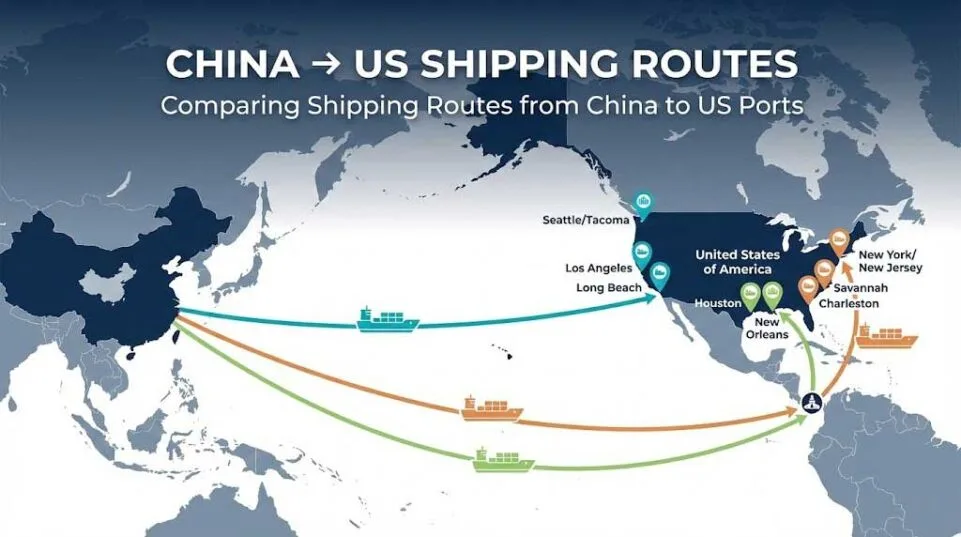
Shipping goods from China to the USA relies on several major trade corridors that connect China’s busiest export ports to the West Coast, East Coast, and Gulf Coast of the United States. These China to US shipping routes differ in terms of speed, freight cost, transit time, reliability, and the shipping lanes used by major carriers.
Importers typically choose a route based on three core factors:
- Transit time China to US ports
- Ocean freight cost China to USA
- Route reliability and congestion levels
Among all routes, the China to US West Coast shipping lane is the fastest, while the China to US East Coast is longer, often requiring passage through the Panama Canal or Suez Canal. Gulf Coast routes offer a balanced alternative for shipments heading toward the central regions of the United States.
Understanding these freight routes from China to America is essential for selecting the most cost-effective and time-efficient option, improving supply chain performance, and reducing unexpected delays.
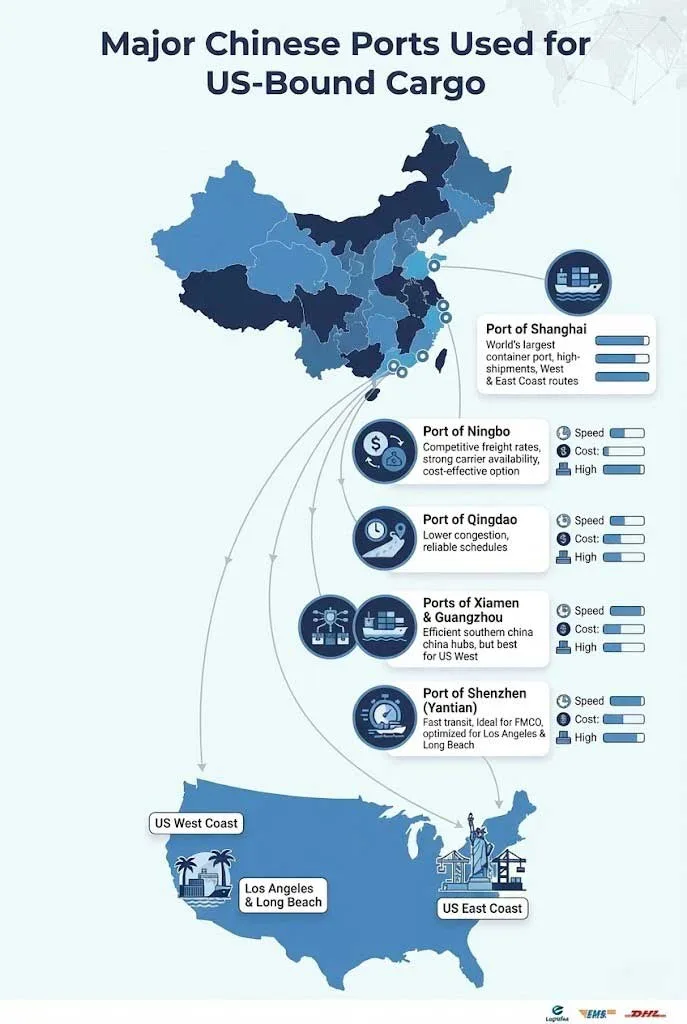
Major Chinese Ports Used for US-Bound Cargo
China operates several world class seaports that serve as the primary origin points for sea shipping China to USA. Each port offers different transit times, lane availability, and freight rates depending on the final US destination.
Port of Shenzhen (Yantian)
One of China’s busiest export hubs and among the fastest options for shipping from China to Los Angeles port and Long Beach.
Ideal for fast-moving consumer goods.
Port of Shanghai
The largest container port in the world. It supports extensive routes to both West Coast and East Coast ports. Often used for high-volume shipments.
Port of Ningbo
Known for competitive rates and strong carrier availability.
A popular option for importers searching for the cheapest shipping route from China to USA.
Port of Qingdao
Reliable with lower congestion levels compared to Shanghai.
Ports of Xiamen and Guangzhou
Efficient choices for shippers located in southern China, especially when targeting the US West Coast.
Choosing the correct origin port can significantly impact transit time, cost, and container availability.
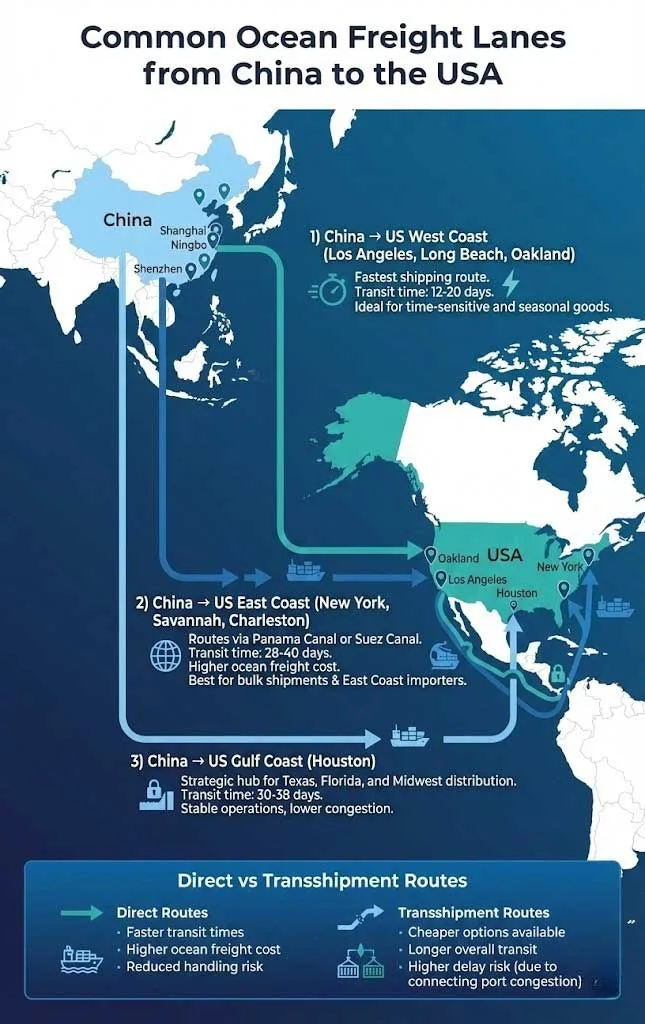
Common Ocean Freight Lanes from China
Ocean freight routes connecting China and the United States follow several established shipping container routes China to USA, each suited to specific cargo types and delivery goals.
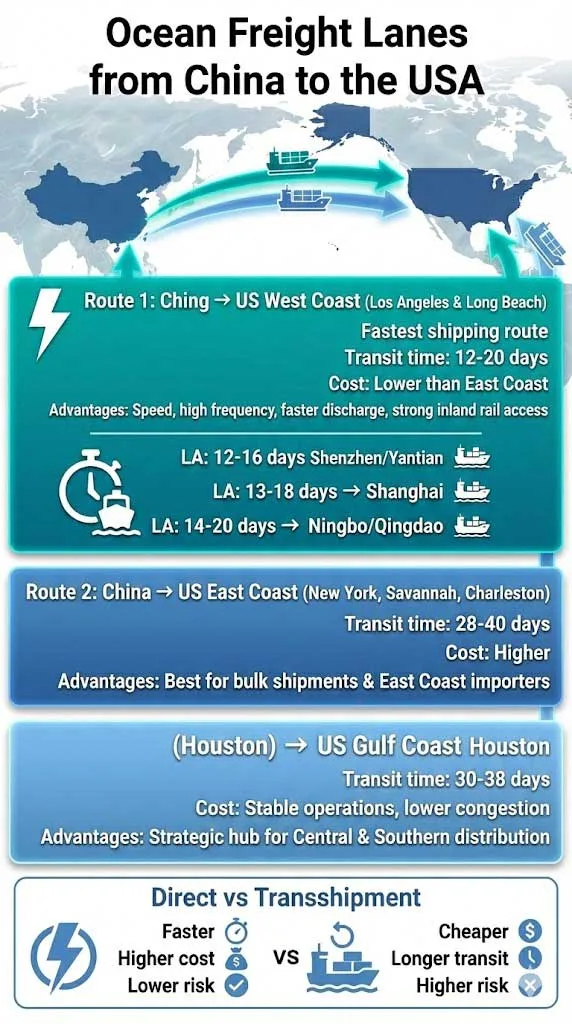
China → US West Coast (Los Angeles, Long Beach, Oakland)
- Fastest shipping route from China to USA
- Typical transit time: 12–20 days
- Best for time-sensitive or seasonal goods
China → US East Coast (New York, Savannah, Charleston)
- Served via Panama Canal or Suez Canal.
- Longer transit time: 28–40 days
- Higher ocean freight costs
- Suitable for bulk shipments and importers located on the East Coast
China → US Gulf Coast (Houston)
A strategic option for importers supplying customers in Texas, Florida, and the Midwest.
- Transit time: 30–38 days
- Stable operations with less congestion
Direct vs. Transshipment Routes
- Direct services: Faster but more expensive
- Transshipment: Lower cost but adds delays and risk of schedule changes
These shipping lanes China to USA may shift slightly based on port congestion, seasonal demand, and carrier schedules.
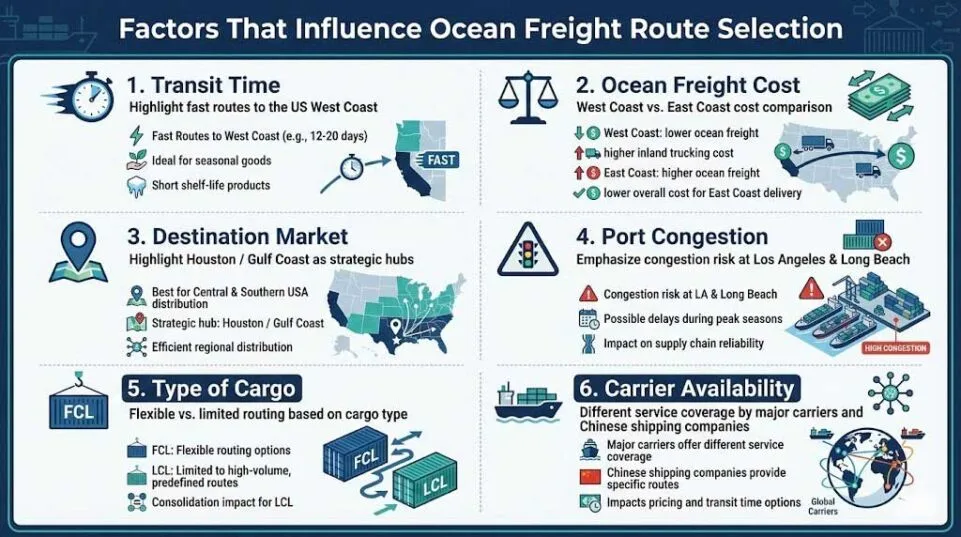
Factors That Influence Route Selection
Choosing the best route requires evaluating multiple variables that affect cost, speed, and operational reliability.
1. Transit Time
Products with short shelf life or seasonal demand should use faster West Coast routes.
2. Ocean Freight Cost
The West Coast is cheaper for ocean freight but more expensive for domestic trucking.
If final delivery is on the East Coast, the East Coast route is often more cost-efficient overall.
3. Destination Market
Shipments heading to the central or southern USA may be better routed through Houston.
4. Port Congestion
Busy ports such as Los Angeles or Long Beach may experience congestion, causing delays.
5. Type of Cargo
- FCL (Full Container Load): More flexibility in choosing routes
- LCL (Less than Container Load): Limited to predefined, high-volume routes
6. Carrier Availability
Major carriers and Chinese shipping companies routes differ in their service coverage, affecting transit time and pricing.
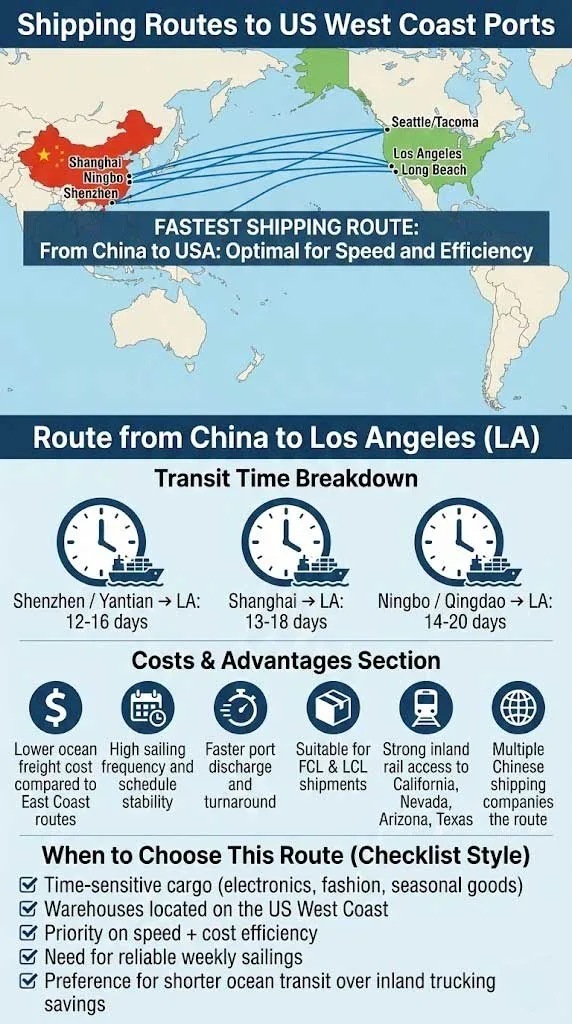
Shipping Routes to West Coast US Ports
The West Coast is the primary gateway for China to US West Coast shipping, offering the fastest shipping route from China to the USA. Ports such as Los Angeles, Long Beach, and Seattle/Tacoma handle the majority of China-origin containers due to their short transit times, dense sailing schedules, and strong connections to inland rail networks.
These routes are ideal for importers who prioritize speed, cost efficiency, and quick access to major distribution centers in California and the Western United States. Below is a detailed breakdown of the most common China to US shipping routes for West Coast destinations.
Route from China to Los Angeles (LA)
The Port of Los Angeles is one of the busiest entry points for ocean freight China to US ports, providing fast transit, frequent sailings, and competitive pricing. It is a top choice for importers seeking a balance of speed and cost.
Transit Time
Transit time for shipping from China to Los Angeles port typically ranges between:
- 12–16 days from Shenzhen/Yantian
- 13–18 days from Shanghai
- 14–20 days from Ningbo or Qingdao
This makes LA one of the fastest shipping routes from China to USA, especially for supply chains requiring rapid restocking.
Costs & Advantages
Advantages of the LA route include:
- Lower ocean freight cost China to USA compared to East Coast routes
- High frequency of sailings, reducing delays
- Faster discharge and shorter transit from major Chinese ports
- Ideal for FCL and LCL shipments due to strong carrier availability
- Easy access to California distribution hubs and inland rail to Nevada, Arizona, and Texas
LA is also supported by multiple Chinese shipping companies routes, improving flexibility for importers.
When to Choose This Route
Choose the LA route if:
- Your goods are time-sensitive (electronics, fashion, seasonal goods)
- Your warehouse or fulfillment center is located on the US West Coast
- You want the cheapest and fastest combination for freight routes from China to America
- You require stable weekly sailing schedules
- You prefer minimal transit time over inland trucking cost
Route from China to Long Beach
Long Beach is directly adjacent to LA and functions as another major entry point for sea shipping China to USA, handling a massive share of China-origin cargo.
Transit Time
Typical transit times:
- 12–16 days from Shenzhen/Yantian
- 13–17 days from Shanghai
- 14–19 days from Ningbo
Transit times mirror the LA route due to shared ocean lanes.
Costs & Advantages
Key advantages:
- Often slightly better container availability for high-volume cargo
- Lower congestion periods compared to LA in some seasons
- Good for importers shipping stable, high-volume SKUs
- Strong inland connectivity via rail to the Midwest
Long Beach is frequently chosen for large retail imports, making it one of the most popular US ports for China imports.
Best Cargo Types for This Route
This route is ideal for:
- High-volume FCL shipments (furniture, machinery, appliances)
- Retail goods needing quick distribution to Southern California
- LCL shipments requiring predictable consolidation lanes
- Imports benefiting from stable schedules and lower congestion risk
Route from China to Seattle/Tacoma
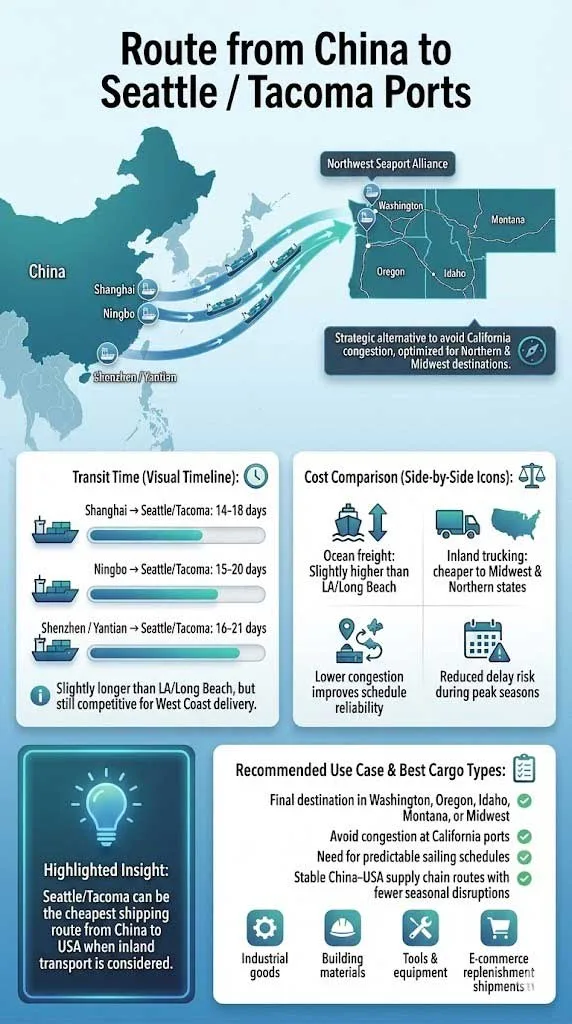
The Seattle–Tacoma Northwest Seaport Alliance serves as an important alternative to California ports, particularly for goods destined for Northern US states.
Transit Time
Typical transit times:
- 14–18 days from Shanghai
- 15–20 days from Ningbo
- 16–21 days from Shenzhen/Yantian
Transit times are slightly longer than Los Angeles and Long Beach but still competitive for West Coast delivery.
Cost Comparison
Compared to LA/Long Beach:
- Ocean freight rates may be slightly higher
- Inland trucking to Midwest and Northern states is more cost-efficient
- Lower congestion improves schedule reliability
- Less delay risk during peak seasons
For certain lanes, Seattle/Tacoma becomes the cheapest shipping route from China to USA when factoring in domestic transportation.
Recommended Use Case
Choose Seattle/Tacoma when:
- Your final destination is Washington, Oregon, Idaho, Montana, or the Midwest
- You want to avoid congestion at California ports
- Your goods require predictable schedules
- You rely on stable China to USA supply chain routes with fewer seasonal disruptions
It is especially suitable for industrial goods, building materials, tools, and e-commerce replenishment shipments.
Shipping Routes to East Coast US Ports
Shipping to the East Coast is essential for importers serving markets in the Northeast, Southeast, and Central United States. These China to US East Coast shipping routes are longer and generally more expensive than West Coast options, as vessels must pass through the Panama Canal or occasionally the Suez Canal. However, East Coast ports offer major advantages, including reduced inland trucking costs and closer proximity to millions of consumers.
Below is a detailed overview of the most important East Coast routes used in ocean freight China to US ports, focusing on transit times, route efficiency, and best use cases.
Route from China to New York/New Jersey
The Port of New York/New Jersey is one of the most important entry points on the East Coast and a top destination for shipping from China to New York port. It offers excellent access to the Northeast, making it a preferred route for retail, electronics, and e-commerce distribution.
Transit Time
Transit times are longer than West Coast routes:
- 32–38 days via the Panama Canal
- 35–45 days via the Suez Canal (used mainly for North China origins)
- 30–36 days from Southern China with fast services
Although transit is longer, NY/NJ routes remain essential due to regional demand and reduced domestic transport costs.
Cost Comparison (vs West Coast)
Compared to Los Angeles/Long Beach:
- Ocean freight is more expensive because of longer sailing distances.
- Inland trucking is significantly cheaper for Northeast deliveries.
- Total landed cost may be equal or even lower if your warehouse is near New York, New Jersey, Pennsylvania, or surrounding states.
For many importers, this route is the most economical option despite the higher ocean cost.
Benefits of East Coast Entry
Choosing New York/New Jersey offers important advantages:
- Direct access to the largest consumer market in the US
- Shorter domestic delivery times for Northeast customers
- Less port congestion compared to LA/Long Beach during peak seasons
- Useful for companies needing China to USA transit comparison for final distribution
- More predictable inland logistics and warehouse availability
This route is ideal for importers operating East Coast 3PLs or large e-commerce hubs.
Route from China to Savannah
The Port of Savannah is one of the fastest-growing ports in the country and a major destination for shipping from China to Savannah port. It is especially popular among retailers, big-box stores, and e-commerce brands serving the Southeast.
Transit Time
Typical transit time:
- 28–34 days via the Panama Canal
- 30–38 days from Northern China
- 29–35 days from Southern China
Savannah offers a more efficient alternative for Southeast deliveries compared to New York.
Capacity & Demand
Savannah has expanded aggressively in recent years:
- One of the largest container yards in the US
- Strong capacity for FCL and LCL shipments
- High demand due to its strategic position near major distribution hubs (Atlanta, Charlotte, Jacksonville)
- Major carriers run stable freight routes from China to America with competitive pricing
The port is known for smooth operations, making it a preferred route during peak seasons.
Ideal Products for This Route
Savannah is an excellent choice for:
- Retail products
- Furniture and home goods
- E-commerce restocking
- Consumer electronics
- Industrial equipment heading to Southeastern states
If your supply chain targets the South or Southeast, Savannah is often the best port for China importers.
Route from China to Charleston
Charleston is a highly efficient East Coast port with deep-water access, modern terminals, and consistent performance. It is used widely for both industrial cargo and high-value consumer goods.
Transit Time
Average transit times:
- 28–35 days via the Panama Canal
- 30–40 days via the Suez Canal (less common)
- Slightly faster for shipments originating in South China
Charleston offers one of the most reliable transit windows on the East Coast.
Route Advantages
Key advantages include:
- Lower congestion compared to New York and Savannah
- Very fast cargo handling speeds
- Consistent scheduling for China to USA port selection guide
- Strong inland network to the Carolinas, Tennessee, Georgia, and parts of the Midwest
- Often more predictable during peak retail seasons
For some importers, Charleston provides the best balance between cost, speed, and reliability.
When It Makes Sense
Choose Charleston when:
- Your final delivery destinations are in the Carolinas, Georgia, Tennessee, Alabama, or the Midwest
- You want a balance of cost and stability
- You prefer a port with lower congestion and better operational consistency
- You need predictable sea shipping China to USA lanes during peak demand
Charleston is especially suitable for auto parts, machinery, retail goods, and stable-volume FCL shipments.
Shipping Routes to Gulf Coast US Ports
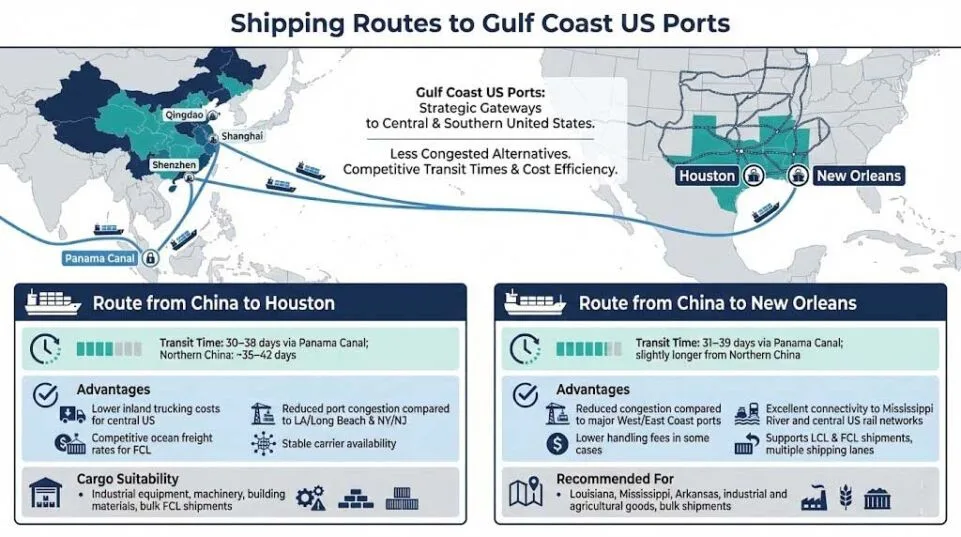
The Gulf Coast provides an important alternative for importers targeting the central and southern United States. These China to USA shipping routes are less congested than major West and East Coast ports, and they offer strategic advantages for inland distribution. Major Gulf Coast ports include Houston and New Orleans, serving as gateways for industrial goods, bulk cargo, and regional distribution.
Gulf Coast ports are ideal for importers looking to optimize ocean freight cost China to USA while maintaining reasonable transit times.
Route from China to Houston
The Port of Houston is one of the largest Gulf Coast ports and a key entry point for China to USA supply chain routes targeting the central US.
Transit Time
Typical transit times:
- 30–38 days via the Panama Canal
- Slightly longer for shipments from Northern China (~35–42 days)
- Faster than East Coast ports for destinations in Texas and the Midwest
Transit times are competitive, offering a good balance between speed and cost efficiency.
Cost Efficiency
Houston is often more cost-effective than East Coast ports for central US deliveries:
- Lower inland trucking costs for central states
- Competitive ocean freight rates for FCL shipments
- Reduced congestion compared to LA/Long Beach and New York/NJ
- Many carriers provide consistent freight forwarder China to USA routes
Houston is a strategic choice for importers prioritizing total landed cost over just ocean transit time.
Cargo Suitability
Ideal cargo types include:
- Industrial equipment and machinery
- Building materials and steel products
- Consumer goods destined for central US markets
- Bulk FCL shipments needing predictable schedules
Route from China to New Orleans
The Port of New Orleans is a smaller but efficient Gulf Coast port, known for its deep-water terminals and smooth operations.
Transit Time
Typical transit times:
- 31–39 days via the Panama Canal
- Slightly longer for Northern China origins
- Consistent schedules make it reliable for planning inventory
While slightly slower than Houston, New Orleans offers dependable timing for Gulf Coast deliveries.
Logistics Advantages
Advantages of using New Orleans include:
- Reduced congestion compared to major West and East Coast ports
- Excellent connectivity to the Mississippi River and central US rail networks
- Lower handling fees in some cases
- Suitable for LCL and FCL shipments
- Supports a range of shipping lanes China to USA options
Recommended For
New Orleans is recommended for:
- Importers serving Louisiana, Mississippi, Arkansas, and surrounding states
- Industrial goods, agricultural equipment, and bulk shipments
- Businesses seeking alternative ports during peak congestion at LA/Long Beach or East Coast ports
It is a strong choice when the priority is reliable China to USA transit comparison for regional distribution.
Transit Time Comparison: West vs East vs Gulf Ports
Understanding transit time China to US ports is critical for importers who want to optimize inventory planning, reduce delays, and select the most efficient China to US shipping routes. Transit time varies depending on the origin port in China, the US destination port, and the ocean lanes used. Below is a detailed comparison of West Coast, East Coast, and Gulf Coast ports.
Fastest Routes from China to USA
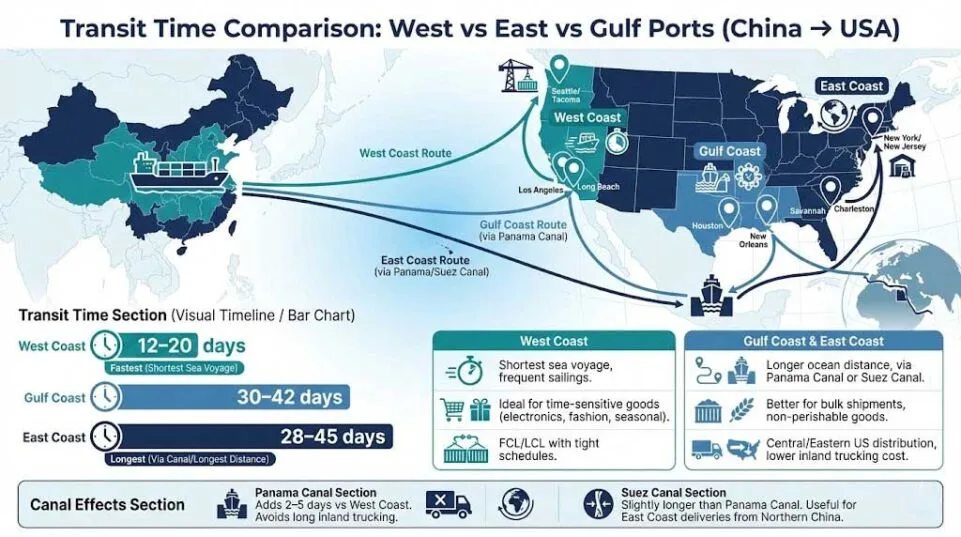
The fastest shipping routes are consistently to the West Coast ports, mainly Los Angeles, Long Beach, and Seattle/Tacoma.
- Transit time: 12–20 days from major Chinese ports like Shenzhen, Yantian, and Shanghai.
- Advantages: Shortest sea voyage, frequent sailings, low congestion in off-peak seasons.
These routes are ideal for:
- Time-sensitive cargo such as electronics, seasonal goods, and fashion
- Importers needing rapid restocking
- FCL and LCL shipments with tight delivery schedules
West Coast ports remain the preferred choice when speed is the top priority.
Longest Transit Routes
The longest transit times occur for East Coast ports and some Gulf Coast ports, primarily due to longer ocean distances and canal transits.
- East Coast: New York/New Jersey, Savannah, Charleston – 28–45 days depending on port origin and sailing route.
- Gulf Coast: Houston and New Orleans – 30–42 days via Panama Canal from Southern China.
Longer routes are better suited for:
- Non-perishable goods
- Bulk shipments where total landed cost matters more than speed
- Importers targeting markets in the Northeast, Southeast, and central US
While slower, these routes can reduce domestic trucking cost, especially for East Coast or Gulf Coast delivery destinations.
Effect of Panama Canal and Suez Canal on Transit Time
Canal passages significantly impact transit times for East Coast and Gulf Coast shipments:
- Panama Canal: Primary route for shipping from Southern China to East Coast and Gulf ports. Adds 2–5 days compared to a direct West Coast route but avoids long inland trucking.
- Suez Canal: Occasionally used for shipments from Northern China; slightly longer than Panama Canal routes but useful for East Coast deliveries.
Choosing the right route requires balancing speed, cost, and final destination, ensuring the most efficient freight routes from China to America for each type of cargo.
Cost Comparison for Different US Ports
Choosing the most economical shipping routes from China to the USA requires understanding how port fees, ocean freight rates, and inland logistics vary across West Coast, East Coast, and Gulf Coast ports. Costs can differ significantly depending on congestion levels, fuel surcharges, labor rates, and inland distribution requirements. Below is a structured breakdown to help importers compare the cheapest shipping route from China to USA based on total landed cost not just sea freight.
Port Fees & Local Charges
Port fees (also known as Destination Charges or DTHC) vary widely among popular US ports for China imports. These charges typically include terminal handling, customs exams, port infrastructure fees, drayage, and documentation.
West Coast Ports (Los Angeles, Long Beach, Seattle/Tacoma)
- Generally higher terminal fees due to heavy demand and union labor.
- LA & Long Beach often have additional environmental or congestion-related surcharges.
- Advantage: Lower drayage costs for West Coast distribution.
East Coast Ports (New York/New Jersey, Savannah, Charleston)
- Moderate to high port fees, with NY/NJ often being the most expensive on the East Coast.
- Savannah has some of the lowest DTHC among major East Coast ports.
- Ports benefit from newer infrastructure and efficient container handling.
Gulf Coast Ports (Houston, New Orleans)
- Typically lower port fees than West and East Coast ports.
- Less congestion and cheaper labor lead to more cost-efficient local charges.
- Houston is the most cost-effective Gulf option for China-to-USA ocean freight.
Ocean Freight Cost Differences
Ocean freight costs are influenced by distance, demand on specific sea shipping China to USA lanes, vessel schedules, and canal tolls.
West Coast Freight (Fastest + Usually Cheapest Base Rate)
- Shorter distances = lower base ocean freight compared to East Coast.
- LA/Long Beach often offer the cheapest ocean freight route from China to USA due to high carrier frequency.
- Best for FCL shippers wanting speed and affordability.
East Coast Freight (Higher Due to Canal Transit)
- Ocean freight is more expensive because vessels must pass through the Panama Canal or, in rare cases, the Suez Canal.
- Longer distance = higher fuel cost + higher transit time.
- More economical for importers selling primarily in the East or Northeast US.
Gulf Coast Freight (Moderate Cost)
- Generally cheaper than East Coast freight, slightly higher than West Coast.
- Routes rely heavily on Panama Canal access.
- Ideal for shippers distributing in Texas, Midwest markets, or near the Gulf region.
Warehousing & Inland Transportation Cost
In many cases, the cheapest overall route is determined not by ocean freight but by domestic logistics after the cargo arrives at the US port.
West Coast Inland Cost
- Inland trucking from LA/Long Beach to Midwest or East Coast is very expensive.
- Rail is available but may take additional time.
- Best for West Coast final delivery or Amazon FBA warehouses like ONT8 and LGB8.
East Coast Inland Cost
- For importers targeting East Coast and Northeast states (e.g., NY, NJ, PA, MA), total landed cost is cheaper despite higher ocean freight.
- Shorter inland trucking = major savings.
Gulf Coast Inland Cost
- Houston provides excellent rail and trucking links to central US states (OK, KS, CO, TX).
- Inland cost tends to be lower than East Coast and sometimes even West Coast for Midwest-bound shipments.
- New Orleans is often used for bulk, chemical, and heavy machinery due to its inland river connections.
Best Shipping Route Based on Cargo Type
Choosing the right shipping routes from China to the USA depends heavily on the nature of the cargo. Different product categories require different transit speeds, handling conditions, and cost structures. Below is a detailed breakdown to help importers select the most efficient and cost-effective route for each type of shipment.
Electronics and High-Value Goods
Electronics, mobile accessories, laptops, and premium consumer goods require fast, reliable, and secure transport. Minimizing transit time reduces the risk of damage, delays, and inventory shortages.
Best Route Recommendation
- West Coast ports such as Los Angeles, Long Beach, and Seattle/Tacoma
- These ports offer the fastest shipping route from China to USA, typically 12–20 days.
Why This Route?
- Faster restocking for time-sensitive electronic products
- Higher vessel frequency and predictable schedules
- Strong distribution networks for fast delivery to Amazon FBA and 3PL warehouses
Furniture, Heavy Goods, Machinery
Furniture, industrial equipment, metal goods, and large machinery benefit more from lower handling costs and wider inland distribution options.
Best Route Recommendation
- Gulf Coast ports, especially Houston, or
- East Coast ports such as Savannah and Charleston
Why These Routes?
- Lower port fees and lower inland trucking cost to central US states
- Gulf ports offer wider space and lower congestion, ideal for oversized cargo
- East Coast ports provide excellent access for heavy goods destined for the Southeast and Northeast
E-commerce and Small Parcels
E-commerce sellers—especially Amazon, Shopify, and Walmart Marketplace—require routes that support steady, predictable, fast inventory flow.
Best Route Recommendation
- West Coast ports (Los Angeles, Long Beach) for speed
- East Coast ports (New York/New Jersey, Savannah) for East Coast fulfillment centers
Why These Routes?
- West Coast = fastest replenishment
- East Coast = closer to major e-commerce hubs and populations
- Ideal for both FCL and LCL flows due to consistent sailings and logistics support
Seasonal or Urgent Shipments
Seasonal goods—such as holiday products, summer inventory, and promotional items—must arrive on time. Delays can destroy profitability due to missed selling windows.
Best Route Recommendation
- West Coast routes remain the preferred option for urgent shipments.
- For East Coast markets, use express services or premium ocean lanes through the Panama Canal.
Why These Routes?
- Shortest transit time
- Most frequent departures from major Chinese ports like Shenzhen, Ningbo, and Shanghai
- Lower risk of stockouts during peak seasons
How to Choose the Right US Port for Your China Shipments
Selecting the right US port is one of the most important decisions in planning shipping routes from China to the USA. The correct port choice reduces transit time, lowers logistics costs, and improves overall supply chain reliability. Importers must evaluate multiple factors—from cost and cargo type to inland delivery requirements. Below is a clear, practical guide to help you choose the best port for your China–USA shipments.
Factors to Consider (Cost, Time, Cargo Type)
Choosing the ideal port requires balancing three major factors:
1. Cost
- West Coast ports (Los Angeles, Long Beach) usually offer the cheapest ocean freight route from China to USA, but inland trucking to the East Coast can be costly.
- East Coast ports (New York, Savannah) have higher ocean freight costs due to Panama Canal transit but lower domestic trucking costs for East Coast delivery.
- Gulf ports (Houston, New Orleans) often strike a balance between moderate ocean freight and efficient inland distribution.
2. Time
- If speed is your priority, West Coast routes provide the fastest shipping route from China to USA.
- East Coast and Gulf Coast ports take longer due to the canal crossings and extended sailing distances.
3. Cargo Type
- Electronics, high-value goods → West Coast (fast & frequent sailings)
- Heavy machinery & furniture → Gulf Coast or Savannah (lower port fees & spacious terminals)
- E-commerce inventory → West or East Coast depending on warehouse location
- Seasonal goods → Always choose the fastest route available
Port Congestion & Reliability
Port congestion is one of the most overlooked but critical factors in choosing a US entry point. Even if a route appears fast on paper, real-world delays can disrupt the entire supply chain.
West Coast
- LA and Long Beach have the highest congestion risk, especially during peak season.
- However, they also offer the most frequent vessel departures, which improves reliability.
East Coast
- Ports like Savannah and Charleston are known for more consistent performance and modern infrastructure.
- NY/NJ is efficient but can experience delays during high cargo volume periods.
Gulf Coast
- Houston and New Orleans generally have low congestion, making them highly reliable options.
- Ideal for importers who prioritize stability and predictable schedules.
Inland Delivery Requirements
Often, the most important cost factor is not sea freight—it’s how far your cargo must travel after arriving in the USA.
West Coast Inland Delivery
- Best if your buyers, warehouse, or distribution centers are located in CA, AZ, NV, OR, or WA.
- Inland trucking to Midwest/East Coast is expensive, making it less suitable for distant destinations.
East Coast Inland Delivery
- Best for shipments destined for NY, NJ, PA, MA, GA, FL, and other eastern states.
- Even with higher ocean freight, total landed cost can be cheaper due to lower domestic trucking distance.
Gulf Coast Inland Delivery
- Houston offers cost-effective trucking and rail access to Midwest cities like Dallas, Kansas City, and Chicago.
- A strong option for importers distributing across central US markets.
Final words
Choosing the best way of Comparing Shipping Routes from China to Different US Ports requires a clear understanding of cost, speed, port reliability, and inland delivery needs. No single route works for every importer—the right choice depends on your cargo type, your deadlines, and where your customers or warehouses are located.
For most businesses, West Coast ports such as Los Angeles, Long Beach, and Seattle/Tacoma offer the fastest shipping route from China to USA, with transit times as short as 12–20 days. These routes are ideal for electronics, urgent shipments, and e-commerce inventory that requires rapid turnover.
Importers targeting the East Coast often benefit more from New York/New Jersey, Savannah, or Charleston, even though the transit time is longer. These ports reduce inland trucking costs and support large retail markets, making them efficient for furniture, heavy goods, and general consumer products.
For companies distributing across the central United States, Gulf Coast ports like Houston and New Orleans provide a balanced option—moderate ocean freight cost, lower congestion, and excellent rail and trucking access.
FAQ Comparing Shipping Routes from China to Different US Ports
Which US ports are the fastest for shipments from China?
The fastest shipping routes are to West Coast ports, mainly Los Angeles, Long Beach, and Seattle/Tacoma, with transit times typically 12–20 days from major Chinese ports. These routes are ideal for time-sensitive goods.
What are the cost differences between West, East, and Gulf Coast ports?
- West Coast: Lower ocean freight, higher inland trucking costs if delivering to East Coast destinations.
- East Coast: Higher ocean freight due to Panama Canal, but lower domestic trucking for nearby destinations.
- Gulf Coast: Moderate ocean freight, cost-efficient inland distribution for central US markets.
How does cargo type affect the choice of US port?
Electronics & high-value goods: West Coast for fast and frequent sailings.
Heavy machinery & furniture: Gulf Coast or East Coast for spacious terminals and lower port fees.
E-commerce & seasonal inventory: Choose port based on warehouse location and speed requirements.
How important is port congestion when choosing a US port?
Port congestion significantly affects reliability and total transit time. West Coast ports can be congested during peak season, while Gulf Coast ports generally have lower congestion and more predictable schedules.
How should inland delivery requirements influence port selection?
Inland trucking or rail costs can outweigh ocean freight:
- West Coast: Best for CA, WA, OR, NV, AZ; expensive for Midwest/East Coast.
- East Coast: Best for NY, NJ, PA, MA, GA, FL; reduces total landed cost.
- Gulf Coast: Houston is ideal for central US distribution (Dallas, Kansas City, Chicago).
Are there alternatives to major ports in case of congestion?
Yes, smaller ports or alternative gateways like New Orleans (Gulf Coast) or Savannah (East Coast) can provide reliable schedules and lower congestion risk.