
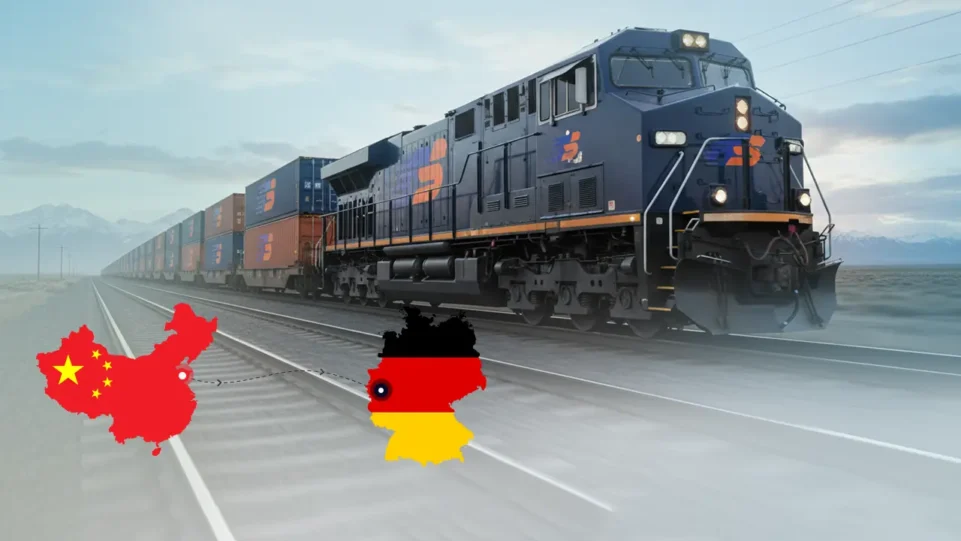
When we talk about the freight train from China to Germany, we’re talking about the China-Europe Railway Express, a massive network that has become the backbone of Eurasian trade since 2011. On December 3, 2024, the 100,000th China-Europe freight train arrived in Duisburg, marking a historic milestone for this rail link that connects Chinese manufacturing hubs directly to Germany’s logistics powerhouses.
Rail makes financial and logistical sense when you’re shipping goods from China to Germany valued between €50,000 and €500,000 and need a reliable, faster-than-sea solution. We recommend a mix: Sea freight for base inventory, rail for replenishment orders, and air for emergencies.
Rail Freight from China to Germany – 2025 Cost & Transit Time Overview
Planning your shipments from China to Germany in 2025? Rail freight offers a reliable balance between cost and speed. Here’s a quick overview of what you can expect in terms of transit times and pricing for different container options.
Cost:
- €3.8-€4.2/kg (LCL)
- €6,900-€7,500 (40ft FCL)
Average Transit Times:
- Average rail freight from China to Germany time: 14-18 days door-to-door
- Fastest recorded: 10 days (Xi’an to Duisburg – full-time schedule train)
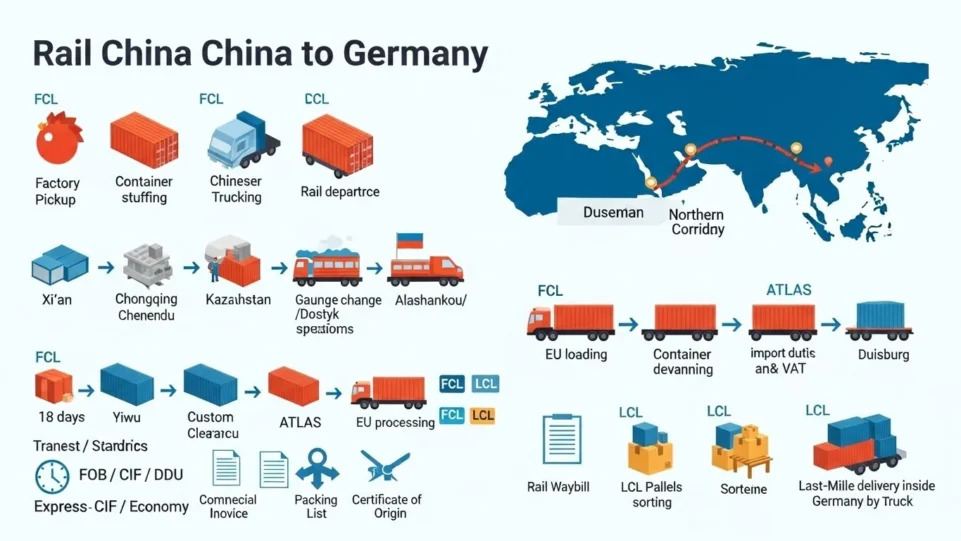
China to Germany Rail Freight Services and Shipping Options
Not all rail freight is created equal. Understanding which option fits your business can save you thousands while getting your products to market faster. Here’s a complete comparison:
| Option Type | Specification | Best For | Cost Range | Transit Time | Key Benefits |
|---|---|---|---|---|---|
| Container: FCL (40ft) | Full container | 15+ CBM shipments | €6,900-€7,500 | 14-18 days | Best per-unit cost, exclusive use |
| Container: FCL (20ft) | Full container | 10-15 CBM shipments | €4,750-€5,300 | 14-18 days | Better protection, cost-effective |
| Container: LCL | Shared space | Under 10 CBM | €3.8-€4.2/kg | 16-20 days | Pay only for space used, flexible |
| Speed: Express | Priority service | Urgent shipments | +15-20% vs standard | 10-12 days | Product launches, time-sensitive |
| Speed: Standard | Regular service | Most shipments | Baseline pricing | 14-18 days | Best cost/speed balance |
| Speed: Economy | Slower service | Low-urgency orders | -10-15% vs standard | 18-22 days | Maximum cost savings |
| Terms: DDP | All-inclusive | Most importers | Higher upfront | Same as chosen speed | Hassle-free, no surprises (Recommended) |
| Terms: DDU | Self-clearance | Customs expertise | Lower upfront | Same as chosen speed | You control customs process |
Delivery Terms
For your rail freight from China to Germany, DDP (Delivered Duty Paid) is generally preferred as it handles rail transport, customs clearance (including German Zoll procedures), duties, VAT, and delivery one price, no surprises.
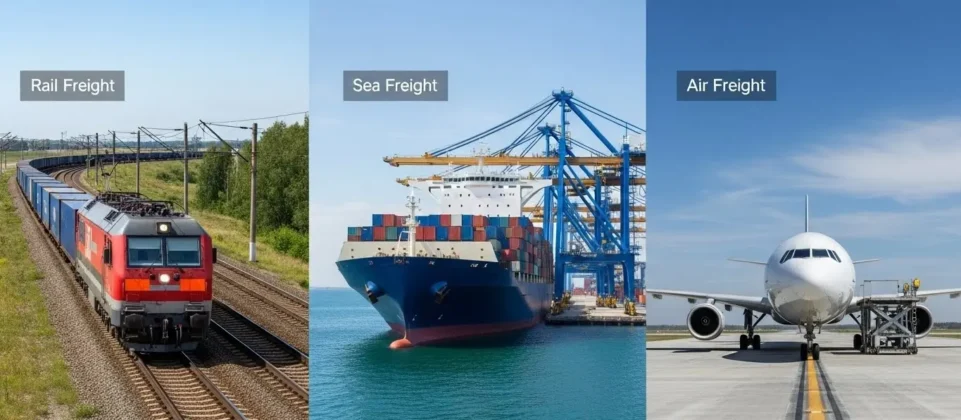
Comparing Shipping Methods: Rail vs. Sea vs. Air (China → Germany)
Here’s a conversation we have with importers almost daily: “Which shipping method should I use?” And the honest answer is: it depends on what you’re shipping and why.
| Factor | Rail Freight | Sea Freight | Air Freight |
|---|---|---|---|
| Transit Time (Door-to-Door) | 14-18 days | 30-40 days | 3-7 days |
| Cost Level | Moderate (≈50% of air, higher than sea) | Lowest | Highest |
| Best For | Mid-value goods needing balance (electronics, automotive parts, machinery) | Low-value or bulky goods (furniture, raw materials) | High-value, urgent, or perishable goods |
| Reliability | High – predictable schedules, fixed routes | Moderate – port congestion delays common | Very high – strict flight schedules |
| Environmental Impact | 95% less CO₂ than air, 80% less than road | Moderate | Highest emissions |
Rail Freight Transit Time from China to Germany
Let’s talk numbers, because vague promises don’t help you plan inventory. The China to Germany train freight time varies based on your origin point and final destination, but here’s what real-world experience shows us.
| Journey Stage | Duration | What’s Happening |
|---|---|---|
| Factory to Rail Terminal (China) | 1-3 days | Collection, documentation, container loading |
| Rail Transit (China to Europe) | 10-16 days | Actual train journey across Asia/Europe |
| Border Crossings & Gauge Changes | 1-2 days | Kazakhstan/Russia, Belarus/Poland borders |
| European Hub Processing | 1-2 days | Customs clearance, deconsolidation if needed |
| German Customs (Zoll) | 1-2 days | German import customs procedures, ATLAS system |
| Final Delivery to Your Warehouse | 1-2 days | Road transport within Germany |
| TOTAL DOOR-TO-DOOR | 14-18 days | Complete journey with all handling |
Transit Times by Service Level
| Service Type | Rail Transit | Total Door-to-Door | Cost Premium | Ideal Use Case |
|---|---|---|---|---|
| Express | 10-12 days | 12-14 days | +15-20% | Product launches, seasonal peaks |
| Standard | 14-16 days | 16-18 days | Baseline | Regular inventory replenishment |
| Economy | 16-18 days | 18-22 days | -10-15% | Low-urgency bulk orders |
Transit Times by Major Chinese Departure Cities
| Origin City | Rail Transit to Germany | Total to Germany | Service Frequency |
|---|---|---|---|
| Xi’an | 10-14 days | 12-16 days | Daily departures (record: 10 days) |
| Chongqing | 13-16 days | 15-18 days | Daily departures |
| Zhengzhou | 12-15 days | 14-17 days | 8 trains/week |
| Wuhan | 14-16 days | 16-18 days | 2-3x weekly |
| Chengdu | 14-17 days | 16-19 days | 3-4x weekly |
| Yiwu | 16-18 days | 18-20 days | Daily departures |
What Affects China Freight Train Delivery Time?
China freight train speed averages around 80-120 km/h depending on the route and country. Not bullet-train fast, but consistently steady. And unlike ocean vessels that can get delayed by port congestion, freight trains from China to Germany tend to maintain more predictable schedules.
Factors that can add 1-3 days:
- Seasonal demand peaks (September-November, Chinese New Year)
- Weather conditions affecting border crossings
- Customs inspections (random or triggered by documentation issues)
- Terminal congestion at German hubs (Duisburg, Hamburg)
- Gauge changes at border crossings
Complete Rail Freight Cost from China to Germany
Here’s a clear look at the main costs involved in China freight to Germany, including transport, customs, and delivery.
| Cost Component | FCL 40ft | FCL 20ft | LCL (per kg) | What’s Included |
|---|---|---|---|---|
| Base Rail Transport | €4,800-€5,500 | €3,200-€3,800 | €2.8-€3.5 | Train freight from China to German hub |
| European Hub Handling | €350-€550 | €250-€400 | €0.3-€0.5 | Terminal fees, deconsolidation (LCL) |
| German Customs Clearance (Zoll) | €200-€350 | €200-€350 | €120-€180 | Document processing, ATLAS system |
| Final Mile Delivery (Germany) | €300-€500 | €250-€400 | €0.2-€0.4 | Road transport to your warehouse |
| Documentation & Admin | €100-€200 | €100-€200 | €60-€100 | Bills of lading, certificates, filing |
| Insurance (optional) | €60-€250 | €50-€180 | €0.05-€0.15 | 0.3-0.5% of cargo value |
| TOTAL ESTIMATE | €6,900-€7,500 | €4,750-€5,300 | €3.8-€4.2/kg | Complete door-to-door service |
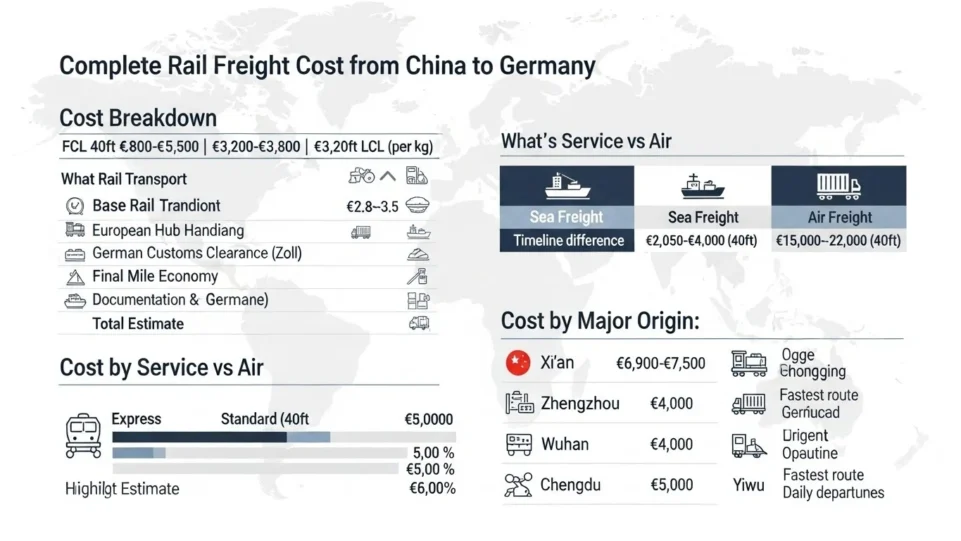
Price Comparison: Rail vs Sea vs Air
| Shipping Method | 40ft Container | 20ft Container | Per kg (LCL) | Best Value For |
|---|---|---|---|---|
| Rail Freight | €6,900-€7,500 | €4,750-€5,300 | €3.8-€4.2 | Mid-volume, time-sensitive |
| Sea Freight | €2,050-€4,000 | €1,240-€2,800 | €35-€45/m³ | High-volume, flexible timeline |
| Air Freight | €15,000-€22,000 | €10,000-€15,000 | €4.70+ | Urgent, high-value goods |
Cost by Service Level
| Service Type | 40ft Container | 20ft Container | Cost Difference | Time Saved |
|---|---|---|---|---|
| Express | €8,000-€9,000 | €5,500-€6,200 | +15-20% | 3-5 days faster |
| Standard | €6,900-€7,500 | €4,750-€5,300 | Baseline | Standard timeline |
| Economy | €6,000-€6,800 | €4,100-€4,800 | -10-15% | 3-5 days slower |
Cost by Major Origin Cities
| Departure City | 40ft FCL | 20ft FCL | LCL per kg | Why Pricing Varies |
|---|---|---|---|---|
| Xi’an | €6,800-€7,400 | €4,700-€5,200 | €3.7-€4.0 | Express service, record speed |
| Chongqing | €6,900-€7,500 | €4,750-€5,300 | €3.8-€4.2 | Daily departures, competitive |
| Zhengzhou | €6,850-€7,450 | €4,700-€5,250 | €3.8-€4.1 | Good frequency, major hub |
| Wuhan | €7,000-€7,600 | €4,850-€5,400 | €3.9-€4.3 | Less frequent service |
| Chengdu | €7,100-€7,700 | €4,900-€5,500 | €4.0-€4.4 | Longer transit to border |
| Yiwu | €7,200-€7,800 | €5,000-€5,600 | €4.1-€4.5 | Longer route, high demand |
Factors Affecting Freight Train from China to Germany Cost
The rail freight from China to Germany cost depends on several key factors:
Cargo Volume & Container Size – Full containers (FCL) cost less per unit than shared space (LCL). Rail transport cost is about one-fifth of air transport, making it highly cost-effective.
Route & Destination – Different railway corridors (via Kazakhstan, Russia, Poland) and your final German destination affect pricing. Duisburg typically offers best rates due to high volume.
Service Speed – Express services (10-14 days) cost 15-20% more than standard rail (14-18 days). Economy options save 10-15% but take longer.
Customs & Documentation – German Zoll clearance fees, ATLAS system submissions, and paperwork processing add to costs. DDP service is pricier upfront but hassle-free.
Seasonality – Prices spike during peak seasons (Chinese New Year, Q4 Christmas rush) when capacity is tight.
Additional Services – Warehousing at German hubs, consolidation, and door-to-door delivery increase costs but add convenience.
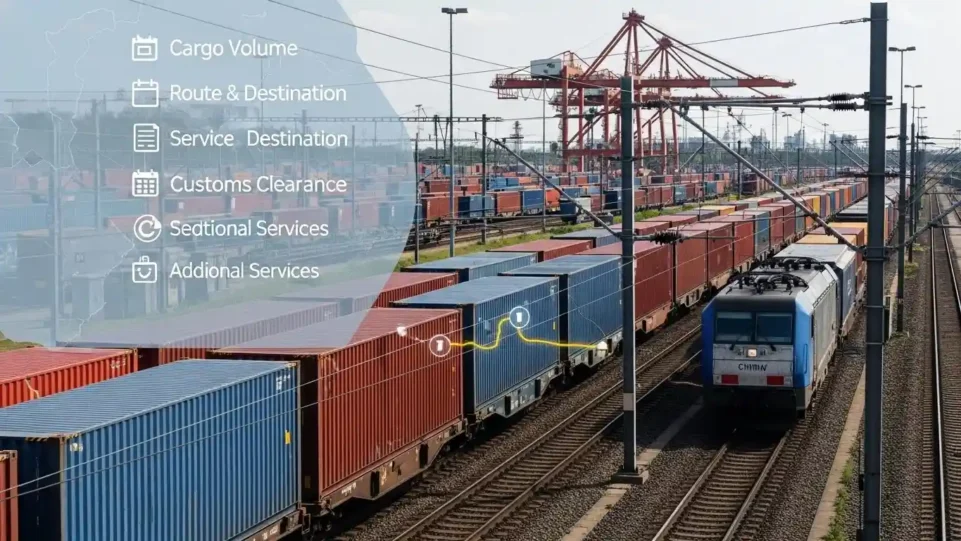
Key Factor: Booking Slots and Terminal Congestion: Duisburg handles up to 70 trains weekly, making it Europe’s busiest rail freight terminal. During peak seasons, securing your space on the train can be challenging. Partnering with a provider that holds secured Block Train Agreements at key terminals ensures your cargo moves without waiting.
Hidden Costs to Watch For
Most freight forwarders don’t include everything in initial quotes. Always ask about:
- German customs (Zoll) clearance fees
- ATLAS system submission costs
- Terminal handling charges at Duisburg/Hamburg
- Final mile delivery costs within Germany
- Insurance (essential for high-value cargo)
- Documentation and administrative fees
Incoterms Impact on Delivery Time and Cost (China–Germany Rail Freight)
Transit times can vary slightly depending on your chosen Incoterm. For example, under DDP (Delivered Duty Paid) or DAP (Delivered at Place), the forwarder handles the full journey including German customs (Zoll) and final-mile delivery, which may add 1–2 days. If you’re using FCA or CPT, responsibility transfers earlier, so your Germany-side logistics need to be ready in advance.
| Incoterm | Description | Recommended for Rail? | Key Consideration |
|---|---|---|---|
| EXW | Buyer covers all costs from factory gate in China | Common in China trade | Requires full logistics coordination by buyer |
| FCA | Seller delivers to carrier (rail terminal in China) | Very common for rail | Responsibility transfers at Chinese terminal |
| CPT | Seller pays transport to named destination in Germany | Suitable for rail | Ideal for all-in freight rates |
| CIP | CPT + transport insurance included | Good for high-value cargo | Recommended for electronics, precision parts |
| DAP | Seller handles delivery to agreed destination in Germany | Very popular | Often offered by experienced forwarders |
| DDP | Seller manages everything: shipping, customs, taxes | Occasionally used | Easiest for buyer, handles German Zoll |
Rail Freight Route from China to Germany: Key Hubs and Path Overview
Here’s where it gets interesting. Unlike sea freight where you’ve basically got one option, China freight rail offers multiple route possibilities.
Main Rail Corridors for China to Europe Freight
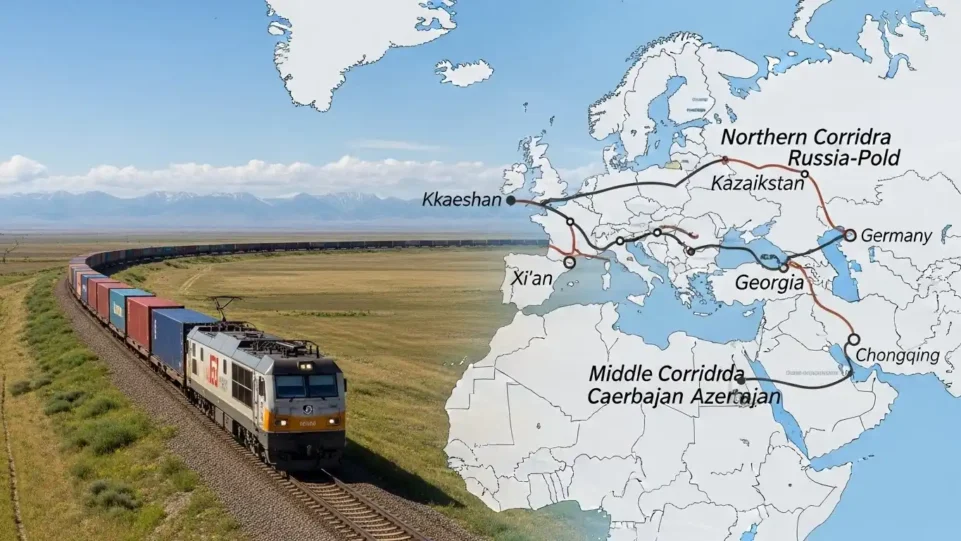
The Trans-Siberian Route (Northern Corridor): This cuts through Russia and is typically the fastest option. Containers depart from hubs like Xi’an or Chongqing, cross into Kazakhstan, traverse Russia, and enter the EU through Belarus or Poland. Total distance: about 10,000-11,000 kilometers.
The Central Corridor (Middle Corridor): Routes through Kazakhstan, the Caspian Sea region, Azerbaijan, Georgia, and Turkey, offering an alternative that avoids Russia. It’s slightly longer but provides valuable route diversity, especially important given geopolitical considerations.
Route Options at a Glance
Your China to Germany freight train completes its journey via:
- Rail to German Hub + Road Delivery: Most cost-efficient; containers reach Duisburg, Hamburg, or Munich, then truck to final destination
- Rail + Short-Sea Shipping: Through Hamburg port, sometimes faster for northern Germany destinations
- Flexible Routing: Experienced forwarders adjust routes based on real-time conditions
Critical Note: At the China/Kazakhstan border and the Belarus/Poland border, containers must be moved between different gauge railcars. Chinese and European tracks use standard gauge (1,435 mm), while Russian and former Soviet states use broad gauge (1,520 mm). This complex operation typically takes only 12-24 hours and is one of the logistical marvels of this route, offering much more predictability than typical port delays.
Documentation and Customs for Rail Freight from China to Germany
Let’s be honest, this is where many rail freight shipments go sideways. The freight train from China to Germany might run perfectly, but if your paperwork isn’t spot-on, you’re looking at delays, fines, or even cargo holds.
Essential Documents for Railway Freight to Germany
For China freight railway shipments to Germany, you absolutely need:
- Commercial invoice (detailed, accurate values—seriously, don’t fudge this)
- Packing list (down to individual carton level)
- Rail Waybill / Consignment Note (rail version of Bill of Lading)
- Certificate of Origin (important for tariff calculations and trade agreements)
- Product-specific certificates (CE marking, safety compliance, etc. depending on what you’re importing)

Germany-Specific Import Requirements
EORI Number – Every German importer must have an Economic Operator Registration and Identification number. Non-negotiable.
ATLAS System – Germany’s electronic customs clearance system. All import declarations must be submitted through ATLAS.
Zoll (German Customs) – Known for strict checks and documentation requirements. Accuracy is critical.
Commodity codes (HS codes) – Must be accurate. An incorrect code means paying wrong tariff rates, and Zoll will catch it.
VAT Registration – If you’re importing regularly, VAT registration in Germany may be required.
Border Crossing Documentation
Rail freight crosses multiple borders, each requiring specific documentation:
- Chinese Export Customs – Export declaration, inspection certificates
- Kazakhstan Transit – Transit declaration (T1 document)
- Russian Transit – Transit documentation for passage through Russia
- EU Entry (Poland/Belarus border) – EU transit declaration
- German Import Customs (Zoll) – Final import declaration, duty and VAT payment
Finding The Best Rail Freight Service (China-Germany)
So, is rail freight from China to Germany right for your importing needs? Here’s an honest assessment framework:
Rail Makes Perfect Sense If You’re Importing:
- Regular shipments (monthly or more frequent)
- Products worth €50,000-€500,000 per shipment
- Goods where 2 weeks faster delivery than sea freight creates value
- Items that don’t justify air freight’s premium cost
- Electronics, automotive parts, machinery, fashion/textiles
- Goods requiring temperature control (refrigerated containers available)
You Might Want to Reconsider If:
- You ship once or twice a year (sea freight’s savings might outweigh convenience)
- Your products are extremely heavy and low-value (sea freight wins on economics)
- You genuinely need goods in 3-5 days (air is your only option)
- You’re shipping hazardous materials (restrictions apply, check with forwarder)
The Critical Difference: Experience Matters
Choosing the right partner is crucial. Rail freight only works if you’re working with a freight forwarder who:
- Truly understands this shipping method
- Has relationships with German terminals (Duisburg, Hamburg)
- Understands German Zoll (customs) procedures
- Can navigate ATLAS system requirements
- Has experience with gauge changes and border crossings
- Can handle documentation in Chinese, Russian, Polish, and German

The best forwarders have been running China to Germany freight train routes since this service reached commercial maturity. They’ve navigated route disruptions, customs regulation changes, and every curveball this shipping method can throw.
TopShipping – Your Trusted Rail Freight Partner
At TopShipping, rail freight from China to Germany isn’t just another service—it’s a core competency we’ve refined through years of experience. With operations in Shenzhen and partnerships across the entire rail corridor, we deliver reliability, transparency, and results.
Why Choose TopShipping?
Guaranteed Capacity: Block Space Agreements with major rail operators ensure your cargo moves on schedule, even during peak seasons (Chinese New Year, Q4 rush).
All-Inclusive DDP Pricing: One quote covering everything from factory pickup in China to your German warehouse—rail transport, customs clearance (including German Zoll and ATLAS), VAT/duty payment, and final delivery. No hidden fees.
German Customs Expertise: Our team has cleared thousands of rail shipments through German customs. We catch documentation errors before your cargo leaves China—not when it’s held at Duisburg terminal.
Terminal Relationships: Direct partnerships with Duisburg Gateway Terminal, Hamburg Port Authority, and Munich CTS mean faster processing, better rates, and priority service.
Real-Time Tracking: GPS tracking, automated milestone notifications, and dedicated account managers (English/German/Chinese speaking) keep you informed throughout the journey.
Ready to experience hassle-free rail freight? Contact our specialists today for a customized quote.
FAQ: Rail Freight from China to Germany
Is There a Freight Train from Germany to China?
Yes, rail freight Germany to China is absolutely possible for German exporters. The return train ratio is 45.6%, carrying European goods like automotive parts, machinery, German beer, French wine, and Swiss confectionery back to China.
What’s the minimum shipment size for rail freight?
Technically 1 CBM via LCL, but rail makes most economic sense from about 5 CBM upward. Below that, express shipping might be more cost-effective.
Can I ship dangerous goods via rail?
Depends on the classification. Some HAZMAT classes are permitted with proper documentation, but rules are stricter than sea freight. Tell your forwarder what you’re shipping upfront for accurate assessment.
What happens if there’s a delay?
Delays are rare (typically 1-3 days maximum), but experienced forwarders notify you immediately with updated estimates and can often reroute to maintain schedules.
How long does rail freight from China to Germany actually take?
The transit time is roughly one-fourth of sea transport, averaging 14-18 days door-to-door. The express service level can bring this down to 10-14 days.
Does the same train run all the way from China to Germany?
No. The container travels via the China-Europe Railway Express across Eurasia, but requires transfers:
- Gauge Changes: At China/Kazakhstan border and Belarus/Poland border, containers transfer between different rail gauges (12-24 hours each)
- Final Leg: After arriving at German terminal (Duisburg, Hamburg, Munich), container transfers to truck for final delivery
Is there a freight train service from Germany back to China?
Yes, with return trains accounting for 45.6% of total traffic. German exporters use it to ship automotive components, machinery, industrial equipment, and consumer goods to China and other Asian markets.
How does the cost compare to sea and air freight?
Rail freight cost sits in the middle:
- About one-fifth the cost of air transport
- 20-40% higher than standard ocean freight
- In 2024, rail was around 59% cheaper than sea on some routes, averaging $3,240/FEU depending on origin and exact route
What is the minimum volume for rail freight?
Technically, you can ship small volumes via LCL rail freight (starting around 1 CBM or 100 kg). However, rail becomes most economically advantageous for shipments above 5 CBM and up to a full container (FCL).
Can I ship high-value or hazardous goods via rail?
Rail is excellent for mid-to-high value goods (like electronics, fashion, automotive parts) where the cost of delay is high. For hazardous goods (HAZMAT), certain classifications are permitted with proper documentation, but regulations are stricter than sea freight. Check specific HS codes with your forwarder upfront.
Where does customs clearance happen for Germany-bound rail freight?
Multi-stage process:
- Chinese Export Customs: Exit clearance at departure city
- Transit Countries: Transit declarations through Kazakhstan, Russia, Belarus
- EU Entry: T1 transit bond upon entering Poland/Belarus border
- German Import (Zoll): Final import clearance at German terminal (Duisburg, Hamburg, Munich), including duty and VAT payment via ATLAS system
What essential documents are needed for China-Germany rail freight?
You must provide accurate and compliant documents to avoid border delays:
- Commercial Invoice and Packing List (highly detailed)
- Rail Waybill (rail equivalent of Bill of Lading)
- Certificate of Origin (COO)
- CE Marking certificates (where applicable)
- Valid German EORI number
- ATLAS system declaration
Do I need separate insurance for rail freight?
Yes. Standard Marine Insurance policies usually do not cover overland rail journeys. It is essential to arrange specific Cargo Insurance for rail freight, covering the full door-to-door route. Typically costs 0.3-0.5% of cargo value.
Which German cities receive trains from China?
Main terminals are Duisburg (largest, handling up to 70 trains weekly), Hamburg (over 200 trains daily), plus Munich, Nuremberg, and Leipzig as secondary hubs.
Can I track my rail shipment from China to Germany?
Yes, GPS tracking and digital platforms provide real-time updates. Border crossings and terminal arrivals are logged, allowing you to see where your shipment is at any point, similar to air express tracking.
What products are commonly shipped by rail to Germany?
- Electronics and IT equipment
- Automotive parts and components (BMW, Mercedes suppliers)
- Machinery and industrial goods
- Consumer goods and e-commerce products
- Fashion and textiles
- Solar panels and renewable energy equipment
Is rail freight environmentally friendly?
Yes, rail freight emits up to 95% less CO₂ than air and 80% less than road transport. Germany actively encourages rail through eco-bonuses and tax incentives for companies using rail over air or road.
What is Duisburg’s role in China-Germany rail freight?
Duisburg is Europe’s largest inland port, and the 100,000th China-Europe freight train arrived there in December 2024. 60 China-Europe trains meet there every week, carrying 30% of China-Europe trade. It’s the undisputed gateway for Chinese cargo into Europe.
