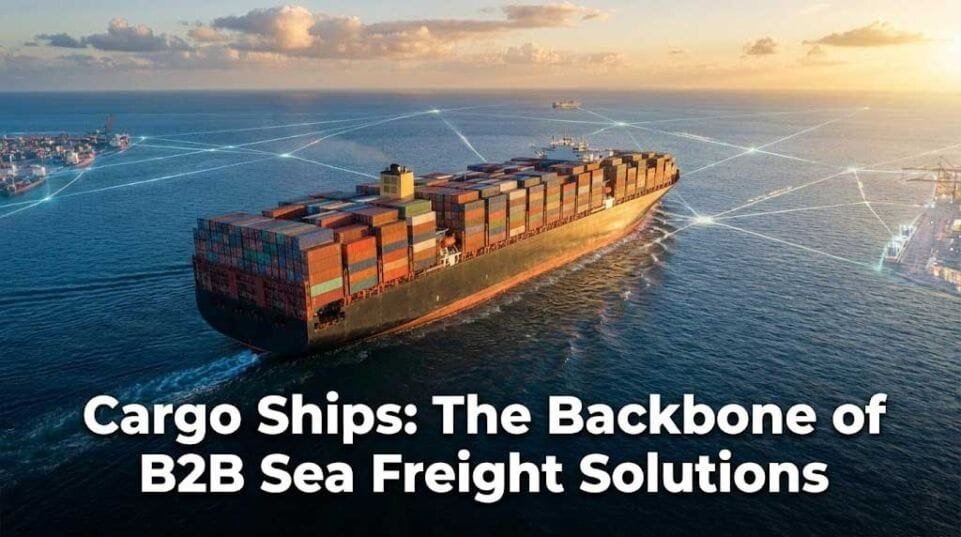
Introduction:
In today’s interconnected global economy, cargo ships are not just vessels—they are the lifelines of international trade. Every year, millions of containers and tons of raw materials traverse the oceans, powering industries from electronics to agriculture. For B2B companies, efficient sea freight such as shipping from China to the US is essential: it reduces costs, ensures reliability, and enables large-scale shipments across continents. This article dives into the evolving world of cargo ships, exploring their types, advantages, and real-world impact on global supply chains, while also examining modern trends and challenges that shape maritime logistics today.
The Role of Cargo Ships in Global Logistics
Cargo ships are central to international trade, moving roughly 90% of global goods by volume.
Whether it’s transporting electronics from Shenzhen to Los Angeles or iron ore from Brazil to China, these vessels ensure that businesses can operate seamlessly across borders.
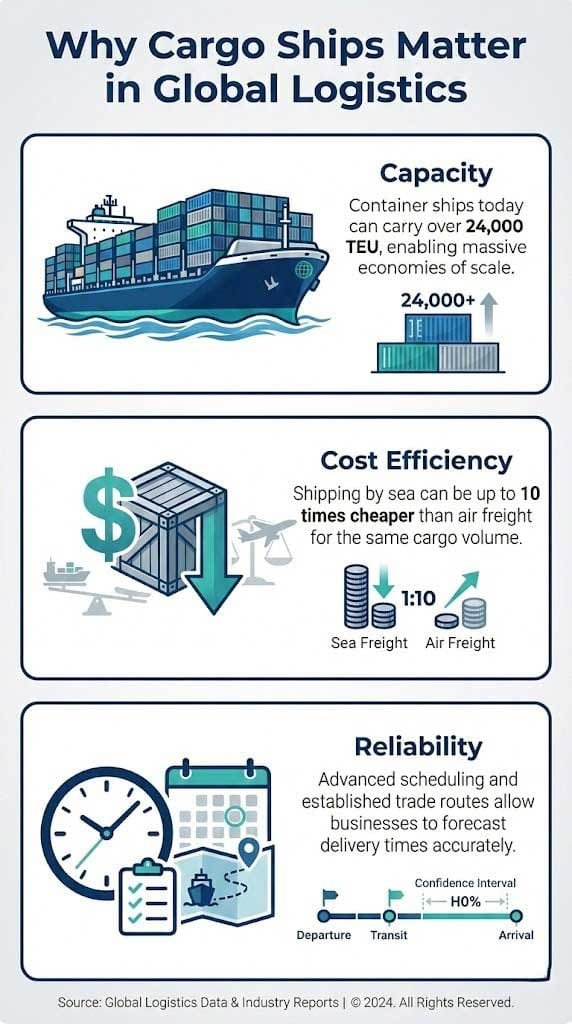
Why they matter:
- Capacity: Container ships today can carry over 24,000 TEU (Twenty-Foot Equivalent Units), enabling massive economies of scale.
- Cost efficiency: Shipping by sea can be up to 10 times cheaper than air freight for the same cargo volume.
- Reliability: Advanced scheduling and established trade routes allow businesses to forecast delivery times accurately.
By connecting ports, suppliers, and consumers, cargo ships remain the backbone of maritime logistics and global commerce.
Types of Cargo Ships for Modern Trade
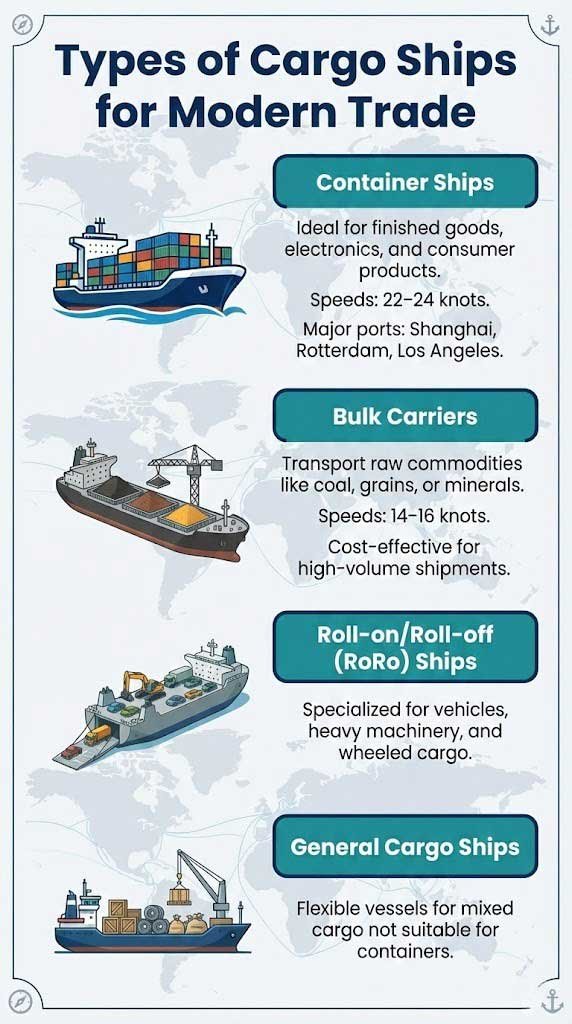
Different cargo types require different vessels.
Understanding these can save time and cost:
- Container Ships: Standardized cargo containers, ideal for finished goods, electronics, and consumer products. Modern ultra-large container vessels (ULCVs) reach speeds of 22–24 knots and call at major hubs like Shanghai, Rotterdam, or Los Angeles.
- Bulk Carriers: Transport raw commodities such as coal, grains, or minerals. While slower (average 14–16 knots), they are cost-effective for high-volume shipments.
- Roll-on/Roll-off (RoRo) Ships: Specialize in vehicles, heavy machinery, and wheeled cargo.
- General Cargo Ships: Flexible vessels that carry mixed cargo types not suitable for containers.
Pro Tip: Choosing the right vessel depends not just on cargo type but also on port infrastructure, demurrage costs, and delivery speed requirements.
Container Ships vs. Bulk Carriers: Making the Right Choice
Businesses often face a choice between container ships and bulk carriers:
| Feature | Container Ships | Bulk Carriers |
|---|---|---|
| Cargo type | Packaged or standardized goods | Raw commodities |
| Volume efficiency | Moderate | High |
| Cost per ton | Slightly higher | Lower |
| Port flexibility | High | Limited to bulk terminals |
| Tracking & handling | Advanced, containerized tracking | Basic, bulk handling |
For instance, a company shipping 1,000 tons of electronics will benefit from containers for secure handling, while a mining company exporting iron ore would save significantly with a bulk carrier.
Advantages of Sea Freight for B2B Companies
Cost Efficiency & Large-Scale Shipping
Sea freight allows B2B companies to ship massive volumes at a fraction of the cost of air freight. For example, a 40-foot container from Shanghai to Los Angeles might cost around $3,000–$4,000, whereas the same volume by air could exceed $30,000. Consolidating shipments and leveraging full container loads further reduces per-unit costs.
Reliability & Global Reach
Maritime shipping ensures access to every major global market. Companies can track shipments in real-time, plan inventory efficiently, and maintain consistent delivery schedules.
Even unexpected disruptions, like the Ever Given blockage in the Suez Canal (2021), have led to innovations in rerouting and predictive logistics, proving the resilience of sea freight.
Modern Trends & Challenges in Maritime Shipping
- Sustainability: The IMO 2023 regulations are pushing shipping companies toward low-sulfur fuels and green technologies, reducing carbon footprints. Some vessels now use LNG or hybrid systems to cut emissions.
- Technology & Automation: Blockchain enables transparent cargo tracking, AI predicts delays, and smart containers monitor temperature, humidity, and location.
- Risks: Weather disruptions, port congestion, fuel price fluctuations, and piracy remain real challenges. Companies must plan routes and insurance carefully.
Integrating these factors into logistics strategy ensures companies are competitive and resilient in today’s dynamic maritime industry.
Navigating Global Trade Routes
Shipping lanes and port hubs define the efficiency of maritime operations.
Key routes include:
- Pacific Routes: Connecting China, Southeast Asia, and the US West Coast.
- Atlantic Routes: Linking Europe, Africa, and the Americas.
- Major Ports: Shanghai, Singapore, Rotterdam, Los Angeles, and Hamburg handle millions of TEUs annually.
Strategic route selection impacts delivery speed, shipping cost, and supply chain efficiency, making route planning a critical task for B2B logistics.
Choosing the Right Shipping Partner
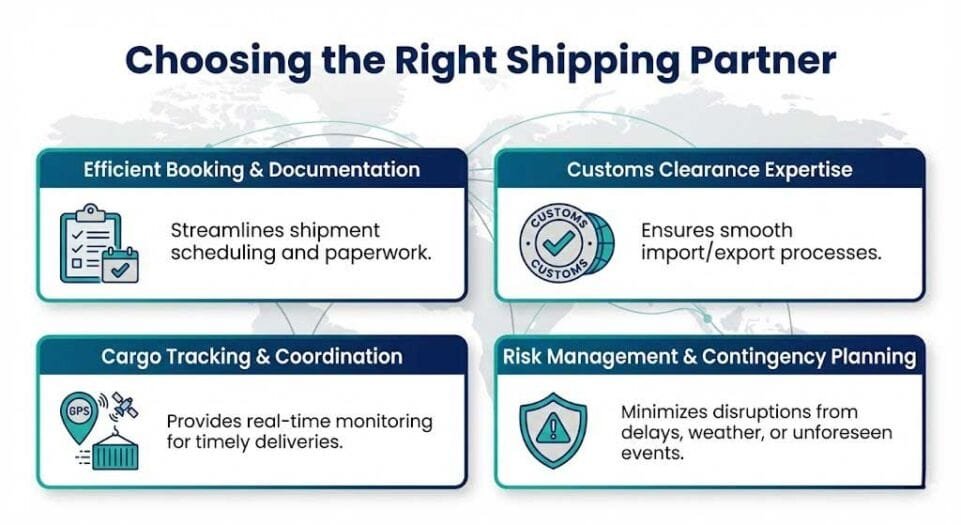
Partnering with a reliable freight forwarder or logistics provider can make or break your supply chain.
Benefits include:
- Efficient booking and documentation
- Customs clearance expertise
- Cargo tracking and coordination
- Risk management and contingency planning
Working with experienced maritime partners ensures businesses maximize cost efficiency, safety, and delivery reliability.
Tips for Efficient Cargo Management
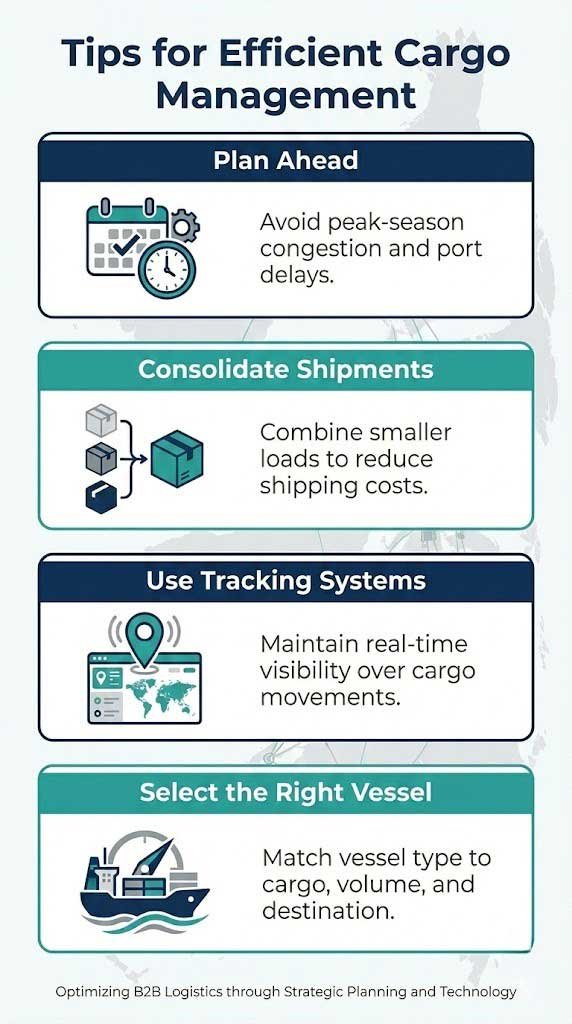
- Plan Ahead: Avoid peak season congestion at ports.
- Consolidate Shipments: Reduce costs by combining smaller loads.
- Use Tracking Systems: Maintain real-time cargo visibility.
- Select the Right Vessel: Match cargo type, volume, and destination needs.
Implementing these strategies enhances operational efficiency, minimizes risks, and strengthens the supply chain.
Conclusion
Cargo ships remain the backbone of international trade, providing B2B companies with cost-effective, reliable, and large scale shipping solutions.
By understanding vessel types, leveraging modern maritime technology, and partnering with experienced logistics providers, businesses can streamline supply chains and stay competitive in a global market.
In an era of sustainability, technological innovation, and fluctuating trade dynamics, embracing efficient maritime strategies ensures that companies are prepared not just to survive but to thrive in the international shipping landscape.
FAQ Cargo Ships
What are cargo ships and why are they essential for B2B trade?
Keywords: cargo ships, B2B trade, sea freight industry
Cargo ships are the backbone of global B2B trade, enabling companies to transport large volumes of goods efficiently and cost-effectively across international markets.
How do cargo ships support global supply chains?
Keywords: global supply chain, maritime logistics, ocean freight
Cargo ships connect manufacturers, suppliers, and distributors worldwide, ensuring stable and scalable supply chain operations for businesses.
What types of cargo ships are best for commercial shipping?
Keywords: container ships, bulk carriers, commercial shipping
Container ships are ideal for packaged goods, while bulk carriers are better suited for raw materials such as grain, coal, and minerals.
Why do companies prefer sea freight over other shipping methods?
Keywords: B2B sea freight, cost-effective shipping, large-scale transport
Sea freight offers lower costs per unit, high capacity, and reliable long-distance transportation compared to air or road freight.
How can businesses reduce shipping costs using cargo ships?
Keywords: reduce shipping costs, freight optimization, maritime shipping
By choosing the right vessel type, optimizing shipping routes, and working with experienced freight forwarders, companies can significantly reduce logistics expenses.
What role do freight forwarders play in cargo ship transportation?
Keywords: freight forwarder, maritime shipping services, B2B logistics
Freight forwarders manage documentation, customs clearance, and cargo coordination, making sea freight smoother and more efficient for companies.
Are cargo ships suitable for long-term B2B logistics strategies?
Keywords: long-term logistics, B2B shipping strategy, ocean freight
Yes, cargo ships provide scalability, cost stability, and global reach, making them ideal for long-term business logistics planning.