Introduction
In international shipping, submitting accurate cargo information before arrival is not just a formality it’s a crucial step for smooth customs clearance. The Automated Manifest System (AMS), managed by U.S. Customs and Border Protection (CBP), allows importers and freight forwarders to submit shipment manifest data electronically, well before the cargo reaches U.S. ports.
AMS ensures better cargo security, enables early risk assessment, and helps prevent costly delays or penalties. This system is particularly essential for shipping from China to the US, where high volumes of ocean and air freight must comply with strict customs requirements.
Understanding how AMS works, its filing requirements, and common pitfalls can save time, money, and stress. In this article, we’ll guide you through everything you need to know about AMS, so your shipments arrive on time and without complications. Keep reading to master the AMS filing process and ensure seamless international shipping.
What Is the Automated Manifest System (AMS)?
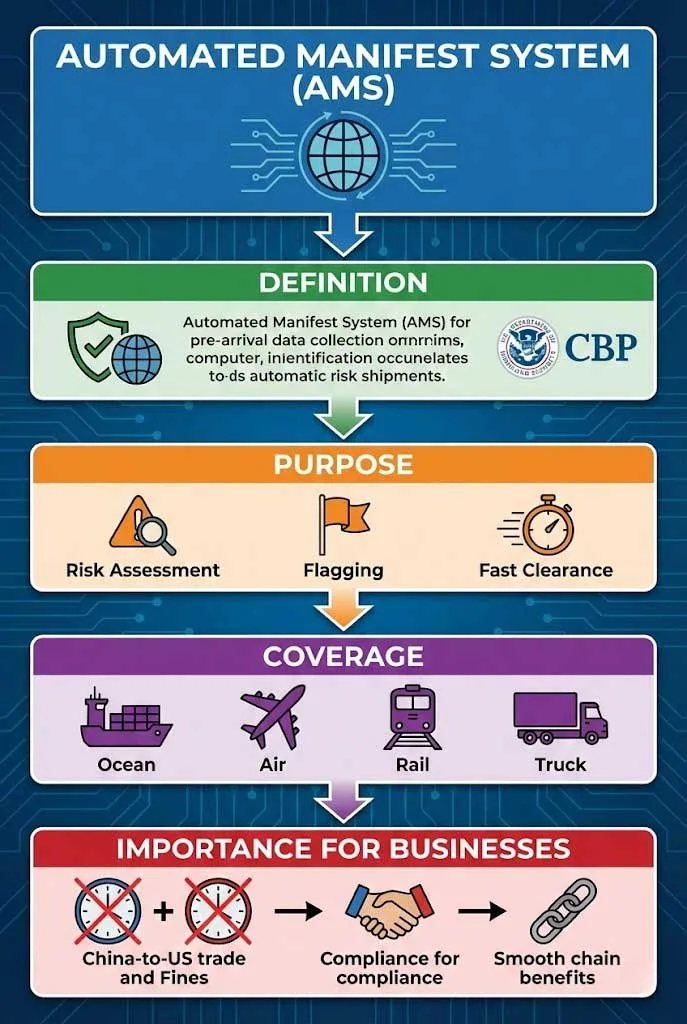
The Automated Manifest System (AMS) is an electronic platform used by U.S. Customs and Border Protection (CBP) to collect cargo manifest data before shipments arrive in the United States. By receiving detailed shipment information in advance, AMS allows CBP to assess risks, identify potential issues, and approve or flag cargo prior to its arrival, ensuring faster and more secure customs clearance.
AMS applies to all modes of transportation, including ocean, air, rail, and truck shipments, making it an essential tool for international trade. For businesses shipping from China to the US, AMS compliance is particularly critical, as it helps prevent delays, penalties, and costly disruptions in the supply chain.
What Is the Advance Manifest System?
The Advance Manifest System refers to the mandatory requirement for shippers to submit cargo manifest information before loading or arrival in the United States. This early submission allows U.S. Customs and Border Protection (CBP) to assess shipments in advance, improving cargo security and facilitating faster clearance.
The Automated Manifest System (AMS) serves as the platform that enables this advance data submission through the CBP Automated Manifest Interface. For businesses shipping from China to the US, complying with the Advance Manifest System is essential to avoid delays, penalties, and disruptions in the supply chain, ensuring shipments move smoothly from origin to destination.
Why Is AMS Required by US Customs?
The Automated Manifest System (AMS) is a critical tool used by U.S. Customs and Border Protection (CBP) to manage and secure international shipments.
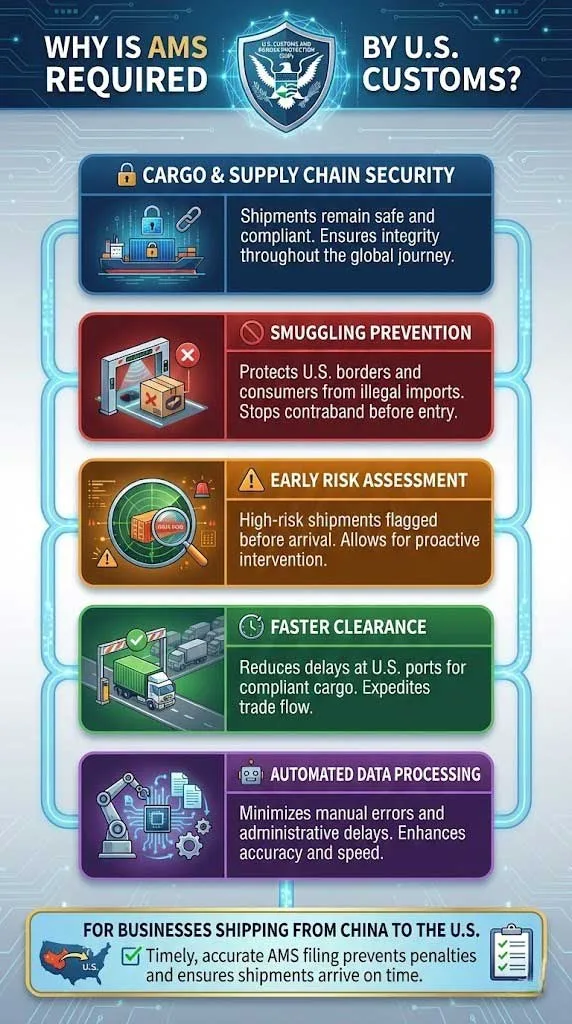
By requiring accurate cargo manifest submissions in advance, AMS helps CBP to:
- Enhance cargo and supply chain security, ensuring shipments are safe and compliant.
- Prevent smuggling and illegal imports, protecting U.S. borders and consumers.
- Improve risk assessment before arrival, allowing high-risk shipments to be flagged early.
- Reduce delays at U.S. ports, streamlining customs clearance for compliant shipments.
- Automate customs data processing, minimizing manual errors and administrative bottlenecks.
For businesses shipping from China to the US, proper AMS filing is especially important.
Timely and accurate submissions ensure that shipments move smoothly, avoid costly penalties, and reach their destination without unnecessary delays.
How Does the Automated Manifest System Work?
The Automated Manifest System (AMS) streamlines the process of submitting and reviewing shipment information before cargo arrives in the United States. The typical AMS filing process involves several key steps:
- Collect shipment and cargo details – Gather all necessary information, including contents, weight, shipper, consignee, and transportation details.
- Submit data through the AMS filing interface – Enter the shipment information electronically via the CBP Automated Manifest Interface.
- CBP reviews and validates the information – Customs officials analyze the submitted data to identify potential risks or discrepancies.
- Errors or rejections are issued if needed – Any issues must be corrected promptly to avoid delays or penalties.
- Shipment is cleared or flagged for inspection – Approved shipments proceed to the U.S., while flagged shipments undergo further examination.
This automated process enhances cargo security, supports early risk evaluation, and reduces delays at U.S. ports. For businesses shipping from China to the US, understanding and following the AMS filing process is essential for smooth customs clearance and timely delivery.
AMS Filing Requirements
Proper AMS filing is crucial to ensure smooth customs clearance and avoid penalties or shipment delays. U.S. Customs and Border Protection (CBP) requires accurate and complete submission of shipment information through the Automated Manifest System (AMS). The main filing requirements include:
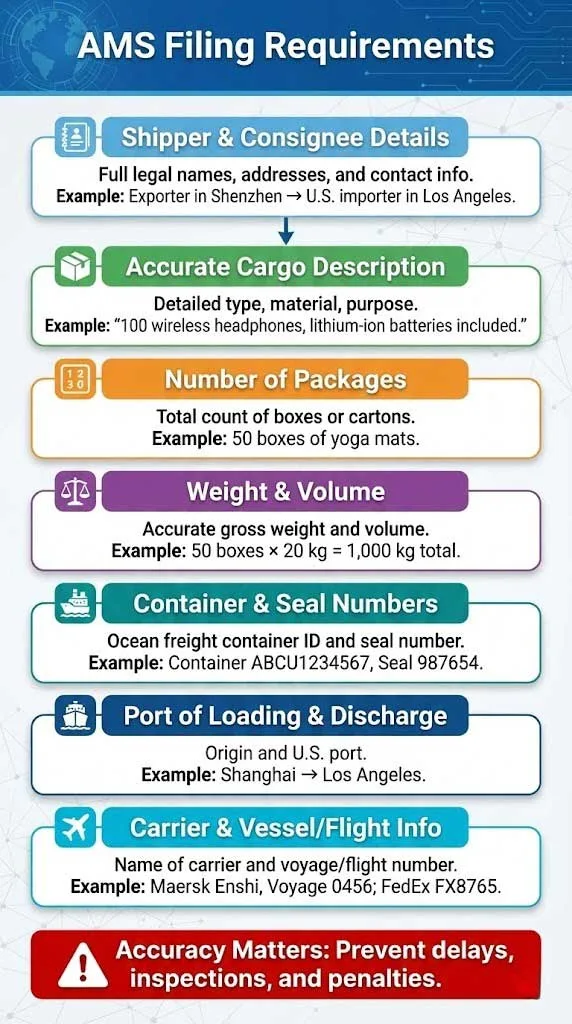
Shipper and Consignee Details
Full legal names, addresses, and contact information of both the exporter (shipper) and the importer (consignee).
Example: A company exporting electronics from Shenzhen, China, must provide its registered business address, and the U.S. importer in Los Angeles must include its full company name and address.
Accurate Cargo Description
Detailed description of the goods, including type, material, and purpose. Vague or incorrect descriptions can trigger inspections or penalties.
Example: Instead of writing “electronics,” specify “100 units of wireless headphones, lithium-ion batteries included.”
Number of Packages
Total count of packages or cartons in the shipment.
Example: If a shipment contains 50 boxes of yoga mats, each box should be listed, and the total count (50) must match the manifest.
Weight and Volume
Accurate gross weight (in kilograms or pounds) and, if applicable, volume measurements.
Example: 50 boxes of yoga mats weighing 20 kg each = total gross weight of 1,000 kg.
Container and Seal Numbers
Identification of each shipping container and its seal number for ocean freight. This is essential for security and tracking.
Example: Container number ABCU1234567, seal number 987654.
Port of Loading and Discharge
The exact port where the cargo is loaded and the U.S. port where it will arrive.
Example: Port of Loading: Shanghai, China; Port of Discharge: Port of Los Angeles, USA.
Carrier and Vessel or Flight Information
Name of the carrier (ocean shipping line or airline) and voyage or flight number.
Example: Carrier: Maersk Line, Vessel: Maersk Enshi, Voyage No.: 0456; or Air Carrier: FedEx, Flight No.: FX8765.
Why Accuracy Matters
Incorrect or incomplete AMS data can cause:
- Shipment delays at U.S. ports
- Penalties or fines from CBP
- Flagging for inspection, which can increase transit time and costs
For businesses shipping from China to the US, ensuring all these details are accurate and complete is critical. Partnering with a reliable freight forwarder or using AMS filing software can help automate the process, reduce errors, and ensure compliance with CBP requirements.
When Is AMS Filing Required?
The Automated Manifest System (AMS) requires advance submission of cargo information depending on the mode of transportation. Timely filing is critical to avoid delays, fines, or shipment rejections by U.S. Customs and Border Protection (CBP).
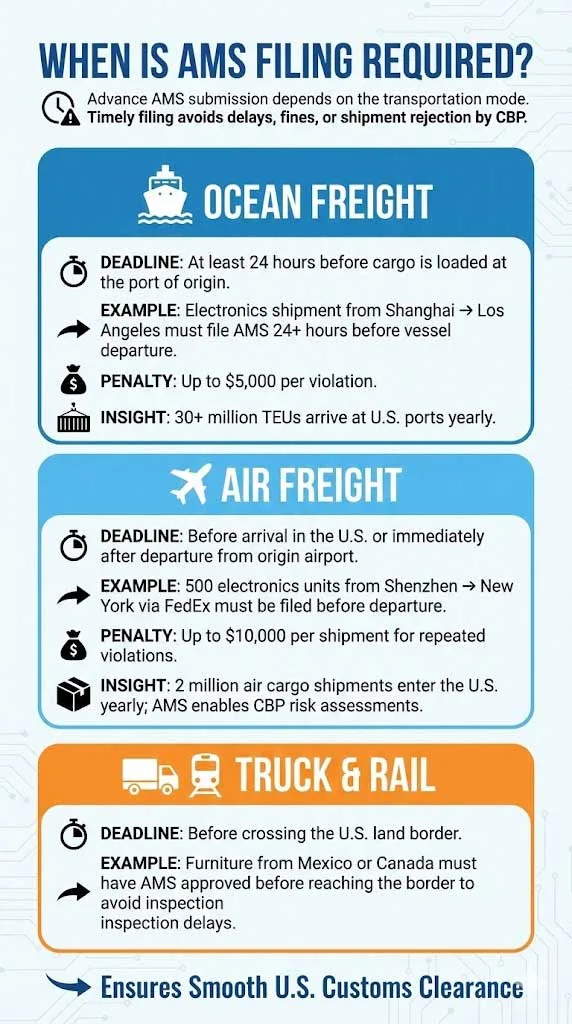
1. Ocean Freight
- Deadline: AMS must be filed at least 24 hours before the cargo is loaded onto the vessel at the port of origin.
- Scope: Applies to all ocean shipments bound for the United States.
- Example: A shipment of electronics from Shanghai, China, to Los Angeles must have its AMS manifest submitted at least 24 hours before the vessel departs. Failing to meet this deadline can result in fines of up to $5,000 per violation and may delay clearance at U.S. ports.
- Additional Data: On average, over 30 million TEUs (Twenty-foot Equivalent Units) arrive at U.S. ports annually, highlighting the importance of accurate and timely AMS filing.
2. Air Freight
- Deadline: AMS filing is required before arrival in the U.S. or immediately after departure from the origin airport.
- Example: A shipment of 500 units of consumer electronics from Shenzhen, China, to New York via FedEx must have its AMS submitted electronically prior to departure. Late filing can trigger penalties up to $10,000 per shipment for repeated violations.
- Additional Insight: Approximately 2 million air cargo shipments enter the U.S. each year, and AMS helps CBP perform risk assessments on high-value or sensitive goods.
3. Truck and Rail
- Deadline: AMS must be submitted before crossing the U.S. land border.
- Example: A truck carrying furniture from Mexico or Canada must have an AMS manifest ready and approved before reaching the U.S. border crossing to avoid inspection delays or refusal of entry.
Key Takeaways
- Accurate and timely AMS filing ensures smooth customs clearance.
- Missing deadlines can result in substantial fines and shipment delays.
Businesses shipping from China to the US should plan AMS submission carefully, often 2–3 days in advance, to account for processing times and possible corrections.
AMS Filing for US Customs: Who Is Responsible?
Filing the Automated Manifest System (AMS) is a critical responsibility in international shipping, and several parties may be involved in submitting the required data to U.S. Customs and Border Protection (CBP). Responsibility is generally shared depending on the mode of transport and contractual arrangements:
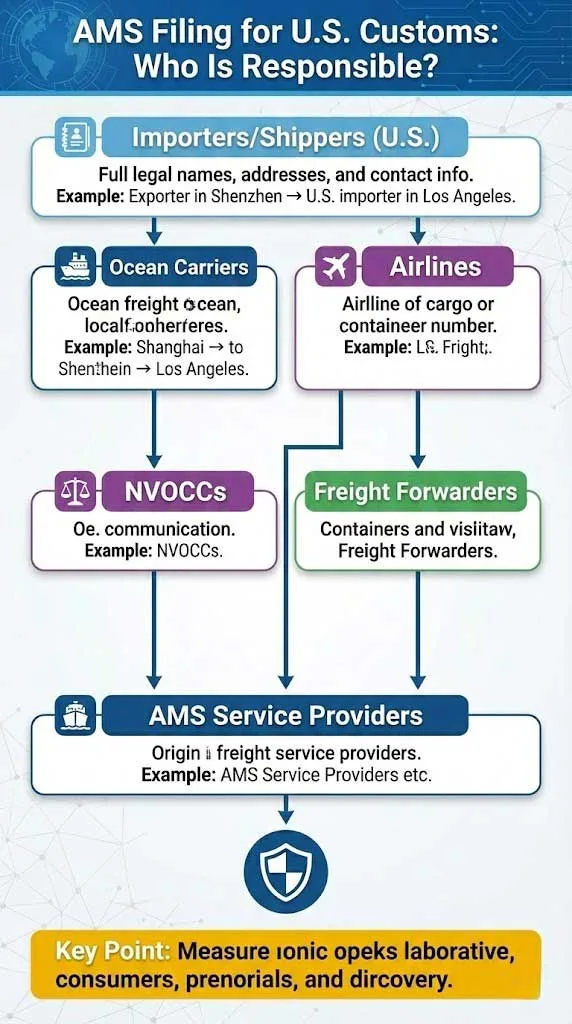
Ocean Carriers
- Responsible for submitting AMS data for all ocean freight shipments.
- Ensure container numbers, seal numbers, and cargo descriptions are accurate.
Airlines
- File AMS for air cargo shipments, including flight details, airway bills, and shipment contents.
- NVOCCs (Non-Vessel Operating Common Carriers)
- Act as carriers for customers but do not operate vessels; they are responsible for submitting AMS manifests on behalf of shippers.
Freight Forwarders
- Often handle AMS filing as part of logistics services, especially for businesses shipping from China to the US.
- Ensure all shipment details, including consignee and shipper information, match CBP requirements.
- Providers of Automated Manifest System Services
- Some companies specialize in AMS submission and compliance, offering software or online platforms to facilitate accurate filing.
Importers (Shippers in the US)
- Ultimately responsible for providing accurate shipment data to carriers or freight forwarders. Inaccurate or incomplete information can result in penalties, shipment delays, or rejection by CBP.
Example: A company importing electronics from Shenzhen, China, to Los Angeles may use a freight forwarder to file AMS on its behalf, but the importer must ensure that all product details, quantities, and packaging information are accurate to avoid customs delays.
Key Takeaways
- AMS filing responsibility may be shared among carriers, forwarders, and service providers.
- Importers are legally accountable for the accuracy of the data submitted to CBP.
Proper coordination ensures smooth shipping from China to the US and prevents fines or delays.
Automated Manifest System for Ocean Freight
For ocean freight shipments, the Automated Manifest System (AMS) is mandatory under the 24-Hour Rule. This rule requires that all cargo information be submitted to U.S. Customs and Border Protection (CBP) at least 24 hours before the vessel departs from the foreign port. Timely and accurate AMS filing is essential for preventing shipment delays and avoiding penalties.
Consequences of Non-Compliance:
- Shipments may be held at the port until issues are resolved.
- Cargo can be flagged for inspection, increasing transit time and costs.
- Fines may be imposed, with penalties reaching $5,000 per violation in some cases.
Example: A shipment of 2000 units of consumer electronics from Shanghai, China, to Los Angeles must have its AMS manifest submitted at least 24 hours before loading onto the vessel. The manifest should include detailed cargo descriptions, container numbers, seal numbers, weight, and consignee information.
Given the high volume of China to US ocean shipments, proper AMS filing is a critical step for importers and freight forwarders. Accurate submission not only ensures compliance with CBP regulations but also accelerates customs clearance, reducing the risk of delays at major ports like Los Angeles, Long Beach, and New York.
Difference Between AMS and ISF
While both AMS (Automated Manifest System) and ISF (Importer Security Filing, also known as 10+2) are required by U.S. Customs and Border Protection (CBP), they serve different purposes and involve different parties. Here’s a detailed comparison:
| Feature | AMS | ISF (10+2) |
|---|---|---|
| Purpose | Provides detailed cargo manifest data for customs risk assessment | Provides security and importer information to enhance supply chain security |
| Filed by | Carriers, NVOCCs, or freight forwarders | Importer or their agent |
| Filing time | Before loading or arrival in the U.S. | At least 24 hours before the cargo is loaded at the foreign port |
| System | Automated Manifest System (AMS) | ISF system, also known as 10+2 filing |
Key Points:
- AMS focuses on shipment details, container information, and cargo description, which helps CBP assess potential risks before the cargo arrives.
- ISF focuses on importer, manufacturer, seller, and other security-related data to strengthen supply chain security.
- Both filings are mandatory for ocean freight from China to the U.S., and failure to comply can result in fines up to $10,000 per violation or shipment delays.
Example:
- A U.S. company importing 500 smartphones from Shenzhen, China, must ensure that:
- The carrier files AMS with container numbers, weight, and cargo description.
- The importer submits Importer Security Filing with information about the manufacturer, seller, buyer, and other security related details at least 24 hours before vessel departure.
Together, AMS and ISF filings ensure compliance, security, and smooth customs clearance for shipments entering the United States.
AMS Penalties and Common Errors
Accurate AMS filing is essential to avoid delays, inspections, and fines. Common issues that can lead to penalties include:
Late Submission
- Failing to submit the AMS manifest on time can result in shipment holds or fines.
- Example: If a cargo container from Shanghai to Los Angeles is filed less than 24 hours before vessel departure, CBP may delay clearance and impose a penalty.
Incomplete Shipment Data
- Missing information such as shipper/consignee details, package count, or container numbers can trigger compliance issues.
- Example: A shipment of 500 electronics units missing the correct weight or carton count may be flagged for inspection.
Incorrect Cargo Descriptions
Vague or inaccurate descriptions, like “electronics” instead of “100 units of wireless headphones, lithium-ion batteries included,” can cause CBP to reject the filing or require corrections.
Mismatch with Shipping Documents
Discrepancies between AMS data and theBill of Lading Commercial Invoice, or Packing List can result in fines or shipment delays.
AMS Penalties
- CBP can impose penalties of up to USD 5,000 per violation for incorrect, incomplete, or late AMS filings.
- Repeated violations may lead to increased scrutiny and longer customs clearance times.
Key Tip for Shippers:
For businesses shipping from China to the US, working with an experienced freight forwarder or AMS filing service can help minimize errors, ensure compliance, and prevent costly delays.
AMS Filing Software and Online Systems
To simplify and streamline AMS compliance, many importers, carriers, and freight forwarders rely on specialized AMS filing software and online systems. These tools help automate data entry, reduce errors, and ensure timely submission to U.S. Customs and Border Protection (CBP).
Common Tools and Platforms Include:
- AMS Filing Software – Desktop or cloud-based applications designed to create, validate, and submit manifests electronically.
- Online AMS Filing Systems – Web portals provided by carriers or third-party service providers for direct submission to CBP.
- Automated Manifest System Tools – Integrated solutions that check for errors and ensure compliance with CBP requirements.
- Integrated Freight Management Platforms – End-to-end logistics platforms that combine AMS filing with shipment tracking, documentation, and reporting.
Example: A company shipping electronics from Shenzhen, China, to Los Angeles can use an online AMS system to submit manifests directly, automatically validating container numbers, weight, and cargo descriptions. This reduces the risk of late filing penalties ($5,000 per violation) and ensures smooth customs clearance.
Benefits of Using AMS Tools:
- Error Reduction: Automated validation minimizes missing or incorrect data.
- Timely Submission: Ensures filings meet the 24-hour rule for ocean freight or pre-arrival deadlines for air cargo.
- Compliance Assurance: Helps maintain accurate records and avoid CBP penalties.
Using the right AMS filing software or online system is especially critical for businesses shipping from China to the US, where high volumes of ocean and air freight require precise and timely data submission.
Conclusion
The Automated Manifest System (AMS) is a vital compliance requirement for all shipments entering the United States. Accurate and timely AMS manifest filing not only helps avoid costly penalties but also reduces delays at U.S. ports and ensures smooth customs clearance.
For businesses shipping from China to the US, proper AMS filing is especially critical due to high cargo volumes and strict CBP regulations. Partnering with professional AMS filing services or using reliable AMS software and online systems can streamline the process, minimize errors, and guarantee that shipments reach their destination on time.
By understanding AMS requirements, following best practices, and leveraging the right tools, importers and freight forwarders can achieve compliance, enhance cargo security, and maintain an efficient supply chain—turning a complex regulatory requirement into a manageable, seamless process.
Frequently Asked Questions (FAQ)
What is AMS in shipping?
AMS (Automated Manifest System) is a US Customs system used to submit electronic cargo manifest data to CBP before a shipment arrives in the United States.
Is AMS required for all shipments?
Yes. AMS filing is mandatory for all shipments entering the United States by ocean, air, rail, or truck.
Who files the AMS manifest?
The AMS manifest is filed by the carrier, NVOCC, or freight forwarder, depending on the shipment structure and transport mode.
What is the difference between AMS and ISF?
AMS focuses on cargo manifest information submitted by the carrier, while ISF (Importer Security Filing) is submitted by the importer and is primarily related to shipment security.